Olympics and graduate research

I want to talk about an interesting parallel between Olympics and research in graduate school. You are probably thinking: “What on Earth is he talking about now?”…

I follow the updates from Sochi and, once in a while, tune in to see some of the events. The athletes do mind-boggling tricks and I constantly hear about medal counts. I respectfully disagree with the notion that getting a medal is the only way to evaluate a given athlete’s success. I think that the concept of personal best is equally important, especially in the events where execution over a defined period of time counts for success. When I look at athletes who do not end up reaching the podium, I catch myself thinking that they often demonstrate tenacity and hunger to improve over their past accomplishments. To me, this is what Olympics should be all about, but personal best metrics of success are not often mentioned.

I also think that in graduate research, each student should strive to achieve his or her personal best. This is naturally accomplished by improving on the number and quality of papers compared to what he or she had published the year before. Striving for a paper in NatureScience, or other type of high impact journal, is probably akin to getting some sort of a medal. These are great goals to have, but we all know that such papers are rare and are not entirely under student control due to a number of complicating factors (politics, etc). On the other hand, if a student publishes a couple of papers in a given year, the following year should be an improvement: how about three papers, or two papers in the same level of journal and one in a higher impact journal? This way one’s personal best is established and there is definite progress.

In trouble? Just add lithium…

Conformations of complex molecules such as cyclic peptides are tough to decipher. What a truism! I have mentioned this many times on this blog. Every now and then, I am forced to ask myself: how much effort do we really want to spend studying these complex systems? At times it feels as if we have a good grip on a given molecule, only to be disappointed by some capricious twist that throws all of our theories down the drain. The main reason things are difficult lies in the effects of media and additives, which can turn into the frustrating end of science. There are just so many geometrical variables a peptide of some complexity possesses that it is no surprise that things aren’t simple.

There are some monumental teachings from the past that suggest there is light at the end of the tunnel. Slowly but surely, I am compiling a list of additives with demonstrable ability to affect conformations as well as biological properties of cyclic peptides. One of these days I am going to publish a paper on this subject. For now, I just want to draw your attention to Dan Rich’s JACS paper from 1992 (the year I started graduate school, by the way). Cyclosporine A (shown below) is a known immunosuppressant that binds to cyclophilin (which is cyclosporine’s protein target). The trouble is, if the Leu-Leu amide bond in cyclosporine A is in its cis state, the molecule is biologically inactive. Dan Rich’s contribution demonstrates that the addition of LiCl to cyclosporine A in THF shifts the cis/trans equilibrium towards the bioactive trans form. What’s remarkable here is that the authors did not stop at evaluating the NMR spectra with and without LiCl, but convincingly demonstrated that the LiCl perturbation method works to alter the biological properties of cyclosporine A. According to the authors, a significantly more potent inhibition of cyclophilin is recorded in the presence of LiCl. Now – how about the effect of LiCl on the cellular permeability of cyclic peptides?

qq

http://pubs.acs.org/doi/abs/10.1021/ja00033a047

Keep it simple – from electrochemistry to flow synthesis

I remember Kevin Moeller’s instructive paper in Tetrahedron, where he showed that, in order to run complicated electroorganic experiments, all you need is a simple Lantern battery from Home Depot. While fancy set-ups with high precision capabilities are available, good experimentalists who lack access to complex set-ups always find a way around the problem:

http://www.sciencedirect.com/science/article/pii/0040403996019466

These days, many of our students are attracted to flow synthesis. We recently had a nice departmental seminar on this subject by Thomas Johnson, one of Mark Lautens’ PhD students. I think chemists relate to the idea that new ways of improving mass transport can accelerate the rate of a given reaction, dramatically improving its efficiency. One of my former PhD students, Zhi He, is now heavily involved in flow synthesis in the lab of Prof. Tim Jamison at MIT. While I see the virtues of flow synthesis, I wonder: what can a lab with no access to microfluidics do in order to run reactions in flow? In short: be resourceful (just like Kevin Moeller). Here is a link to a great recent paper in J. Chem. Ed. by Prof. Thomas Wirth. Thomas was a visiting scholar at the University of Toronto several years ago and taught organic chemistry to our graduate students. The point of this work is to show that one can reap the benefits of flow set-ups and do it in an undergraduate lab using inexpensive syringes and glass tubes.

http://pubs.acs.org/doi/abs/10.1021/ed3006083

By the way, you can get glass reactors for these kinds of experiments from a cool German company by the name of “Little Things Factory”:

http://www.ltf-gmbh.com/index.html

In memory of Alan Katritzky

Earlier today I was very sad to find out about the passing of Professor Alan Katritzky of the University of Florida. He is one the legends of chemistry with countless contributions to the field.

Image

This giant of heterocyclic chemistry has always struck me as someone with remarkable clarity of thought when it came to teaching the fundamentals of heterocycle construction. I think that his legacy will live on, and this is not a cliché: Katritzky’s teachings are engrained in our understanding of heterocycles. I myself learned an important and simple lesson about nitrogen chemistry from Professor Katritzky. Shown below are the three kinds of nitrogen one might expect in heterocycles. Despite the mind-boggling diversity of nitrogen-containing structures, there are only three ways of having nitrogen within the frameworks of heterocycles. This concept is both powerful and simplifying. In my own classes, I have always observed that this simple concept really helps students in their efforts to navigate the treacherous and often confusing concepts of heterocycle synthesis.

Image

I wondered what would be the best way to pay a tribute to the legacy of Professor Katritzky and realized that there could be nothing better than an example from his own work. I chose his regioselective synthesis of pyrazoles. In this process, Katritzky used benzotriazole, one of his favourite tools. In the regioselective pyrazole synthesis shown below, the Bt-reagent condenses with an aldehyde, which is followed by another condensation with a substituted hydrazine. Subsequent alkylation and extrusion of the elements of benzotriazole produces the pyrazole ring as a single regioisomer. This powerful condensation/alkylation/elimination method of preparing polysubstituted pyrazoles has been used countless times in medicinal chemistry. The wonderful world of Katritzky’s synthetic tools will continue to provide versatile solutions to the synthesis of small molecules.

Image

http://pubs.acs.org/doi/abs/10.1021/jo0101407

Skeletons from the closet

There are many different ways of coming up with research ideas in organic synthesis. Broadly, chemists tend to be driven by either functional significance of their favorite molecules or by methods of synthesis. Some of us simply desire to reach a given target and then move on to the next one, without necessarily spending any extra time deciphering how molecules function. These are the three main types of research directions in organic synthesis.

I want to talk about a very frequently encountered and, judging by the amount of papers, fertile area of inquiry: studying the effect of solvent on reactivity. I cannot say that this domain of knowledge ever attracted me, although my lab does have a list of our favourite solvents that dictate our preferences for running reactions. However, I would never seek this to be a defining feature of a research project. It just isn’t my thing. But whatever rocks your boats, ladies and gentlemen! On the subject of solvent systems, many people feel passionate about all sorts of reaction milieu. Ionic liquids, fluorous media, biphasic systems based on water/organic solvents, you name it. Some of this research is purely Edisonian, but every now and then I see papers that go into my “skeletons from the closet” folder. This file grows from year to year and occupies a segment of my computer I am almost afraid to visit. I know each of these papers documents intriguing results, but I am just not yet prepared to fully understand the corresponding rationale.

Below is a typical example. It comes courtesy of Professor Zwanenburg. On a recent trip to the Netherlands I met several of Zwanenburg’s disciples who spoke very fondly of his contributions over the years. I am certainly one of Zwanenburg’s fans. Take a look at the graphic and a link below. The facts described suggest that nucleophilic ring-opening of the acyl aziridine ring (inset A) is not selective in dichloromethane, but improves to 100% in selectivity in water (inset B). There are examples of solvent-driven regioselectivity out there, but I am not aware of cases (and I urge you, reader, to draw my attention to prominent examples I am missing), in which a profound improvement in selectivity was recorded upon switching to a biphasic system. Of note is the rationale put forth by the authors of the Chem. Comm. paper. They suggest that the methylene portion of the aziridine is more “exposed” to the aqueous system when the reaction is carried out in the biphasic regime. Apparently, this accounts for the relative accessibility of the methylene group compared to the methane portion of the ring. Many years have passed since this Chem. Comm. paper appeared and I am still puzzled…

Image

http://pubs.rsc.org/en/content/articlelanding/2001/cc/b009294k#!divAbstract

Out West: good times and a paradox

I flew into Calgary last night and spent this Friday visiting the University of Calgary. I have not been to the Department of Chemistry here for over 10 years, the last time being for the PhD exam of one of Warren Piers’ students. Earlier today I gave a talk at the Department, met with the faculty and students, and just came back to the hotel after a great dinner with Warren, Todd Sutherland, and Thomas Baumgartner. Warren treated us to some awesome wine, which will be fondly remembered. To me, these kinds of visits always provide the best way to catch up on what goes on in other labs. I particularly enjoy hearing students talk about their research, and today was no exception.

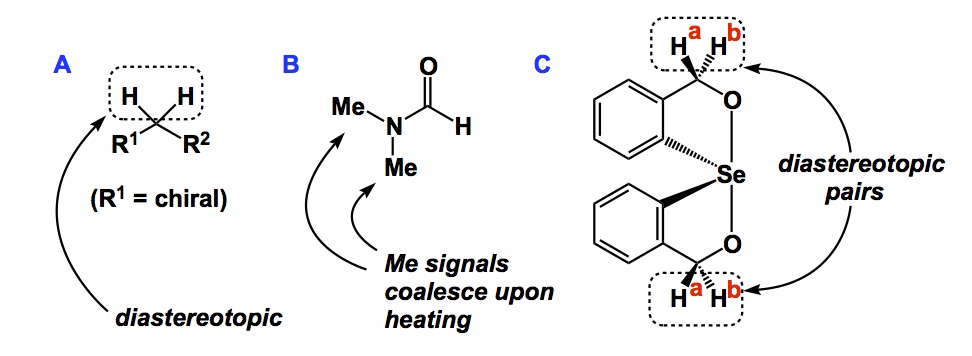
I want to mention one interesting piece of research that made me think (a lot). Take a look at the figure below. “A” represents a diastereotopic pair of protons in a generic RCH2R1 molecule. I can name many cases where VT NMR measurements have been employed in efforts to reveal the so-called coalescence temperature, which provides a measure of conformational preferences of a given compound. Dimethylformamide (inset B) is a simple achiral molecule that serves as a relevant example. In it, the methyl groups have different 1H NMR chemical shifts at room temperature, but coalesce at higher temperature. This property has important ramifications as it enables one to measure barriers to rotation, rate constants, etc. The example shown in inset “C” comes from Tom Back at the University of Calgary and teaches a peculiar behaviour seen in the 1H NMR of the depicted selenium compound. Apparently, the CH2 group appears as a AB quartet at 213K. Slowly but surely, this set of signals is transformed into a singlet at 291K. We might all be inclined to say: “Gotcha… This must be coalescence”. However, upon further heating, another AB quartet emerges at 377K! This appears to be a paradox, but only if we assume that coalescence of NMR signals of diastereotopic protons in variable-temperature experiments must be due to dynamic exchange processes. The danger of default assumptions… The re-appearance of the AB quartet at higher temperature (inset C) suggests that coalescence must attributed to coincidental chemical shift equivalence. In other words, the two diastereotopic protons that are shown display temperature-dependent chemical shifts that change in opposite directions, and whose coalescence is not to be equated with dynamic exchange. This is a fascinating finding suggesting that a lot of papers out there need to be reexamined (just heat beyond coalescence, baby, and see what happens).

aaa

http://pubs.acs.org/doi/abs/10.1021/jo301846a?m=102ivao&af=R&pageSize=20&searchText=PES

On this note, I am off to bed – I am catching a 7:30 plane back to Toronto. I hope not to see any nightmares related to overinterpretation of coalescence in our own work (as I write this note, I don’t think we did it, but the night is still young…).

Picking pockets

By now you have probably noticed that I have a lot of respect for cool publication titles. Earlier today I was thinking about some of the great ones. Who can beat Barry Sharpless’s “Vicinal Diol Cyclic Sulfates – Like Epoxides Only More Reactive”? I just love it. You can find this paper on the link below:

http://pubs.acs.org/doi/pdf/10.1021/ja00230a045.

Here is another one. It is a paper that comes “close to home” from the standpoint of our projects that are directed towards fragment-based interrogation of epigenetic proteins: “How Chromatin-binding Modules Interpret Histone Modifications: Lessons From Professional Pocket-Pickers”:

http://www.nature.com/nsmb/journal/v14/n11/abs/nsmb1338.html.

This manuscript details some of the intricate ways used by histone binding domains to differentiate among mono-, bis-, and trimethyllysine (to name a few) residues within histone proteins. Biologists might not yet know the rules that govern this complex process, but they are trying to find out. Chemists are uniquely suited to play an important role in this process by finding molecules that can disrupt the corresponding protein-protein interactions. To do this, we need two components: a well behaved domain that recognizes a post-translationally modified amino acid of interest and a method of making small molecules that disrupt this interaction with high specificity. Ever since I ended my sabbatical stay at the SGC in December of 2013, my graduate student Victoria (shown below) took over the reins and delved into various ways to produce and crystallographically characterize methyllysine-binding targets in collaboration with the SGC. Elena (shown below) has been her mentor in this undertaking. Last night Victoria made an important step forward: one of the key trimethyllysine-binding proteins succumbed to crystallographic characterization. Victoria was able to isolate and crystallize the molecule which is shown below on the right hand side (I made the images using PyMol). SGC’s Aiping Dong has been instrumental (as always) in solving the structure. You see two proteins side by side. On the left is the trimethyllysine containing peptide bound to the target, and on the right is Victoria’s domain that contains an empty pocket. Which molecules can get in and stay there? This is for Victoria to find out… We need to understand how these “professional pocket pickers” work.

Image