Attack of the killer lithium atoms

I wanted to talk about something really sweet, but last Friday’s encounter with my friend and colleague Dwight Seferos has been lingering in my head over this long weekend. Dwight brought to my attention a recent Angewandte paper by Yan, Zhang and co-workers. Upon reflection, this might represent another example of not using Occam’s razor (see my previous post: https://amphoteros.com/2015/02/24/treading-lightly/). But… There are other issues here, more systemic in nature, and I would like to comment on those. The reason for this paper being “the last straw” for me is that more and more frequently I see bastardization of structures in materials’ science papers.

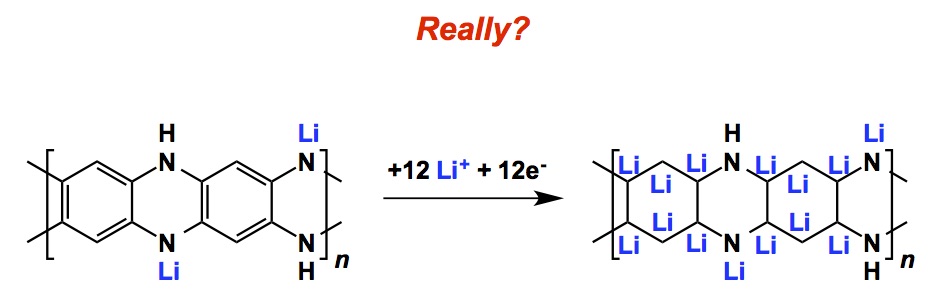
When we learn first year chemistry, we come to terms with a distinction between covalent and ionic bonds. Kekule’s depiction of covalent bonds has been tremendously useful and has allowed us to do everything from counting electrons to being responsible for how reasonable structures might appear in print. In contrast, ionic bonds are much less “directional”. Therein lie both advantages and disadvantages of the two types of interatomic connections. When I saw Scheme II in the aforementioned Angewandte paper, I could not believe my eyes. This depiction instantly took the air out of the work. I am not claiming to be an expert in polyazacene materials for lithium storage, but I do not need to be one in order to take offense in the way the authors rendered their structures and offered a rationale for the observed effect. I will faithfully reproduce the drawing I saw in the paper:
2

http://onlinelibrary.wiley.com/doi/10.1002/anie.201503072/abstract

These mean lithium atoms seem to do a number on the poor polyazacene molecule, don’t they? I wonder what David Collum of Cornell (http://chemistry.cornell.edu/faculty/detail.cfm?netid=dbc6) would think about this picture. He has spent his whole career painstakingly teaching us about carbon-lithium bonds…
Filling the groove of BCL-2

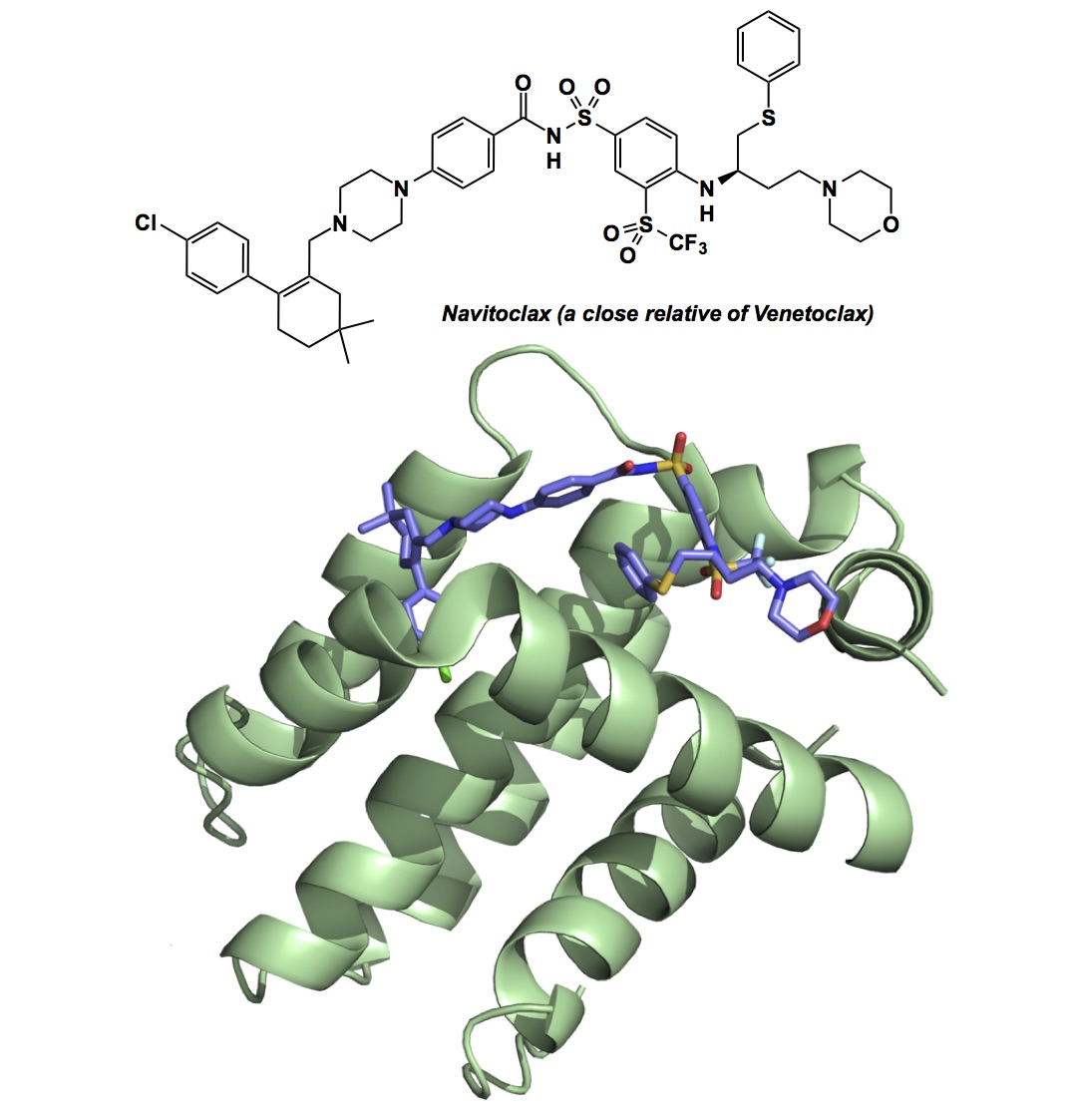
The impressive recent traction received by Abbvie’s Venetoclax is the subject of today’s post. Dr. G. Poda of OICR brought this molecule to my attention. Venetoclax constitutes a notable addition to the growing list of small molecule inhibitors that target protein-protein interactions. The compound just got the breakthrough therapy designation from the FDA, which speeds up the regulatory review process (http://www.dddmag.com/news/2015/05/abbvie-receives-breakthrough-designation-cancer-drug). A potent inhibitor of the B-cell lymphoma-2 (BCL-2) protein, Venetoclax shows once again that small molecules (more on that later…) can inhibit fairly extended protein interfaces. Below I am showing a view of the co-crystal structure between BCL-2 and one of Venetoclax’s close relatives – Navitoclax (pdb ID 4LVT). The last 10 years have witnesses a ton of research aimed at the BCL-2 family of proteins with all manner of synthetic tools thrown at this challenge. You probably saw stapled peptides developed by Verdine and Walensky. Abbvie’s compound now nicely fills the coveted hydrophobic patch while showing clinical efficacy.

33

If there were such a thing as chemical aesthetics in drug design, Venetoclax would probably not get the top prize. I am sorry, but this is one ugly molecule with all sorts of weird overhangs. Some of the structural features remind me of the mess the construction crew left in our basement two weeks ago. Those guys did a decent job in terms of the ultimate functionality we desired, but we did have to always watch out that the never-ending adjustments would not take a toll on the aesthetics.

Coming back to Venetoclax, calling it a small molecule is a stretch. Despite all of this, I am drawn to this structure, no matter how clunky it may look. Venetoclax is a nice way to showcase the merit of elongated molecules, which I have been developing quite an interest in. One of these days I will write a paper dedicated to inhibitors that look like sticks. I do think they occupy an interesting niche (as do macrocycles, but those serve a more “circular” purpose).

Some really good chemistry

A couple of weeks ago, Professor Carolyn Bertozzi (she is now at Stanford: https://chemistry.stanford.edu/chemistrynews/carolyn-bertozzi-join-chem-h) asked me to comment on a paper published by Professor Frances Arnold and colleagues at Caltech (http://cheme.che.caltech.edu/groups/fha/). Of course I agreed. It was difficult to say no to such a fine piece of work, which just appeared in ACS Central Science.

Take a look at Frances’s paper:

http://pubs.acs.org/doi/abs/10.1021/acscentsci.5b00056

You can read what I had to say about this neat manuscript:

http://pubs.acs.org/doi/full/10.1021/acscentsci.5b00140

My long-standing claim has been that nature does not know how to make C-N bonds by oxidation, which culminates in the inability of biosynthesis to produce aziridines (and other amines) by oxidative C-N bond formation. I do not want to dwell on the salient features of the Arnold approach because I already said enough in my commentary on this new way to coax p450’s to make aziridine rings.

But what’s up with all these new journals? Carolyn is the Editor-in-Chief of ACS Central Science. I am happy for her and wish her the best of luck establishing the centrality (as the name implies) of this new publication. I have always thought that the whole point of JACS were to be fairly central, which is why we have an interesting identity challenge in the case of ACS Central Science. This reminds me of the discussions I had with my good friend MG Finn many years ago. We were talking about starting a journal to end all journals, so to say. The name? Here it is: The Journal of Good Chemistry. You might think this is ridiculous, but think again. The job of an editor of this hypothetical publication would be as easy as pie. Imagine the following decision letter:

Dear Professor X, I regret to inform you that your paper is not good enough. Sincerely, the Editor”.

Really – just think about it – there will be no way to argue with something like this. And the editor does not need to be overly wordy. Or imagine the following response to a pre-submission inquiry sent to an overly ambitious author who is scoping where to send his/her breakthrough:

Dear Professor X, we have carefully considered your proposal. Unfortunately, we cannot be supportive of your submission because our journal publishes only good papers. We suspect that yours won’t be one of them. Sincerely, the Editor”.

Isocyanides and Lewis acids (and a tribute to Paul Gassman)

I really enjoyed reading Chris Vanderwal’s synthesis of kahalinol B published in JACS not too long ago. As someone who has had a keen interest in the chemistry of isocyanides, I have been attracted to the structure of kahalinol B and other natural products containing that venerable “NC” functionality.

44

http://pubs.acs.org/doi/abs/10.1021/jacs.5b01152

In Chris’s synthesis, the key step that enables isocyanide group transfer (see the graphic above) involves some chemistry developed by Ryan Shenvi. That in itself was a notable advance:

http://www.nature.com/nature/journal/v501/n7466/full/nature12472.html

I am sure you all agree that these isocyanide transfer reactions represent very elegant ways to use TMSCN, which is typically known for its role as the cyanide donor. That TMSCN can act as the isocyanide source with alcohol and epoxide electrophiles is leading some students to suggest to me that this whole TMSCN/Lewis acid business might be a cool way to make novel isocyanides for multicomponent reactions. To that I say: “Sure, but let’s take a sober look. Why is it that no one feels any burning desire to cite Professor Paul Gassman’s contributions to this area?” I am not sure, maybe I am way off here, so you can be the judge about whether or not any of the recent isocyanide transfer reactions need to mention Paul’s name. Paul was a well-regarded scientist, by the way. He was the President of the ACS and, in his free time, published on the “isocyanide/smart Lewis choice” idea in JACS back in 1982 (see the link below). As a matter of fact, he even had the well-known OrgSyn prep dedicated to this chemistry (the last link below). You all know what that means: his epoxide ring opening reactions were no fluke. I think people need to acknowledge these seminal contributions for what they were, namely precedent-setting advances (which are important to cite).

http://pubs.acs.org/doi/abs/10.1021/ja00385a078

http://www.orgsyn.org/demo.aspx?prep=CV7P0294

Watching wavelengths move

There has always been a problem in our ability to properly evaluate Brønsted acids in non-polar organic solvents. This is because acidities are commonly measured in water or DMSO. These solvents are quite polar and their high dielectric constants make them far from ideal in organic synthesis. As a corollary to that, anything measured in these polar media is of limited use.

Sherif Kaldas, who is one of the PhD students in my lab, brought up a nice paper at our journal club about 2 weeks ago. This JACS manuscript provides the best (in my view) way to experimentally determine the pKa of a molecule in your solvent of choice.

2

http://pubs.acs.org/doi/abs/10.1021/jacs.5b01805

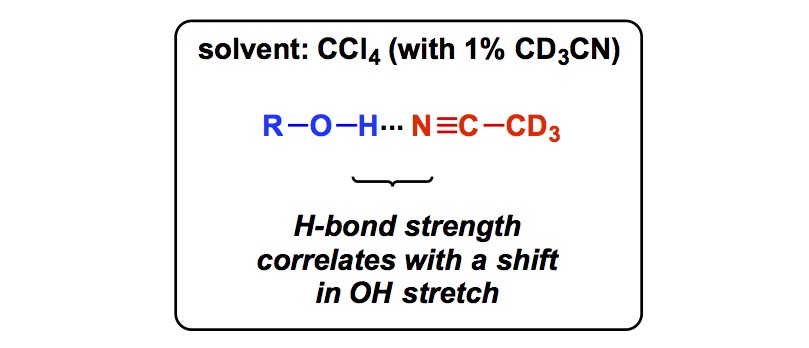
While pKa is an overwhelmingly useful metric in organic chemistry, I think we all have an example or two that will demonstrate how misleading it is to use tabulated pKa’s for acids in non-polar media. Now Steven Kass and co-workers of the University of Minnesota report an ingenious tool to measure acidities in non-aqueous media. In their work, IR spectroscopy provides a convenient analytical method. For instance, the IR spectra of dilute solutions (5 mM) of phenols in carbon tetrachloride and 1% deuterated acetonitrile result in a sharp band for the “free” O−H stretch around 3600 cm-1. In a series of derivatives, the frequency reduction of the band correlates with the formation of an ROH···acetonitrile hydrogen bond. Some really useful findings reported in this paper are transferable to proton-mediated catalysis in organic transformations. In my view, this paper fills an important gap in the literature and should find many applications.

The tie that binds us

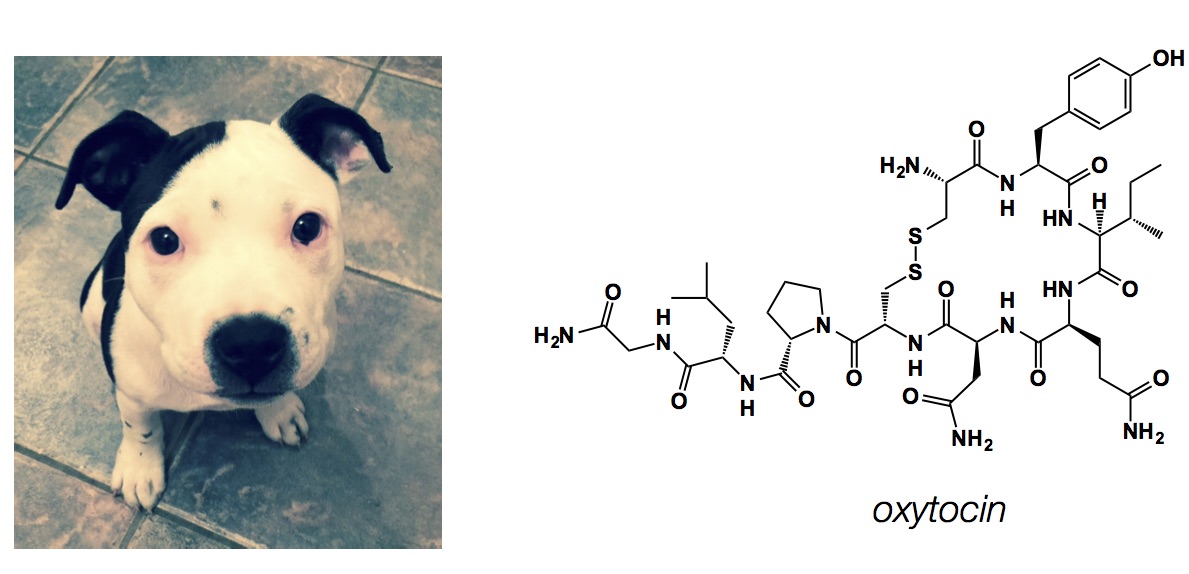
Here’s Lulu, our new puppy. At only 3 months old, she displays everything we love about dogs: affection, curiosity, a certain sense of humour, and – specifically for her breed – a good dose of stubbornness. I often wonder what goes on in Lulu’s head when she stares at me. Is it a mere plea for a treat or is it something else that she wants? Although we will never know, there are probably many answers to this question. All of them likely have one thing in common: staring into our eyes allows these domesticated descendants of wolves to establish a bond.

As someone who has been interested in cyclic peptides for a while, I chuckled when I found out that, on a molecular level, the tie that binds us involves a familiar chemical. In a paper recently published in Science, Japanese researchers presented evidence suggesting that there is measurable feedback that links human oxytocin levels with those in their pet dogs. The authors measured changes in both the dogs’ and the owners’ urinary oxytocin levels before and after their interaction, discovering large and correlated (!) increases in oxytocin concentration in both species. A control group of human subjects under investigation was also made to stare into wolves’ eyes. Nothing happened: there were no recorded oxytocin changes in either wolves or humans as there does not appear to be any cyclic peptide-driven communication between us and those predators.

2

http://www.sciencemag.org/content/348/6232/280

Some amine tricks worth noting

Over the years, Professor Tohru Fukuyama of the University of Tokyo has come up with a multitude of imaginative ways to make bioactive amines. In the past, I mentioned some of his chemistry on my blog. As someone who is constantly on the lookout for new ways of making electronically challenged amide structures, I recently learned to appreciate Fukuyama’s way of making N-acylpyrroles, which are valuable synthetic intermediates without a particularly straightforward synthesis. Until Fukuyama’s Org. Lett. publication that is…

N-Acyl pyrroles are fascinating amides due to the aromaticity of the leaving group when the time comes for the corresponding tetrahedral intermediate to collapse. Fukuyama’s method to make acyl pyrroles starts from the tetramethoxy derivative shown below. The amine intermediate obtained by a straightforward sequence is converted into an N-acylpyrrole under acidic conditions. The fact that Boc-L-phenylalanine can be converted into the corresponding N-acylpyrrole without racemization is particularly striking. While in Brazil 2 weeks ago, I heard Professor Ludger Wessjohann talk about an adaptation of Fukuyama’s N-acyl pyrrole sequence in the area of multicomponent reactivity. You probably guessed that this involved making a convertible isocyanide. As a result, it is now possible to treat a range of Ugi-based products and cleanly generate the products of acyl transfer to your favourite nucleophiles.

2

http://pubs.acs.org/doi/abs/10.1021/ol3005613

http://www.sciencedirect.com/science/article/pii/S0040403912012397

The real outlier amongst amines

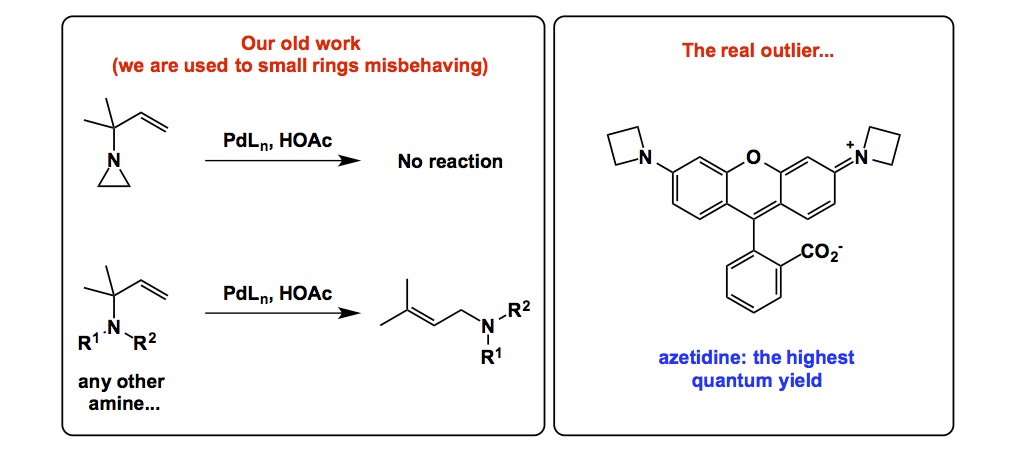
Treating nitrogen with respect is one of the things I have learned to appreciate over the years. No other element has so much going for it, especially under seemingly trivial conditions and in mundane settings. When Iain Watson was doing his PhD in my lab, he stumbled upon an effect that helped shape our thinking for many years. At that point of time, we had just started looking at the properties of amines in constrained environments. Iain discovered that aziridines displayed some aberrant behaviour in palladium-catalyzed allylic amination reactions. The kinetic branched product never isomerized into the linear one, which was odd considering what had been known prior to our work. We spent several years trying to understand this effect; several generations of my students took those results further and developed some rather nice methods. The irony is that we still have arguments about the origins of allyl aziridine stability against isomerization. But then again, at least the experimentally observed aberration was at the very “start” of the cyclic amine series, allowing us to end any argument with “Oh well, these rings are seriously strained after all… Let’s just go have a beer or something”. You probably know how circular arguments develop and propagate.

33

 http://pubs.acs.org/doi/abs/10.1021/ja049242f

 http://www.nature.com/nmeth/journal/v12/n3/full/nmeth.3256.html

Now hold on to your seats. Professor Igor Alabugin of Florida State University sent me a really nice book chapter he has been writing. In it, he elaborates on the s-character trends in the secondary amine series and cites a paper that made me scratch my head. This 2014 Nature Methods piece prescribes the use of azetidines (four-membered heterocycles with one nitrogen) in order to dramatically boost the quantum yield of certain fluorescent dyes. The three- and five-membered congeners are both inferior in this application, whereas the four-membered one hits the sweet spot.

Planting outliers in a series where one might naively expect some cute little trend is where organic chemistry is at its finest. The rationale behind the azetidine effect is most likely rather complicated. That’s ok: incorporating azetidines into dyes is now billed as a general method to improve fluorophores for live-cell microscopy. Way to go, azetidines…

On Brice Bosnich

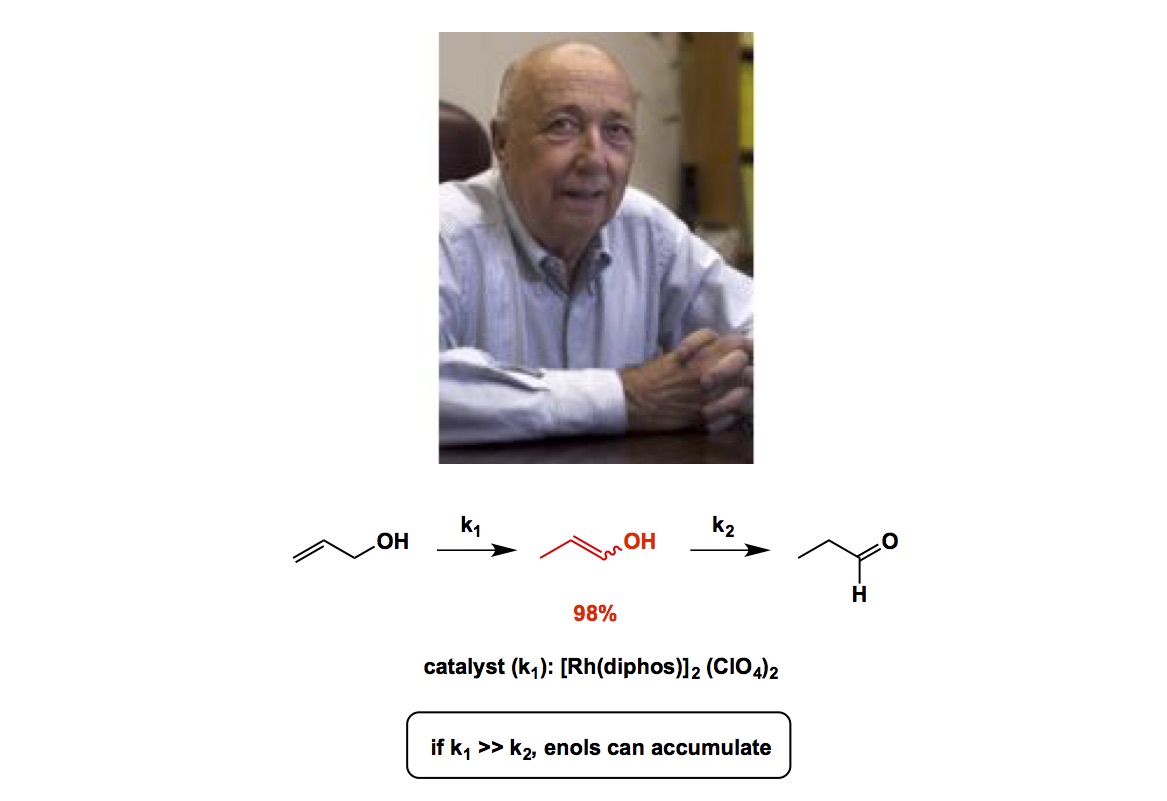
Today I learned the sad news: Boz passed away. For those of you who hear this nickname for the first time, this is how Professor Brice Bosnich has been known in the chemistry community. There are many admirers of his work out there, which is a testament to the mark this man has left on the field of organometallic chemistry.

Before finishing his career at the University of Chicago, Boz was a faculty member at the University of Toronto. I met him on a couple of occasions (although I arrived to Toronto after he had already been gone) and got to appreciate his uncompromising ways. I can tell you many stories that outdo one another in their political incorrectness. But that’s not the point today. We need to remember Boz for what he did in round bottomed flasks, where he turned many a molecule into a frenzy.

Which Boz’s paper I like the most? The answer is clear: it is the one that raised my eye brows. In 1991 Boz published a curious report of the rearrangement of allylic alcohols catalyzed by rhodium complexes. What’s interesting is that enols produced during this transformation are stable against ketonization. While something like this would be a heresy in the presence of water, it is entirely feasible in an organic medium such as acetone, provided that protons are excluded. The trick to avoid ketonization is to ensure that allylic alcohol isomerization is much faster than subsequent tautomerization. That’s it, deceptively simple and nuanced. As a result, we have the most effective method of generating enols in aprotic solutions. RIP, Boz.

2

http://pubs.acs.org/doi/abs/10.1021/ja00003a032

On bisulfite adducts of aldehydes

We tend to come across bisulfite adducts of aldehydes fairly infrequently and mostly as a means to get rid of aldehydic traces during work-up. I distinctly recall learning this in my undergraduate chemistry lab many years ago. Remember all those “magical” tricks – decolorizing charcoal, sodium bisulfite, etc?

Bisulfite adducts can pull their own weight, though. It has been demonstrated that these compounds are there to not only transfer aldehyde impurities into aqueous phase, but to reversibly protect sensitive molecules. I have been fascinated by these compounds, but I have never seen their solid-state structure. Over the years, I have been searching the Cambridge Crystallographic Database (CCD) in hopes of looking at the crystalline forms of these compounds, but it was all in vain.

Last night I came across a paper published in 2013 by the scientists from Eli Lilly. This manuscript has several nuggets that are worth considering. First of all – there you have it – a crystal structure! It is too bad that our colleagues in industry are not always vigilant about depositing their crystallographic data into the CCD, otherwise I might have seen this report earlier. The cation screen is the most peculiar part of the paper. Why does it always have to be sodium bisulfite? This is a great question. The report by Kissane and Frank shows that potassium salts possess superior properties, at least with their aldehyde. There are additional attributes that were considered by the authors. When was the last time I thought about filterability as a go/no go decision? I can’t recall… This is clearly important in process chemistry. Hygroscopicity is another metric that we do not take seriously in academia (at least not in quantitative terms). Here is a quote: “In a variable humidity solid state experiment, the sodium bisulfite adduct 2a was found to be quite hygroscopic, with a weight gain of 27% at relative humidity of up to 95%”. Hey – now I know why “academic yields” are often inflated… We just don’t think too much about weight gain along similar lines (this is a sarcasm). 44

http://www.sciencedirect.com/science/article/pii/S0040403913016705