Sitting on a benzene ring

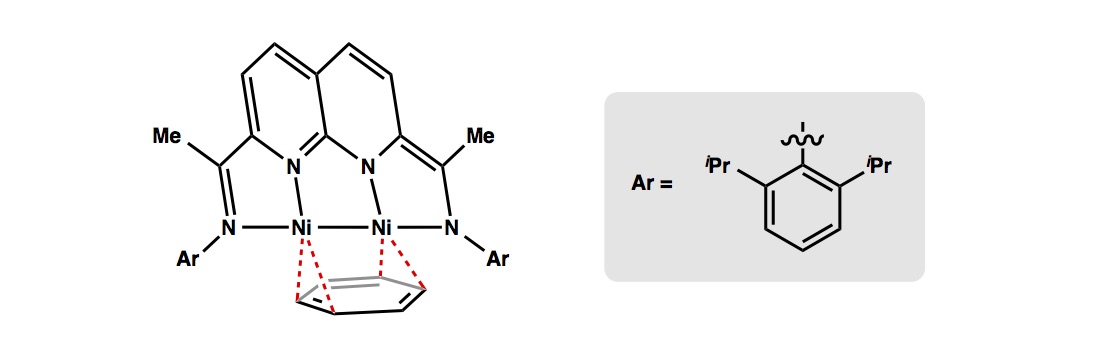
I do not, in all honesty, have a habit of reading Inorganic Chemistry, but Chris Uyeda’s account of a fascinating dinickel system has attracted my attention. I met Chris on a trip to Purdue University last Fall and was impressed by his ideas in the area of bimetallic reactivity. Several days ago I came across a paper from the Uyeda team, describing a really cool bis(nickel) system and its capacity to interact with benzene. The most interesting thing here is how redox-active donor ligands are called upon to stabilize nickel-based complexes
 in unusual oxidation states.
 In fact, a wide range of oxidation states (5 in this case) can be accessed by varying the π-system of the ligand. There are many applications one can imagine for this bimetallic framework in catalysis (particularly in multielectron 
redox reactions), which is something I am sure we will see in due course. pp

http://pubs.acs.org/doi/abs/10.1021/ic5020785

Uncommon acid fluorides

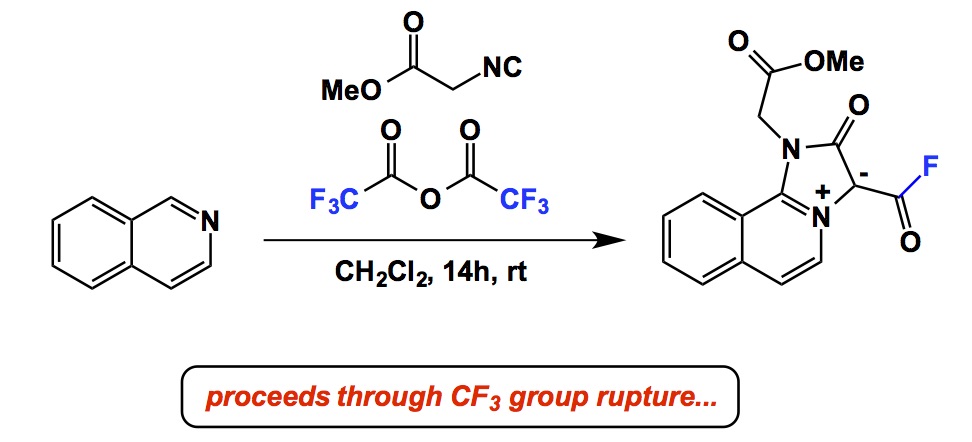
Acid fluorides are enigmatic compounds that can often withstand aqueous conditions. This happens to a certain degree, of course. Relative rates kick in at some point and reactions with nucleophiles do take place. Heck, this is why we love these intermediates, not to mention the corresponding acid chlorides. Acid chlorides partake in the best organic reaction I know – the Schötten-Baumann process. The fact that the classic version of this reaction is carried out in water/dichloromethane is one of the best ways to illustrate to virtues of kinetics in chemistry, especially when you also teach that acid chlorides are hydrolytically unstable. Organic chemistry is indeed a study of contrasts.

But let’s get back to acid fluorides. The following molecule, made by Lavilla and co-workers from Barcelona, Spain, is one of the most bizarre acid fluorides I have ever come across. I heard Professor Lavilla speak about this chemistry last week in Brazil. The synthesis is pretty fascinating and hinges on El Kaïm’s finding from many years ago. That report documented some peculiar reactivity between isocyanides and fluorinated acid anhydrides. The mechanism proposed by Lavilla hinges on destroying the CF3 group. As someone who worked on trifluoromethylation in the past, I cannot say that I know many good methods of monofluorination that have CF3-containing starting materials. There is a neat application of Lavilla’s zwitterionic heterocycle as a sensor of histamine. It is remarkable that the compound works well in cells. Histamine Blue (the name of this new dye) shows good selectivity over a range of metabolites in live RBL-2H3 basophils.

2

http://pubs.rsc.org/en/Content/ArticleLanding/2012/CC/c2cc32292g

What about simple amino acid-based bicycles?

Based on some discussions with my graduate students, I decided to look at bicycles containing diketopiperazinone sub-structures. As it turns out, there is not a whole lot of simple natural products with this architecture. By “simple” I imply a fairly uncomplicated connection between the alpha-carbons in the structure. This is somewhat surprising given the facility with which structures with diketopiperazinone cores are biosynthesized. Bicyclomycin is one molecule of this class that comes to mind. It was made several times in the past, with perhaps the most notable contribution coming from Bob Williams of Colorado State University. To me, the intermediacy of the bridgehead organolithium species shown below is one of the highlights of that synthesis. At that time, bicyclomycin’s mode of action was not fully established, although there were some good clues about the antibiotic nature of this natural product. It is now known that bicyclomycin inhibits the transcription termination factor Rho. There is a fairly unusual mode of noncompetitive inhibition in this case. The structure was determined by Berger and colleagues in 2005, which provided a rare view of this non-nucleotide inhibitor bound to a hexameric helicase/translocase (the yellow sphere you see is magnesium ion).

Still, given the fact that there are so many bioactive diketopiperazinones, it is interesting that nature has not come up with too many structures in which the two alpha carbons are linked by 4-5 atoms in a fairly uncomplicated way.

ppp

http://pubs.acs.org/doi/abs/10.1021/ja00331a066

http://www.sciencedirect.com/science/article/pii/S0969212604003879

Making useful contacts

An opportunity to meet people who have made important contributions to science is one of the most rewarding parts of attending a conference, particularly if you are a student. I was glad that my PhD student Sean Liew has been at the MCR conference in Brazil along with me. Sean’s yet to be published total synthesis of one of the ceramide natural products is based on his keen interest in pushing the frontiers of amphoteric reactivity. In his work, Sean has used the Petasis borono-Mannich reaction and, as luck would have it, had a chance to meet the man himself. Below is a photo of Sean together with Professor Nicos Petasis of the USC, which was taken right about time when we were all heading out to a nearby churrasqueira (a Brazilian barbeque). Giving a talk in the same morning session with Nicos was a real treat for Sean, something he will treasure for a long time. One of these days I will ask Sean to explain the key steps of his synthesis on this blog (his talk went great).

Unknown

Speaking of the latest trends in that remarkable boronic acid-based process developed by Nicos and his students, here is their neat paper published a couple of weeks ago in Organic Letters. Try to figure out the origin of the difference between the two products before you click on that link. It is an interesting story. I have always been amazed by how many surprises await those who continue to stick to an area of inquiry for many years. The Petasis reaction has led to a treasure trove of discoveries and the paper below demonstrates that one more time. Finally, I really want to thank Professor Carlos Kleber for organizing this event and bringing us all to Brazil.

33

http://pubs.acs.org/doi/full/10.1021/acs.orglett.5b00024

Do it your way

I am in Brasilia, the capital of Brazil, where I am attending the 6th International Conference on Multicomponent Reactions (http://www.mcr2015.unb.br). I have learned a lot of interesting things today and, while I could discuss something that is “hot off the press”, I am going to instead comment on something that is old, yet not well known.

2

https://www.jstage.jst.go.jp/article/bcsj1926/59/1/59_1_179/_article

Take a look at the triazole synthesis shown above. I learned about this reaction from the talk of Professor Bernie Westermann, who shared with us his latest results in the area of biological probe design. This 1986 route to triazoles reported by Sakai is not particularly high-yielding, yet it allows me to relate to a discussion I had with my graduate students several weeks ago. Here is the irony: once some reactions reach a certain level of stardom, they lose their educational value. I refer to azide-alkyne cycloaddition, olefin metathesis, Suzuki reaction, etc. Whenever we have a group meeting where my students try to work on a synthetic problem set, I try to emphatically prohibit them from doing the obvious. In other words, if you see a cyclic alkene – do not make it using metathesis, if you see a triazole – forget that azides exist, and so on. Think about something else.

The example above has been chosen to emphasize that there are alternative ways of looking at the stomping grounds of contemporary synthesis. As a corollary to that, I suppose that it is possible for a reaction to fall victim to its own success. This is the way I see it, at least when it comes to advanced chemistry education when we expect our students to display original thinking. Sakai’s case is also curious as it provides a product with a chain of four nitrogen atoms. It is not clear what to do with the N-Ts “overhang”, but I think this chemistry is really nice.

Revisiting the Norrish type II reactions

We have been fortunate to have Niklas Heine visit our lab from the University of Münster, where he is working on a PhD degree in the laboratory of Armido Studer. Niklas has brought with him a lot of expertise in radical reactions. These sorts of visits are great for my students as they encourage us to try things we have wanted to attempt for a while, but have encountered high barriers due to lack of familiarity with certain kinds of techniques. Those of you who follow my posts know that this is a general frustration of mine – I refer to convincing students to use methods that are less common than all those round bottom flask getups. For many years we have not done any electrochemistry, which I absolutely love. My lab published a lot in that area thanks to Tung Siu, who ran anodic oxidation experiments 15 years ago. He came to us with electrical engineering background, which is why electrosynthesis was a natural fit for him. Thus, I am not really laying any blame on others who might not have viewed the use of wires with the same level of enthusiasm. I even had a company, Ylektra, who pioneered parallel electrosynthesis (Tung worked there for a while). Ylektra was the wholly owned subsidiary of Affinium Pharmaceuticals, which was in turn acquired by the Swiss company Debiopharm last year… So there is a lot of good stories ultimately rooted in electrons!

When it comes to photochemistry, there is a surprisingly curious connection with electrochemical reactions. This connection has less to do with the phobia of getting started (in fact, electrochemistry is trickier), but is more about conceptual similarity in that radical cations are often involved as intermediates in electrochemical and photochemical reactions alike. But not all the time…

The lost art of Norrish type II reactions is the scientific part of today’s post. Below is a fantastic example of its use in total synthesis by Leo Paquette. The ketone you see was taken up in dioxane and placed in a Pyrex tube. The resulting solution was deoxygenated, and then irradiated using a medium pressure Hanovia lamp for 10 h. The process was run on a 100mg scale and delivered a 62% yield (not bad!). As with many photochemical reactions, the reaction was fairly dilute (10mL of dioxane was used). Still though, this a great example of C-H activation… Isn’t it? Of course it is.

tt

http://pubs.acs.org/doi/abs/10.1021/ja00244a025

A pleasant surprise

Here is a pleasant surprise. For the life of me, I cannot believe that this has never been tried before. The venerable Passerini reaction, one of the cornerstones of multicomponent reactivity, hinges upon the union of a carboxylic acid, an isocyanide, and an aldehyde. Now Soeta and Ukaji are telling us that sulfinic acids are also competent participants in this process. While the report triggers that classic response “Why didn’t I try this?”, finding the right sulfur-containing participant was probably not that straightforward. After all, readily accessable and infinitely more stable sulfonic acids would have probably been the first choice. Alas, the stars in the pKa universe are not aligned in that case and the reaction does not work (Or does it? Maybe someone should give another kick in that can!). The good news is that synthetically meaningful sulfonates in the Soeta/Ukaji method can be generated through in situ oxidation, giving rise to substrates that undergo straightforward nucleophilic displacement reactions.

This chemistry is nicely set up for a lot of divergent possibilities and lends itself really well to library synthesis. As far as the mechanism – the “sulfono-version” of the familiar acyl transfer is taking place here. Still, with all the effort spent in the area of multicomponent reactivity I am somewhat puzzled by this report that just appeared two weeks ago… But then again – this only underscores the notion that the most obvious things have not been attempted. This is the golden rule of research in my view (and a rather ironic one).

yy

http://pubs.acs.org/doi/abs/10.1021/acs.joc.5b00131

There is no free lunch

Earlier today, we had the first of a series of joint symposia between the University of Toronto and the University of Münster. Apart from MIT’s Mo Movassaghi (who gave a great lecture on his ongoing studies of alkaloid total synthesis), the speakers in the line-up were from Toronto and Münster. I thoroughly enjoyed the talks by the students as well as those by my colleague Mark Taylor and by Frank Glorious from Münster.

Frank and I discussed the following point I was trying to make. You see, I think there is a temptation to present some of the state of the art in the bustling area of transition metal-catalyzed C-H activation as breakthroughs that now allow one to carry out reactions at significantly lower temperatures than before. In general, mild reaction conditions run counter to what we have learned to expect from this field. Transformations, while often elegant and enabling, typically require a lot in terms of activation energy. As we all know, it is common to see temperatures well above 100 oC prescribed in C-H activation protocols. However, some of the processes that recently appeared from the labs of Cramer, Glorius, and others, suggest that significantly lower temperatures can now effect the desired transformations. This sounds really good and appears to formally represent a significant improvement.

Having said that, should we be so enthusiastic? If you consider the aforementioned studies, you will often note a common theme: a heteroatom-heteroatom bond as part of the substrate. The appearance of a lower temperature at which such substrates are activated is due to what I would call “energy front-loading”. I am showing a representative molecule that is commonly seen in these reports. It is perhaps not a surprise that an N-O containing substrate would require less activation energy than some other molecule. This is purely thermodynamic in nature: it all amounts to a clever redistribution of energy that gives us an illusion that the overall process is milder. Don’t get me wrong – the reaction conditions are relatively mild – but it is because you “front-load” the starting material with energy. I will make the following analogy: should we be touting epoxide ring-opening reactions as amazingly mild Sn2 processes? Epoxide ring-openings do appear to require less activation than other, strain-free, reactions with ordinary leaving groups, but they benefit from the energy embedded in 3-membered scaffolds.

44

http://pubs.acs.org/doi/abs/10.1021/ja109676d

http://www.sciencemag.org/content/338/6106/504

I would be very impressed if someone came up with a ligand system to channel a relatively energy-costly metal catalyzed reaction into a more reasonable regime. This is very different from front-loading substrates with energy, but does this option even exist? After all, there is no free lunch and there is always a need to get energy from somewhere. We had a nice discussion with Frank. I think there are many interesting challenges that lie ahead in the field of C-H activation, yet I have my doubts that truly relevant energy barriers in this field will be coming down any time soon. These reactions seem to need special tricks to appear mild. For a number of years now, those who have acknowledged challenges associated with high barriers in this area, have been implying that solutions in the form of ligands might be in store. I have not seen these but, as George Olah would say, please forgive my ignorance. Do let me know if you have encountered such studies.

Shifting cyclopropane rings around

I do not have a habit of reading or commenting on biosynthesis papers, but there is often a lot to learn in them, particularly when cationic rearrangements are involved. Dean Tantillo showed us some fascinating examples several weeks ago, so I started paying more attention to terpene chemistry. Below is a real piece of razzle-dazzle, exemplified by a reaction that rearranges the skeleton of an 8-membered terpenoid system of cyclooctatin. The colored circles represent labels (one is carbon- and the other one is deuterium-based). One sees such “swaps” quite rarely, particularly in biosynthesis. The unique carbon–carbon bond rearrangement shown below is thought to involve cyclopropane intermediates. As is often the case in studies such as this, the authors resorted to labeling experiments and obtained their precursors from 13C-labeled glucose (cell culture work) in combination with in vitro reactions of regiospecifically deuterated geranylgeranyl substrates. The overall process is catalyzed by cyclooctat-9-en-7-ol synthase in a stereospecific fashion. I do find the water attack (depicted by the authors) somewhat of a bold statement from a synthetic organic chemist’s point of view…

OK, so this is a fairly esoteric example and you might wonder why I am bringing this up. I suppose it is because I find it interesting to look at stuff that is unusual and lies outside the beaten track. I have always loved such science and I always will.

tt

http://onlinelibrary.wiley.com/doi/10.1002/anie.201411923/epdf

A case for divergence

When I visited Purdue University last Fall, Prof. Mingjie Dai shared with me some innovative and highly divergent synthesis of alkaloids that was inspired by their possible biosynthesis. At that time the work was not yet published, but now that it is, I want to draw your attention to a cool application of the Witkop-Winterfeldt oxidative indole cleavage. Upon C=C bond scission, transannular collapse leads to the formation of the cyclol structure shown below. This transformation is followed by azide-to-imine transformation mediated by triphenylphospine. The paper describes the synthesis of several indole alkaloids, of which I am only showing the molecule of mersicarpine. If you read the manuscript carefully, you will marvel at the application of the functional group pairing in order to arrive at some really intricate structures from a common starting material. It is too bad that I already gave my cumulative exam last week….

rrr

http://pubs.acs.org/doi/abs/10.1021/ol503150c