Life unknown

In tonight’s post I will attempt to bridge hydrophobic interactions and life as we know it. It might get philosophical, so bear with me. As many of you probably know, not long ago, Romesberg and colleagues at Scripps created the first organism that can grow and replicate with a completely unnatural base pair in its DNA. The DNA of this organism can, in principle, code for up to 172 amino acids. On a molecular level, the “glue” that holds the novel base pair together is purely hydrophobic in nature (the pair comprises a substituted methylisoquinoline and a methoxynaphthalene). There are no hydrogen bonds there at all:

ttt

http://www.nature.com/nature/journal/v509/n7500/abs/nature13314.html

The most interesting part of this research is how the authors managed to get their cells to replicate. In order to pull this off, they needed to figure out a way to smuggle the new bases inside the E. coli bacteria. The team found a unique protein transporter that was able to specifically take up the aforementioned synthetic bases. As a result, the new base pair was incorporated into DNA and was later found in replicated plasmids.

While there are many hurdles that prevent this system from being truly efficient, there are as many ethical questions that can be posed here. Apparently, the Romesberg study has already resulted in renewed calls to halt research in synthetic biology (for instance, by the ETC group: http://www.etcgroup.org). I am not an expert in these kinds of debates and it is difficult to speculate on the dangers of this science at this point. But I do want to note something else that might be interesting. Without going into a theological discourse, I note that anti-religion zealots such as Richard Dawkins are (ironically) not that far from some of the key principles they try to attack at all costs. I refer to how Dawkins looks back in time to find our ancestors, assuming that evolution is progressive, culminating with us. He does it in his book The Ancestor’s Tale. The amusing feature of this logic is that he ends up with a chain of being that is very similar to what religion promotes, namely that man is the culmination of it all. There is an excellent piece published by Sean Nee in Nature close to 10 years ago (I urge you to read it) that discusses this central issue and presents an alternative view of evolution. This essay offers a conjecture. Nee reminds us that over the past 600 million years a great variety of Bacteria, Archaea and microbial Eukarya have been evolving. And (I quote): “One of the huge species, Homo sapiens, got remarkably self-important. But when, to his surprise, a virus wiped him out, most of life on Earth took no notice at all.”

http://www.nature.com/nature/journal/v435/n7041/full/435429a.html

The lesson here is that we tend to assume too much about our relative significance in the great chain of being. But how does this relate to synthetic biology? We have curious minds. What if we do indeed create a form of life that will prove Nee’s conjecture that we might have gotten somewhat self-important?


On monomethylation

I was looking at an old paper collection that I have, trying to find methods that enable clean monomethylation of amines (we rely on this reaction in our macrocycle work) and came across a brilliant old paper by Grieco. I have always been very fond of this reaction. As you might imagine, many studies in organocatalysis have this 1987 report as one of their cornerstones. The question of amine monomethylation may sound simple, but it is anything but trivial. Low chemoselectivity is usually quoted as the main obstacle towards high yields in this chemistry. The trouble is typical of amine transformations: the product is more reactive than the starting material. Even reductive amination cannot offer a decent monomethylation solution, which is due to the fact that the corresponding imine is not easy to isolate and that formaldehyde is quite reactive. The workaround developed by Grieco involved in situ Diels-Alder chemistry that rapidly generates the azanorbornene skeleton shown below. Once this is accomplished, the adduct can be carried through various steps and can then be cleanly reversed to the iminium ion through retro-Diels-Alder reaction. In the presence of triethylsilane as the hydride source, the desired methylated amine is generated. Temporary masking of reactive functional groups using reversible processes is a really useful trick. We need to use this process more often in our own peptide synthesis efforts.

rtr

http://pubs.acs.org/doi/abs/10.1021/jo00235a021

Better heterocycles

What is the best heterocycle out there and how do we find it? This is a dumb question because it is not clear what the purpose of the query is. Let’s say we are talking about drug discovery. I really doubt that there are yet-to-be-discovered “silver bullets” that will beat everything else from the standpoint of ligand efficiency (I blogged about this concept in the past). It is actually quite amusing to talk to biologists, who expect that our heterocycle-containing inhibitors can be magically turned into something that is way better (by several log units – this is what they want) by some simple tweak that should be obvious to us based on our years of training… Something like this might become possible if we discover a handful of new elements on Mars, bring them down here, and plug them into pyridine. But not before… If we consider drug discovery a bit further, though, there are reasons to rank heterocycles in terms of their metabolic liability. In fact, there are efforts aimed at comparing heterocycles from the standpoint of binding to human serum albumin, CYP450 inhibition, etc. One recent study carried out at GlaxoSmithKline suggests that pyridazine is one of the most “developability”-friendly heterocycles as it presents the fewest downstream issues. This is quite interesting and you can read the details of analysis here:

http://pubs.rsc.org/en/Content/ArticleLanding/2012/MD/c2md20111a#!divAbstract

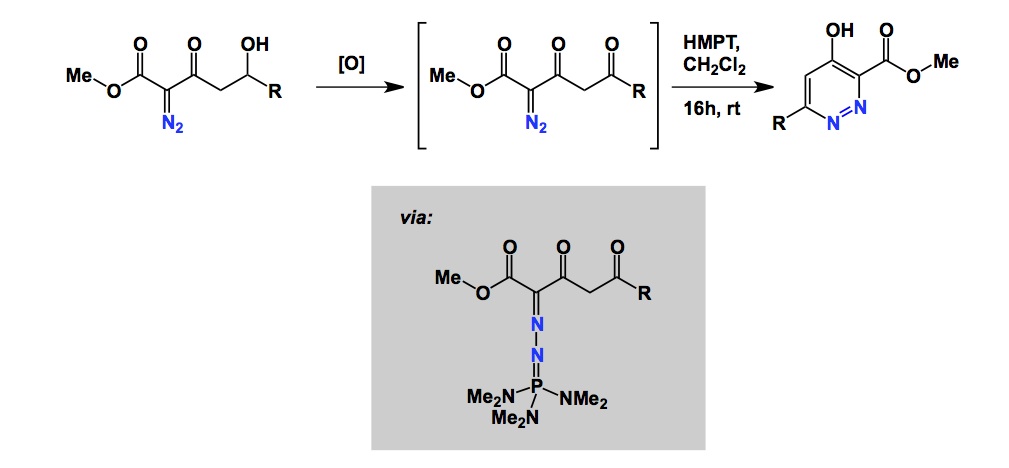
As luck would have it, I got some interesting “pyridazine” insights today. Earlier I had a phone conversation with Dr. Herdewijn of Galapagos in Belgium. I am not at liberty to disclose the subject of our conversation at this point, but I went online to read about some chemistry developed at Galapagos and was excited to come across a really cool pyridazine construction that came out of their labs. The sequence that you see below is a fantastic way to these scaffolds; it employs a rarely used process – the diaza-Wittig reaction (not to be confused with the aza-Wittig reaction, which is a very well established way to make imines).

ooo

http://pubs.acs.org/doi/abs/10.1021/jo400989q

Forgotten tools of separation

First of all, you might say: “Forgotten by whom? Not by me!”… You might be right, I admit that it is rather presumptuous of me to come up with post titles boasting the words “forgotten”, “neglected”, etc. But I would still venture to say that, given the wealth of high tech machines a synthesis laboratory might have these days, the majority of us do not resort to the older, more obscure purification methods. Today I want to bring to life silver nitrate (SN) impregnated chromatography as a method par excellence in really tricky separations. Below you can see two pinene isomers that are rather difficult to separate using conventional silica gel chromatography, yet are differentiated by the delta Rf of 0.2 using SN chromatography. I am including an excellent review by Mander that goes into the details of this great method. Some of you wonder if this would work best on alkene-containing molecules and you are right (due to silver-alkene coordination), but the method is not limited to separating on this basis alone. In Mander’s review, you will notice some intriguing examples of heterocycles that have been successfully separated using SN chromatography. So let’s keep these old methods in our lore of separation tricks, ladies and gentlemen.

rr

http://ac.els-cdn.com/S0040402000009273/1-s2.0-S0040402000009273-main.pdf?_tid=d58d3f28-1c38-11e4-b6a2-00000aacb360&acdnat=1407199295_da63f5f704c1feeca9ae9c76aa93e476

My recent visit to Alphora

I visited Alphora Research about 10 days ago. Alphora is a company that specializes in organic synthesis and leverages their tremendous process research expertise in projects that involve production of pharmaceuticals (under GMP standards). I think this is a great place to practice one’s synthetic skills because pretty much everything that is remotely interesting in the pharmaceutical process research is nowadays outsourced from places such as Pfizer (who are busy doing acquisitions) to smaller companies such as Alphora. As a result, students who are trained in synthesis may get jobs in such smaller companies and practice what they are passionate about – making molecules. I was really impressed with the kinds of projects Alphora scientists get to work on. They really solve important problems. For a representative recent example I direct you to a paper they put out earlier this year in Tetrahedron Letters (see the link below). The target of synthesis here is Eisai’s Eribulin molecule, which is a truncated version of the natural product Halichondrin B. I am amazed that molecules of this complexity (there are 15 chiral centers here!) have reached the market. The innovation in Alphora’s approach was to introduce nitrogen early in synthesis, which is something you typically want to avoid as the risks outweigh the benefits: according to conventional wisdom, one is better off introducing nitrogen atoms towards the end of synthesis. But, under the leadership of Dr. Boris Gorin, Alphora scientists took the risk of the “early nitrogen game plan” and, as a result, reaped the benefits of dealing with crystalline intermediates along the way.

http://www.sciencedirect.com/science/article/pii/S004040391301825X

There was something else during this trip that attracted my attention. It was one of those Chemtrix instruments that perform flow synthesis. I have seen a ton of flow synthesis machines in recent times at various venues, but Chemtrix really caught my eye. My beef with flow synthesis has always been about what happens next. It is ok to make a few mg’s really well. Or a gram. But what if you need to make 100 kg’s or 100 tons? Apparently, this Chemtrix instrument is a result of a ton of work on behalf of a very dedicated team of engineering geeks who promise linearity in scale-up. In other words, they have figured out an appropriate scaling algorithm that enables one to take the results of flow synthesis on a very small scale and have close to a guarantee that it will produce the same yield on a multi-kg or a multi-ton scale. All you need are fancier pumps and larger surface area in your tubes and reactors (which they produce and supply). None of this is random, but is calculated with utmost precision taking into account flow dynamics, mixing times, turbulence, etc. I need to buy one of these instruments one day.

http://www.chemtrix.com

Stereospecificity and protons

Recent efforts to chart novel classes of molecules beyond the co-called “rule of 5” space have consistently pointed at macrocycles as privileged scaffolds. A lot has been said about their conformation and capacity to hide hydrogen bonds. It is not easy to evaluate the significance of complex conformational ensembles, let alone extract useful rules that might have predictive power. I have been longing for a reductionist approach that could hopefully unambiguously demonstrate the effect of ONE hydrogen bond on lipophilicilty and other drug-like properties in a cyclic molecule. In fact, there is a recent study that does just that. In their J. Med. Chem. paper, Kihlberg and co-workers evaluate a diastereomeric series of T. cruzi growth 
inhibitors and showcase vastly different 
solubility, lipophilicity, pKa, and cell permeability for two sets
 of four stereoisomers. Intriguingly, all it takes is a switch in chirality of one of the stereocenters to improve the chances for intramolecular hydrogen 
bond and concomitant pKa difference. The authors carefully analyzed the conformations of their 8-membered rings by NMR, considered the differences in chemical shifts, their temperature dependencies, and obtained solid evidence pointing toward the formation of intramolecular hydrogen bond in the trans (not cis) diastereomer shown below. This is a very thought-provoking case as it highlights a fairly small perturbation that results in a substantial difference in properties. While I am impressed with the results, I keep reminding myself that obtaining this sort of data is not trivial and we are unlikely to see easy fixes as there are so many different scaffolds out there. The main reason there is a higher degree of difficulty in macrocycles compared to small molecules is that functional groups are much more interrelated through limited rotation (and the one you see isn’t even a macrocycle… it is a medium-sized model).

hh

http://pubs.acs.org/doi/abs/10.1021/jm500059t

What’s in a name?

Where do some of the more obscure functional groups get their names? This is the topic for tonight’s discussion. For instance, everyone is familiar with amidines – you get them by replacing oxygen atoms with nitrogens in carboxylic acids. The properties change rather drastically, but I am not talking about them tonight. In fact, I will not even go into a protracted discussion about where amidines got their name from. There is a certain logical connection to amides here, and I am just going to leave it there. Now let’s switch the letters “m” and “d” in the name “amidine”. We are going to end up with adimines. Who are they? Maybe this name hints at some imine character? Well, despite the fact that I cannot, for the life of me, figure out the origins of adimines, these intermediates are absolutely fascinating, if rare. Take a look at the sequence shown below. The arylpyridinium salt is first hit with a hydrazine, followed by ring-closure to generate the adimine skeleton. In this particular work, courtesy of Alvarez-Builla’s lab, adimine serves as a springboard into other heterocycles by way of palladium catalysis. The reactions are interesting, especially to me since I am very fond of unusual nitrogen arrangements (here we have a all-sp2 NCNN sequence, which is really rare).

ll

http://pubs.acs.org/doi/pdf/10.1021/jo801549u

In regards to names, I recall Nicos Petasis’s story of how his 5-year old daughter (at the time) corrected his mistake when she thought he misspelled “aminal”. Of course, she thought it must be “animal”…

Soaking in inorganic cages

I love reading papers that describe crystallization conditions and I make it a habit to read the experimental section. As you are probably well aware, Professor Fujita published some thought-provoking papers some time ago that described what he calls “crystal-free crystallography”. In this method, a molecule that is reluctant to form single crystals suitable for X-ray analysis, is coaxed into forming inclusion compounds that diffract reasonably well. This process has a number of far-reaching implications, particularly in structure determination of natural products. I have to admit that, for me, this process has always been reminiscent of what people routinely do in protein crystallography. In fact, my lab has been involved in experiments of this type in collaboration with our colleagues at the SGC (I refer to soaking experiments I mentioned several times in the past). The main difference is that the lattice is based on metal/ligand complexes in the Fujita technology. Another aspect is that when we run protein/small molecule soaking experiments, we already know which molecules we put in (or do we?). Fujita’s trick is to use well-defined inorganic materials that provide a “surrogate” lattice, so to say, and enable diffraction data to be collected for the guests that have been entrapped in nanocompartments. There was a lot of press surrounding this methodology, some of which hinted at some difficulties encountered in attempts to repeat the procedure, which the authors later admitted, aiming to work on process improvements. I was glad to see a Nature Protocols published by the Fujita team that provides a step-by-step recipe for how to run these crystallization experiments. It appears that making the metal-organic framework is a piece of cake and sounds like a lot of fun: you take a test tube and set up diffusion of a metha
nol solution of zinc diiodide layered onto a nitrobenzene/methanol solution that contains 2,4,6-tri(4-pyridyl)-1,3,5-triazine. Single crystals of the networked material form at the boundary (I enjoyed looking at the images). 
The rest is no different from how one would soak a small molecule into a protein crystal.

pichttp://www.nature.com/nprot/journal/v9/n2/full/nprot.2014.007.html

Transannular events

Of late, I have not come across too many unusual reactions that involve silicon (if you have any recent examples – do let me know), which is why I am going a couple of years back to the rescue. One of the reasons I am keen on transannular collapse processes will become evident once you will (hopefully) read the Perspective on macrocycles I am putting together for Chemical Science. Tonight, though, I am showing an eight-membered ring that undergoes a very interesting and unusual contraction to generate the cyclopropyl-containing seven-membered heterocycle shown below. When a silicon-bearing molecule is being “hit” with fluoride anions, one typically expects a fairly mundane silyl group removal. There are, of course, some really useful reactions (such as aldol processes using silyl enol ethers) that accompany the process of desilylation. Here is a good example that is unusual in terms of what goes in the course of desilylation. According to this report by Dowden and coworkers, clean “ablation” of the trimethylsilyl group from the eight-membered ring triggers conjugate addition and generates the cyclopropane ring that you see. What’s more, attempts to induce conjugate addition to the unsaturated amide intermolecularly (e.g. by adding thiophenol and base to the starting 8-membered ring) did not result in anything tractable. Thus, it is clear that the conformation of the 5,6-dihydroazocinone helps to guide the observed cyclopropanation. This example attests to how medium sized rings are full of surprizing features when it comes to uncommon reactivity patterns such as transannular ring formation. hth

http://pubs.rsc.org/en/Content/ArticleLanding/2013/CC/C2CC37739J

Cyclic enzymes – how rare is that?

I have always been fascinated by the fact that close to one half of the single domain proteins in the Protein Data Bank have their N- and C-terminal elements in close proximity. Some years ago, Krishna and Englander pointed out that this number is rather high. In fact, it is much higher than what one would expect on a random probability basis. The exact reasons for this peculiar observation are still being debated:

http://www.pnas.org/content/102/4/1053.full

Now, if we go 30 years back, we would find a classic study by Creighton, which showed a clean cyclization of the BPTI protein (its structure is shown below). Remarkably, the cyclization was triggered by a “middle of the road” carbodiimide reagent, so there is nothing fancy in this chemistry. In the graphic below you can clearly see that the ends of BPTI are fairly close to each other and can be forced to cyclize without much trouble.

tt

http://www.sciencedirect.com/science/article/pii/S0022283683802654

I wonder why we do not see more naturally occurring cyclic enzymes (although David Craik has been talking about some really cool ones of late)? The artificially cyclized versions can be significantly more stable than the corresponding non-cyclized ones, which can be seen time and again, for instance in the following paper by Howarth, although here the authors used a fairly “fancy” cyclization brew (you just can’t beat Creighton’s carbodiimide…):

http://onlinelibrary.wiley.com/doi/10.1002/anie.201402519/abstract