Azetes and their reasons to exist

Here is a heterocycle we do not hear a whole lot about these days: azete. Once you wonder about this kind of molecule, you will find yourself at the outskirts of organic chemistry! Azetes do not get mentioned at all when we teach sp2-rich nitrogen heterocycles (such as pyridine and pyrrole). However, they do exist and are isolable, despite being antiaromatic. I am always reminded of Alan Marchand’s instructive remark that one should not incorporate thermodynamically controlled steps when building strained molecules. Accordingly, azetes are made by a thermal decomposition of the cyclopropenyl azide (see below). The very existence of azetes is clearly kinetic in origin, which is to say that these four-membered rings can be obtained once a sufficient barrier preventing their decomposition has been secured. In the language of those brave souls who consider making molecules of this kind, successful isolation of an azete can be achieved once several tert-butyl groups are placed at the periphery of the molecule. The NMR of tris(tert-butyl)azete is the most interesting part of the classic Angewandte paper by Regitz (link below). There are only two groups of signals corresponding to tert-butyl groups, which means that the molecule is a time-averaged form of the two structures shown in the magenta rectangle below. It is as if the atoms are dancing around and the molecule keeps distorting itself…

http://onlinelibrary.wiley.com/doi/10.1002/anie.198608421/abstract

az

Why am I bringing up this obscure heterocycle? As I teach my CHM 249 class, I always contemplate really weird things. I feel a need to mention this sort of stuff as it makes me feel particularly good to be a synthetic chemist. What can be better? We create our own subject, the stuff that often has no business being stable, let alone found in nature. Just think about it: have you ever heard of synthetic astronomy? Nope. But synthetic chemistry – by all means! Synthetic biology seems to be emerging, though.

Housekeeping and vacuum cleaners

How do we get students interested in chemistry? There are many ways of achieving this goal and some of them work better than others, depending on a particular individual. I recall being interested in fundamentals and mechanism. For instance, the first time I heard about benzene ring and its electron cloud, I was awestruck for a while. Some people prefer to see parallels with macroscopic objects. What works for them are “molecular rulers”, “molecular robots”, and so on… All of these cases involve reductionist approaches to a particular action or an object that is familiar to everyone. Nowadays, people do less of this sort of blue-sky science.

Now… What if we think about a vacuum cleaner? What would be a molecular-level analogy in this case? Does it exist? I was just thinking about it today and I have to say that this is not a stretch at all. We do not need to create anything artificial in this case as there is something we all have in us and it works pretty well. Hydrophobic vacuum cleaners perform vital roles in cells. Consider molecules such as p-glycoprotein (or p-gp). The role of p-gp is to pump out all manner of hydrophobic molecules out of cells. While this function is critical when toxins are considered, one would actually want to minimize the premature “suction” of life-saving therapeutic agents. The reason I thought about this problem today is due to our long-standing interest in peptide macrocycles. We have some cool recent results pointing to a correlation between certain structural aspects of our macrocycles and their cellular influx. But what about efflux, which is the opposite process? The following paper by Chang and co-workers came out in Science several years ago: http://www.sciencemag.org/content/323/5922/1718.full. It serves as a reminder that nature has its clever ways of dealing with almost anything we throw at it. Alas, we can spend tremendous efforts designing macrocycles for a particular function, but p-gp will have its final say… What you see in the graphic below (I made it using PyMol) is molecular-level view of a selenium-containing macrocycle that has been co-crystallized with the molecule of p-gp. The bad news (for those of us who care about molecular design of bioactive molecules) is that there is a large hydrophobic cavity in p-gp that is geared to accept all sorts of “cargo”, ultimately removing molecules from cells. Remarkably, the enantiomer of the macrocycle you see also got co-crystallized with the protein. The position of the enantiomeric molecule is different from its mirror image, but as far as p-gp is concerned, the score is p-gp – 2: selenium macrocycle – 0! As an aside – check out the C-Se-C angles…

Image

Watching paint dry

My distinguished colleague, Professor Mitch Winnik, used to give a really interesting talk entitled “Watching paint dry”. This slightly facetious title is meant to represent a popular belief that watching paint dry is one of the most boring things known to man. If you know something about colloidal chemistry, you would quickly realize that this complex and multifaceted process is anything but boring.

Today I want to talk about infrared (IR) spectroscopy. Does this sounds boring? I think the majority of organic chemists look at IR spectroscopy as the chore of compound characterization. I think you will all agree that synthetic organic students rarely use IR in order to answer questions pertaining to mechanism and/or compound characterization (unless they are putting together their theses or supplementary materials for papers). There is indeed something to be said about other methods that provide way more information and are almost as fast (eg NMR). Accordingly, there are more streamlined means to ascertain product purity and identity, unless you are an inorganic chemist studying the structure of antimony pentachloride. In this case you have no choice but to use IR…

This week I started teaching my second year organic chemistry class (CHM 249), which is one of my favourite courses. I always start with spectroscopy and my first week is all about IR. I asked myself if I can think of an example where IR has enabled structural assignment and led to a valuable insight. I did not have to go far in order to dig out an example… When compared to cyanides, isocyanides are distinguished by a shift in the characteristic CN absorbance of about 100cm-1 in their IR spectrum. Here is a classic paper from the 1960’s that takes advantage of this difference: http://pubs.rsc.org/en/content/articlelanding/1968/c1/c19680001347#!divAbstract. In it, Booth and Frankiss showed a very peculiar property of trimethylsilyl cyanide. This molecule is in equilibrium with its isocyanide form, albeit the latter accounts for a very small percentage of the mixture. Curiously, the composition is pressure-dependent and the amount of the isocyanide component increases with pressure (someone should use this property, by the way).

Image

The relatively small amount of the isocyanide form in TMSCN did not prevent Hulme and co-workers from using this reagent in a multicomponent reaction: http://www.sciencedirect.com/science/article/pii/S0040403906003583.

Balancing reaction “coolness” with selectivity

Over the Christmas break, I wrote about my long-standing interest in electrochemistry. Indeed, many interesting things are possible on electrode surfaces. But let’s not forget that there are some aspects of electrosynthesis that are exceptionally challenging. The biggest one of all lies in the difficulty to control the fate of electrogenerated intermediates. For instance, you can create some really neat radical cations using anoxic oxidation, yet their diffusible nature renders them tough to control. Unless one of the reagents is used in large excess or the reaction is intramolecular, alternate pathways can take over the reaction landscape. It’s no wonder that metal catalysis continues to be the go-to source for achieving selective transformations in chemistry: bond-forming events tend to take place within the metal coordination sphere, which helps achieve control over reactive intermediates.

Now let’s consider photochemistry. Photochemical transformations have a lot in common with electrochemistry in that it is often difficult to control the pathways accessible to photoexcited states. Yet, there are marvelous examples that enable rapid increase in molecular complexity despite the low isolated yields. Witkop reaction is one such process. This transformation has been expertly reviewed by Gaich and co-workers in Angewandte Chemie (http://onlinelibrary.wiley.com/doi/10.1002/anie.201307391/abstract). The Witkop reaction is believed to proceed through intramolecular photon-induced electron transfer from the excited state of the indole chromophore to the chlorocarbonyl group. Subsequent loss of the chloride anion leads to a diradical cation, which ultimately gives the substitution product shown below. As the authors point out, average yields range from 30 to 55% (with by-products rarely reported, which is too bad…). However, the utility of this reaction in complex molecule synthesis proves its value relative to cumbersome alternatives to achieve the same objective.

Image

A call to arms: ligand efficiency

Happy New Year, everyone!

As our lab opens a new chapter in its quest for bioactive macrocycles, I thought it would be fitting to dedicate the first post of 2014 to the concept of ligand efficiency. We all know that there is a “size continuum” when it comes to biologically active molecules. Everything under the sun has been engaged in drug discovery efforts – from small molecules that “poke” targets using a handful of contacts to antibodies that employ multivalent interactions. It is also known that, during the process of optimizing a clinical candidate, a compound typically increases in molecular weight. This makes sense because legions of medicinal chemists throw everything they have learned in grad school in efforts to improve the compound potency. Not surprisingly, potency within a chemical series is often strongly correlated with molecular weight. This was noted by luminaries such as Chris Lipinski at Pfizer as well as by researchers at other pharmaceutical companies.

Here is an interesting fact, though: despite the rise in the molecular weight of clinical candidates, the mean molecular weight of drugs in clinical development declines in each subsequent stage to market (http://pubs.acs.org/doi/abs/10.1021/jm021053p). Isn’t that interesting?

It is at this stage that we need to consider the concept of ligand efficiency. The latter is quite intuitive: it represents the binding free energy for a ligand divided by its molecular size. In this regard, the following paper by Reynolds and co-workers is significant: http://www.sciencedirect.com/science/article/pii/S0960894X07005914. Upon examination of thousands of examples, the authors came to the conclusion that ligand efficiency increases rapidly up to 20 heavy atoms, but reaches plateau beyond 25 heavy atoms. This “magical number” 25 roughly corresponds to the size of a tripeptide sequence. In fact, there is an awesome paper in J. Med. Chem. that discusses “privileged” sequences of amino acids. This manuscript stresses the significance of tripeptide motifs due to the maximal ligand efficiency achieved at around 25 heavy atoms (http://pubs.acs.org/doi/abs/10.1021/jm1012984).

RGD (Arginine-Glycine-Aspartic acid) is the proverbial example of a privileged tripeptide motif. Discovered by Erkki Rouslahti (now at UCSB) using phage display, RGD is a protrusion on the surface of fibronectin (shown below). This area of fibronectin mediates its interactions with integrin receptors. As you might know, the RGD sequence has found numerous applications in the area of cyclic peptides. Nature is really telling us something with this loop and suggests cyclization as a means of designing peptidomimetics. But let’s think about it: how many other, undiscovered, RGD-like sequences are lurking out there? I will bet that there are many… We need to find them.

Image

Tough guys can run electrosynthesis

Here are some facts I took from one of my old lectures:

– Electrochemical alumunium production annually consumes more than 10% of electrical power in North America

– All oxidants and reductants accessible to organic chemists (chlorine, potassium permanganate, metallic sodium, hydrogen, to name a few) are produced in industry using electrochemistry

Shouldn’t these facts serve as reasons to use electrochemistry in order to run organic reactions directly, without involving all the waste associated with chemical reducing and oxidizing agents (we’re talking about chromium, lead, etc)? Think about it: if you pay electricity bills on time, electrons coming out of your electrical outlet will cost about 0.5 cents/mole… Curiously, the aforementioned considerations are not good enough to ensure widespread adoption of electrochemistry (otherwise there will be a lot more papers on this subject). The reason for this neglect lies in a steep barrier to entry into this field.

In the area of electrosynthesis, my lab has benefited tremendously from Tung Siu’s expertise. Tung was my first PhD student. When he came to my lab in 1999, Tung already had an undergraduate electrical engineering degree under his belt, which made it easy for him to engage in electrosynthesis. Tung was not intimidated…

Shockingly, I just realized that our last electrochemistry paper came out almost 10 years ago (http://pubs.acs.org/doi/abs/10.1021/jo048591p)… This work was done together with Tung and Christine Picard (now a Professor of Biology at Indiana U.: http://biology.iupui.edu/people/christine-picard). Ensuring continuity of projects is a big challenge in academic research and we somehow dropped the ball on electrochemistry in 2005… Now let’s fast forward to 2013. During this Christmas break I reasoned that it would be a perfect time to take our old Amel power supply off the shelf and see if that bad boy can still perform. Thankfully, Dmitry Pichugin was willing to help. Several years ago, Dmitry worked in my lab under the guidance of Igor Dubovyk. During his stay with us, Dmitry published a nice Angewandte paper together with Igor (http://onlinelibrary.wiley.com/doi/10.1002/ange.201100612/abstract). Of significance to our electrosynthesis aspirations, Dmitry is well versed in matters related to instruments and engineering (at the moment, he is working in our Departmental NMR facility). At 3:21pm, Dec. 27, Dmitry and I gave our Amel instrument a 2013 tune-up. Shono’s alpha-alkoxylation reaction (http://pubs.acs.org/doi/abs/10.1021/ja00848a020) was our test case. Do you want to see the easiest CH activation possible? Here it is! In the graphics shown below you will see our power supply and the reaction setup (2 graphite electrodes immersed into a methanolic solution of ethylpiperidine carbamate mixed with tetrabutylammonium tosylate as the supporting electrolyte). If you want, you can run this alkoxylation chemistry using graphite pencil inserts, it’s that simple. When I saw hydrogen bubbles at the cathode, I knew we were in business. Dmitry and I did not intend to push this reaction to completion. We ran it for 1.5 hours and just wanted to see the product. My PhD student Jeff St. Denis helped with the GC/MS analysis (thanks Jeff!). The most important outcome of this experiment is that things are working, we now have an updated standard operating procedure (even I can use this setup now), and I certainly hope that we will re-introduce electrochemistry back into our bag of tricks.

Image

Image

Image

GC/MS analysis of our crude reaction

Holiday blog posts

My blog posts will be fairly irregular until January 3-4 as I plan to get ready for the new semester, prepare my lecture notes, and write some papers and a grant proposal. After January 3, I plan to resume my humble writings with a new vigour and on a regular basis, although I will no longer be on sabbatical.

I would like to wish everyone a happy and safe holiday season!

On acyl radicals

On this gloomy Friday evening in Toronto (accentuated by the fact that we were supposed to go to the movies with my wife, but I purchased the tickets online to the wrong theater…), I am going to talk about some thought-provoking radical chemistry. Earlier today, I was talking with my PhD student Jeff about some radical-related matters relevant to our own research. This discussion brought to light a paper that I have always found fascinating. The work deals with facile generation of acyl radicals. Acyl radicals are not that uncommon, especially when generated from seleno- and thioesters. However, radical cleavage of an aldehyde’s C(sp2)-H bond is a less precedented reaction that raises a few eyebrows. Back in 2005, Tomioka and colleagues reported a marvelous example of this process. In their efforts to add nucleophilic thiol-derived radicals to double bonds (with the ultimate hope of making 6-membered rings), the authors serendipitously discovered that thiol radicals prefer to abstract the aldehyde’s hydrogen, leading to facile generation of acyl radicals directly from aldehydes. The resulting intermediate went on to form the cyclopentanone shown below. Several years ago, Stoltz and co-workers put this chemistry to good use in their synthesis of cyanthiwigin F (http://www.nature.com/nature/journal/v453/n7199/full/nature07046.html).

 Image

http://pubs.acs.org/doi/abs/10.1021/jo048275a

Adding colour to your science

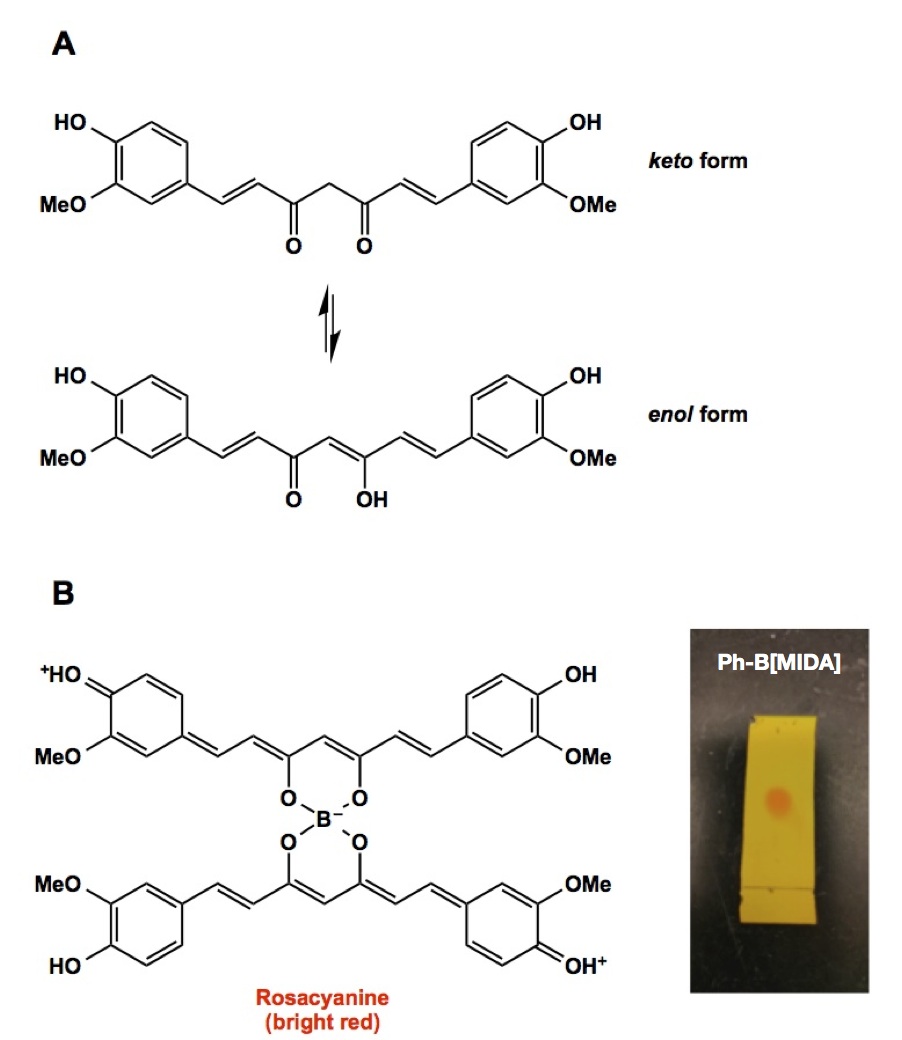
Tonight I am happy to host Adam Zajdlik, a second year PhD student in my lab, on my blog. Over the past year or so, Adam has been tirelessly pushing the frontiers of boron chemistry. I was hoping that he would share some of the “tricks of the trade” on this page. Because TLC and its significance came up on this blog recently, it is fitting that Adam has his favorite spot visualization method to share. Here is how Adam develops boron-containing molecules in his TLC experiments.

“Curcumin is a diarylheptanoid found in the popular spice turmeric. It is a highly conjugated diketone and its enol form is thermodynamically favored (see inset A below) as it allows electron delocalization across the entire molecule. An interesting feature of Curcumin is its ability to coordinate with boronic acids to form brightly colored boronate conjugates (inset B). During the coordination process, electron density is donated from the curcuminoid pi system to fill boron’s valence shell. This lowers the LUMO of the pi system and leads to a red-shift of its UV/vis absorbance. Boron-coordinated curcuminoids are bright red in color, while curcumin is yellow in the absence of boron.

This visible change in color has enabled some interesting applications. The reaction of curcumin with boric acid to form the corresponding boronate complex (Rosacyanine) is a remarkably favorable process and can be harnessed to detect trace amounts of boric acid. This is a highly sensitive analytical tool and allows quantification of boric acid in slightly alkaline solutions at levels as low as 3 ppm (!). Curcumin is also used as a TLC stain that is selective for boronic acids and their derivatives. Most boronic acid analogues appear as bright red spots on TLC when stained with curcumin including free boronic acids, boronates esters, MIDA boronates and BF3K salts. This is an extremely useful extension of TLC reaction monitoring in the development of novel boron-containing molecules.”

mmm

Stitching with acetonitrile

Acetonitrile is rapidly turning into one of my favourite reagents. Its nucleophilicity can be quite instrumental under special circumstances, which is why acetonitrile is not just an overpriced HPLC solvent whose cost goes through the roof whenever Chinese economy tanks. The Ritter reaction instantly comes to mind whenever the nucleophilic properties of acetonitrile are considered. Of course, there are other examples, particularly in the organometallic literature.

Below is a recent case published by Lavilla and coworkers. This chemistry reminds us that acetonitrile can be a useful stitching element when employed at the right place and at the right time. The multicomponent reaction developed by the Lavilla group involves a cyclic imine that, upon activation by a Lewis acid (scandium triflate), undergoes a Mannich-type process. The resulting oxonium endpoint cannot undergo Povarov ring closure (my colleague Doug Stephan might call this a “Povarov-frustrated oxonium ion”). It appears that the oxonium ion’s reluctance to undergo Povarov reaction with the aromatic indoline fragment is due to geometrical constraints. Well, mother Nature hates voids and acetonitrile gladly fills the gap. The nucleophilic addition leads to the formation of a nitrilium ion (a special “hello” to my lab members is due at this point – they know what I am talking about), which is rapidly trapped by the nitrogen center. This is an awesome new multicomponent reaction that is rooted in the exceptional properties of acetonitrile.

lll

http://onlinelibrary.wiley.com/doi/10.1002/anie.201202927/abstract