A case for divergence

When I visited Purdue University last Fall, Prof. Mingjie Dai shared with me some innovative and highly divergent synthesis of alkaloids that was inspired by their possible biosynthesis. At that time the work was not yet published, but now that it is, I want to draw your attention to a cool application of the Witkop-Winterfeldt oxidative indole cleavage. Upon C=C bond scission, transannular collapse leads to the formation of the cyclol structure shown below. This transformation is followed by azide-to-imine transformation mediated by triphenylphospine. The paper describes the synthesis of several indole alkaloids, of which I am only showing the molecule of mersicarpine. If you read the manuscript carefully, you will marvel at the application of the functional group pairing in order to arrive at some really intricate structures from a common starting material. It is too bad that I already gave my cumulative exam last week….

rrr

http://pubs.acs.org/doi/abs/10.1021/ol503150c

Subtle structural effects in modern drug discovery

Thanks to Dr. Yusheng Xiong, I had a very informative visit to Merck in Kenilworth (New Jersey) this past Friday. The location of this site is very close to Rahway, which used to be Merck’s primary medicinal chemistry center. Since the acquisition of Schering-Plough several years ago, Kenilworth has been steadily turning into the main discovery hub for Merck.

While I can’t describe the proprietary details I learned during this trip, I can make several general statements that define the overall visit. When compared to the days past, there is clearly a new approach to drug discovery at Merck. This company used to be very much a small molecule-driven operation. It is now more about “whichever modality fits the target in question”. This is the main reason why there is so much interest in macrocycles, which was one of the topics covered in my lecture.

My second point is more scientific. Throughout the day, I had several discussions that involved some stereoelectronic arguments. While I cannot talk about them, I think I can mention a paper that just came out in J. Med. Chem. It describes the role of divalent sulfur in the structures of therapeutic agents and provides an excellent demonstration of intramolecular oxygen-sulfur interactions. Take a close look at the two structures below. There is no way (in my view) of guessing which one of these two extremely similar compounds is more effective in inhibiting VEGF. Interestingly, one of them is potent, whereas the other is completely inactive. People are just beginning to fully appreciate the involvement of sigma hole-driven interactions and, in the example below, conformational stabilization is evidenced in the shorter through-space O-S distance in the active molecule compared to the “dud”.

bl2

http://pubs.acs.org/doi/abs/10.1021/jm501853m

We need some new proline-based blocks

Tonight I am not covering anything from the recent literature. My post is very much need-driven, rather than current literature-based. My lab has contemplated ways of putting together alpha-substituted proline derivatives. Our long-standing plan is to use them in a range of reactions, including our peptide macrocyclization. While you can buy the alpha-methyl variant, good luck finding something that is a bit more elaborate. In this regard, you might say that there has to be a way to use sigmatropic reactions and induce transfer of a nitrogen-bound group to the alpha carbon. Something like this rings a bell and formally corresponds to the Stevens rearrangement. The trouble is, this process is never clean due to the competing Sommelet-Hauser rearrangement. By the way, there is nothing wrong with this “competition” because the Sommelet-Hauser process is equally attractive from the endpoint perspective. However, the rule of reciprocity tells us that, in this case, the product will be contaminated by the amino acid derivative emanating from the Sommelet rearrangement.

There is a delightful Angewandte paper by Tayama and co-workers that shows how control can in fact be exercised. Take a look. I definitely want to use some of these amino acid building blocks in our chemistry. There is something really interesting about potassium tert-butoxide (I’ve also heard that if you have a bottle of this stuff, you do not need any transition metal catalysts anymore… I refer to that curious Grubbs/Stoltz paper, of course).

2

http://onlinelibrary.wiley.com/doi/10.1002/anie.200703832/abstract


Some frivolous ways of interpreting structures

I want to talk about the levity with which organic molecules are sometimes depicted. More specifically, my point tonight deals with how biologists bastardize chemical structures.

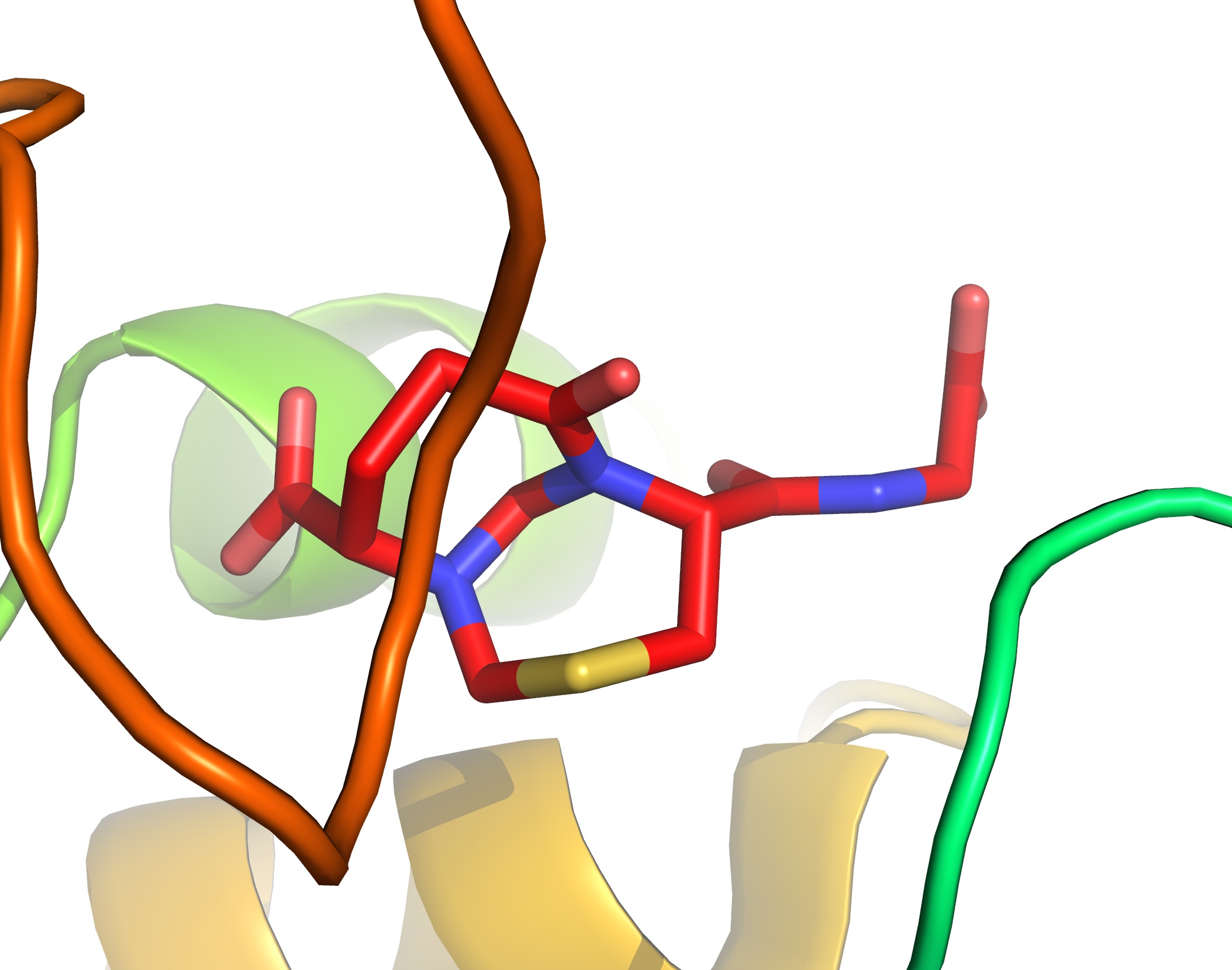
Some background is in order. This past weekend we had prospective graduate students visit our department from other schools. This is one of those annual events that serve to remind us what our craft is all about. For me, one of the appeals of synthesis is in finding a low molecular weight entity that can interrogate a protein that is hundreds, if not thousands, of times larger in size. This is nothing but a spectacular manifestation of ligand efficiency, which bolsters the notion that all it takes in order to shut down some sophisticated cellular machinery is a few correctly positioned hydrogen bonds and hydrophobic contacts. Chemists who make such molecules deserve some respect in terms of how their compounds are rendered by the end users (biologists). This is where I have a problem. Some representative cases on display below prove my point. While there can be numerous semi-legitimate reasons for these egregious errors, it is strange to see this sort of stuff in reported crystal structures. Annoyingly, on several occasions, I heard the following comment: “Well, we did not really spend a lot of time refining the small molecule ligand because all we cared about was the protein“. Really? And which pivotal factor contributed to you solving the crystal structure? It was the protein’s low molecular weight “partner”. Ironic, isn’t it?

pic

Finding real gems

I don’t know about you, but sometimes all I want out of reading papers is pure basic science. I get particularly upbeat when I see an occasional outlandish structure that reminds me that not all ground states are created equal. Truth be told, with fewer and fewer people doing “blue sky” research, it is difficult to find such examples in the sea of utility-oriented manuscripts. While it is easy to get inundated with the amount of information being published, TOC (Table of Contents) graphics offer a glimpse into what to expect in a given paper. These devices were introduced by the publishers only about 13-14 years ago, which sounds crazy given how indispensible they seem to be. The trouble is that some of the most interesting vignettes and detours hardly ever appear in these graphics. As a result, it is virtually impossible to find real gems unless you read the whole thing (and who has the time for that?). Here is a good example: based on the TOC graphic alone, I could have easily missed some of the fascinating details in the paper from Hosoya and co-workers that appeared in Org. Lett. not too long ago. Upon perusing the contents of the article, I saw one of the characterized by-products. To me, this happens to be one of the most interesting results in this contribution.

11

http://pubs.acs.org/doi/abs/10.1021/ol5031734

Bromine Division of the ACS?

As a first year graduate student many years ago, I was teasing my friends who were going to attend a symposium organized by the Division of Fluorine Chemistry of the ACS. At that time, I was not into fluorine chemistry (this subsequently changed) and, understandably, found it funny that among 30 or so divisions of that society, one was entirely dedicated to a single element in the periodic table. It is probably fair that fluorine has its central role as there are just so many applications of this halogen. But what about the rest of that venerable group? Are they all just “ugly cousins” of fluorine?

Below is a reference to a cool paper that shows how valuable organobromine libraries are. On the surface, there is nothing new here: the effect of anomalous scattering has been known for a long time. But, in the context of fragment-based screening, bromine is turning into a very useful tool when one needs to soak organic molecules in protein crystals with the goal of detecting which fragments stick. My students perform soaking experiments together with our colleagues at the SGC and we know all too well how unhappy crystallographers get when they have to solve 40 or so crystal structures of a protein (corresponding to a 40 compound library), only to find out that they are all identical and nothing got stuck in the lattice. When you have a bromine atom in your molecule, there is no need to run full structure determination: due to anomalous scattering, you will see really fast if your molecule is “in”. So there you have it: bromine is special. If we add its central role in halogen bonding (my colleague Mark Taylor is one of the leaders in this field), all of a sudden there are many gains to be made by placing bromine atoms in selected positions of our molecules. I think we need to approach ACS and ask them to start the Bromine Division

99

http://onlinelibrary.wiley.com/doi/10.1111/cbdd.12227/abstract

Treading lightly

I think scientists need to approach their research from the standpoint of Ocham’s razor. This way of thinking is by far the best way to analyze complex experimental data where many parameters are interconnected and cause / effect relationships are convoluted. From time to time, I will be posting cases in which Ocham’s razor might not have been applied. But first – what is it? This tool of logic posits that out of several plausible hypotheses, the one with the fewest assumptions is the winner. In other words, the simplest explanation is usually the correct one.

We were discussing an interesting Nature Chemistry paper at our journal club today. The asymmetric phase transfer-catalyzed reaction described by Paton and Smith is billed as a violation of Baldwin’s rules. On a cursory look, it does appear to be an example of the disfavored 5endotrig process (see top equation in the graphic below). A theoretical rationale put forth by the authors includes a sophisticated quantum mechanical backing. I like the reaction, but if I were to apply Ocham’s razor here, I would consider a simpler resonance-based explanation shown at the bottom. Here I am using the methoxy substrate (incidentally, one of the better ones in the paper), although we all know that the Curtin-Hammet principle might “rescue” the less fortunate reactants. My goal here is not to say that the more elaborate explanation offered by the authors does not have merit. It is possible that my suggestion is energetically unattractive, but I think it ought to be considered and thoroughly evaluated in addition to the more complex ideas that are being presented. By the way, I have always liked how Eric Carreira refers to Baldwin’s rules as Baldwin’s “suggestions”. One can often avoid violating these “commandments” using resonance structures.

88

http://www.nature.com/nchem/journal/v7/n2/full/nchem.2150.html