
Polar, yet greasy

Solvation/desolvation processes have put a spell over chemical reactivity. Indeed, had this not been the case, we would have been able to computationally predict pretty much anything at this point. As it stands, though, failure to accurately account for the balance of entropy and enthalpy during solvation/desolvation is one of the biggest deficiencies of quantum mechanical calculations. Outliers that are found among organic solvents underscore this fact. In this regard, trifluoroethanol (TFE) is one of my favourite solvents. I think my lab uses several liters of this stuff per year, despite the fact that our reactions are typically fairly small in scale. TFE is one of the strangest beasts out there and you might wonder why. The reasons are shown below.

Image

One of the most interesting and useful consequences of this unusual combination of TFE’s relatively high acidity (for an alcohol) and its low dielectric constant is its capacity to encourage “hydrogen bond shielding”. There is a lot of literature on the profound effect exerted by TFE on the peptide secondary structure. Many years ago, Kemp published a definitive paper that explored the mechanism of increased helicity of peptides in the presence of TFE. It appears that TFE raises the energy of the solvent exposed hydrogen bonds. As a result, medium-sized peptides with an intrinsic tendency to assume helical conformations in water show a dramatic increase in helicity upon addition of TFE. I am betting that some of the effects of this solvent on our peptide cyclization reactions are due to globular conformations promoted by TFE. There are many interesting effects of TFE on organic reactions and a lot remain to be discovered.

http://pubs.acs.org/doi/abs/10.1021/ja952900z

Alkynyl ketones – the boron way

I have enjoyed reading Prof. Yuri Bolshan’s paper, recently published in Org. Lett. Yuri hails from the University of Toronto, where he did his PhD under the direction of Professor Robert Batey. Afterwards, Yuri did his postdoctoral studies with Tohru Fukuyama in Tokyo and worked at the Ontario Institute for Cancer Research (OICR) here in Toronto. Right now Yuri is an Assistant Professor at the University of Ontario Institute of Technology (http://sites.uoit.ca/yuri-bolshan/y-bolshan/). What attracted me to the Org. Lett. paper is the symbiotic relationship between two types of boron units: BF3 and BCl3. The BF3 fragment enters the reaction bound to an alkynyl ligand (as the trifluoroborate salt), while BCl3 acts as the Lewis acid promoter. The authors propose several mechanistic possibilities, one of which is shown below. In it, the transiently formed alkyne-BCl2 reagent coordinates to the oxygen center of the acyl chloride component, which triggers alkynyl migration to the carbonyl carbon, ultimately producing the alkynyl ketone product. I want to wish Yuri all the best in his new position. It looks to me that he is off to a nice start!

Image

http://pubs.acs.org/doi/abs/10.1021/ol403370t

In and out, without a trace

The sulfonamide… I have always been fascinated by this functional group. Tonight I will discuss its relationship to regular amides. If you look at the inset below, you will find a peculiar difference in behavior of cyclic and acyclic sulfonamides/amides. We all know that acyclic sulfonamides are substantially more stable than regular amides towards hydrolysis (boiling HBr has been prescribed many a time, especially in the older literature). However, if you consider 4-memberd ring sultams and their carbonyl “relatives” – beta-lactams, you will note that now the reactivity is reversed and the sulfur analogs are more reactive during hydrolysis.

Image

There is a paper by Page that discusses this interesting property:

http://pubs.acs.org/doi/abs/10.1021/ja050787z

There are many outstanding features possessed by sultams, and one of them is their ability to inhibit serine proteases. Not long ago, Sieber and colleagues made an interesting observation in the course of figuring out the mode of action of sultam-containing inhibitors of ClpP. Covalent labeling of ClpP’s Ser98 resulted not only in irreversible labelling of the active site serine, but proceeded to give the product of elimination, which resulted in dehydroalanine formation. This is an interesting lesson for those of us who are interested in the design of irreversible enzyme inhibitors. I am not aware of similar cases where the active site residue participates in such an elimination, although there might be some. Notably, the Dha residue was characterized by the authors using X-ray crystallography.

 Image

http://pubs.acs.org/doi/abs/10.1021/ja4082793

Using math in synthesis

Synthetic chemists do not use a lot of math. We rely on it, there is no question about it, especially when it comes to our daily NMR experiments. Indeed, there is just so much math in the FID treatment alone. It just does not seem to affect our hypothesis-generating abilities, so we do not have a need to worry about all those complexities.

When I was doing my protein experiments with Elena Dobrovetsky during my sabbatical stay at SGC, it seemed that the “C1V1 = C2V2 (C: concentration, V: volume)” equation ruled our days. I suppose this one simple relationship is the most widely used piece of math when you need to prepare your 142nd buffer of the day.

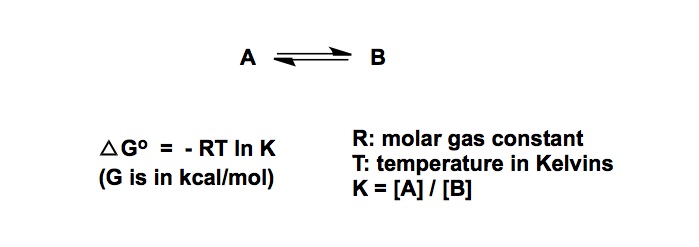
But what is the single most important mathematical equation every organic chemist should know? In my personal view, it is the one describing the relationship between temperature, energy, and the ratio of two molecular entities expressed as K:
1

We normally refer to K as the equilibrium constant, but I wish we had a more generic term. This is because the value of the equation is in that it relates the difference in energy barriers to the ratio of products or transition states. Thus, the equation covers the domains of both thermodynamics and kinetics. Below you will see that equation again, this time rewritten in a more palatable way for quick calculations at room temperature. An immediate consequence is that each factor of 10 between the respective ratios of A and B (these could be ground or transition states) translates into a free energy change of about 1.4 kcal / mole.

2

Simple tools are often better

I am continuing my second year organic chemistry class, and although I am now covering NMR spectroscopy, the material of last week stirred some more “infrared memories”. I want to come back to the glory of this kind of spectroscopy and make it even more exciting… What if we want to see a situation where a unique reactivity insight is offered by way of analyzing an IR spectrum? This is different from the example I discussed in my last week’s post, in which the isocyanide functional group was distinguished from its cyanide counterpart through a shift in the wavenumber. This was more about functional group characterization. Now we want to shed light on reactivity preferences.

Image

http://pubs.acs.org/doi/abs/10.1021/jo00078a014?journalCode=joceah

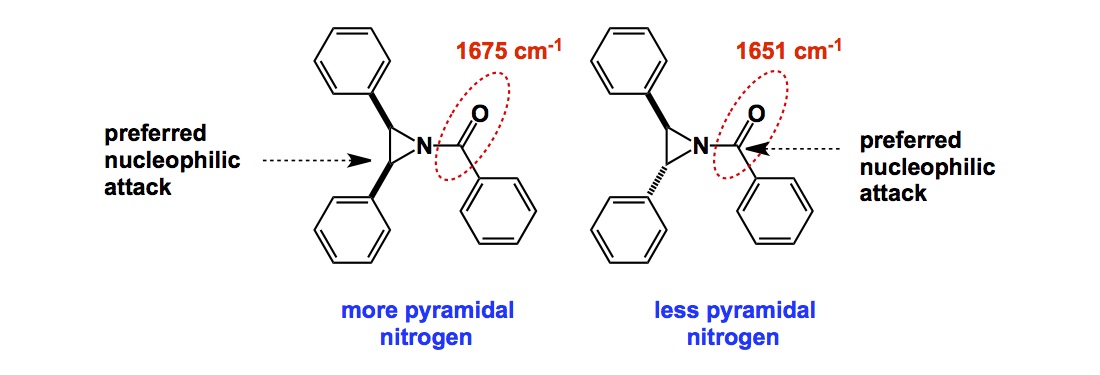
Above is a classic aziridine paper from Stamm and co-workers. Due to their substantial strain (about 27 kcal/mol), aziridines are different from other amines because aziridine nitrogen is much more pyramidal (which is to say that its barrier to inversion is high). Stamm’s experiments suggest that there is a marked difference between the chemistry of cis- and trans-acyl aziridines shown. You can see that the cis-isomer has a stronger C=O bond (reflected in the higher wavenumber). Interestingly, the cis-aziridine was found to preferentially react with nucleophiles (there were several nucleophiles and these details are beyond the scope of this post) at the carbonyl carbon, whereas the trans-aziridine preferentially reacted just like an epoxide. What might be the reason for this peculiar dichotomy? The IR spectra provide valuable clues. Apparently, the equalized steric environments of the top and bottom faces in the trans- case contribute to more efficient conjugation between the nitrogen lone pair and the carbonyl group. The trans-aziridine reacts as strained heterocycles normally do: the three-membered ring pops open. In contrast, in the cis-aziridine case, the acyl substituent prefers to occupy the less hindered face of the molecule. The nitrogen center is substantially more pyramidalized, which is reflected in less extensive conjugation and, hence, lower wavenumber. This explains why the carbonyl carbon is now preferentially attacked by the nucleophile. The Stamm study clearly shows the strong dependence of acyl aziridine reactivity on the nitrogen pyramid. In closing, IR can be really useful and full of insights.

Twisting and turning: small molecule ligands in bound states

The protein database (www.rcsb.org) is a wonderful resource that provides plenty of ideas for structural biologists and chemists alike. While the value of pdb is self-explanatory when it comes to structural biologists, it is not that clear-cut as far as organic chemists is concerned. I do think we should all use this important and searchable resource. There are many reasons to like it and one of them is that you can get some interesting ideas about molecular design. Today I will discuss torsional preferences in protein-bound small molecules. Entropic tricks used by chemists allow one to narrow down conformational freedom that is accessible for a given small molecule and, regardless of your view on the entropy/enthalpy compensation (this should be a separate topic for a post), small molecules likely engage their targets by involving a “quantized” set of functional group orientations. But do these correspond to energy minima? For instance, what if you look at the diarylamine fragment shown below and ask a question about statistical analysis of all pdb instances where it appears bound to a protein? Might there be a preferred abc dihedral angle? If yes, what is it?

Image

In this regard, I will post two important papers today. The first one is rather controversial. It has seen a fair amount of criticism in the literature. This work by Perola shows that over 60% of the ligands do not bind to their targets in a local minimum conformation (http://pubs.acs.org/doi/abs/10.1021/jm030563w). The criticism directed against this work questions the validity of geometrical parameters of small molecules determined by protein crystallographers (remember my old posts – these guys are a different breed when compared to chemistry-oriented crystallographers). The controversy here is connected to the age-old problem of resolution, I suppose. The second paper is by Hao and co-workers (http://pubs.acs.org/doi/abs/10.1021/ci700189s ). This work is about accessible ranges of geometrical parameters for functional groups in small molecule ligands. Figure 1 of this paper is really cool: it shows the conformational histogram derived from PDB X-ray structures as a bar diagram. The authors superimpose the number of occurrences of a given torsional motif with the potential energy calculated using DFT. This paper suggests that the most probable values of the torsion angles agree well with the calculated global energy minima. I think there are creative ways of using these kinds of findings in efforts to design constrained ligands.

Old habits and common sense: a case of desulfurization

In our group meetings I always lament on how reluctant we are to change our set ways of running a given synthetic operation. I understand the argument of sticking to what works, but I just don’t get it when we are reluctant to give a chance to superior methodology, especially when it represents a synthetic operation that might be superior to our favorite tool. For instance, in our peptide work, we often run reductions of C-SH bonds into C-H bonds. What do we use in order to effect this transformation? We typically use Raney nickel… My main “beef” with this substance is its poor safety profile. The misery this reagent can bring when mishandled is considerable. Given the emphasis on safe laboratory operations these days, pyrophorics should be the first chemicals to be careful about. Yet, we continue to rely on that Raney nickel concoction. In this regard, Danishefsky’s radical desulfurization mediated by trialkylphosphites provides a marvelous and significantly safer alternative. Below is its mechanism and a paper that appeared some time ago.

Image

http://onlinelibrary.wiley.com/doi/10.1002/anie.200704195/abstract

In my view, one of the goals of modern chemistry research should be to replace hazardous reagents with alternatives that accomplish the same objective while minimizing risks. While technical expertise is a reliable antidote against mistakes in the lab, complacency and routine are among the dangers affecting everyone. And routine is the worst of them, a real bane of laboratory practice. Even experienced chemists may fall into this trap… A given reaction would go safely and without a glitch 100 times, but might abruptly fail without an apparent reason on the 101st attempt.