Curious homologs

I think we all know about the significance of triazoles, which are readily accessible via [3+2] dipolar cycloaddition between organic azides and variously substituted alkynes. These aromatic heterocycles have found a myriad of applications, immortalized in what we now know as the click chemistry. Are there any 6-membered analogs derived from azides? This is the question I asked myself earlier today. These molecules would correspond to 1,2,3-triazines. As it turns out, there is a pretty nice method by which organic azides produce this sort of heterocycle. Below you see an example that involves triphenylphosphine that acts upon the molecule of an azido ketone. The role of triphenylphosphine in this Staudinger-like reaction is to “mop up” an oxygen atom that is produced upon attack of the terminal azide nitrogen at the carbonyl carbon. In this process, the organic azide acts as a nucleophile. The other notable case where an azide partakes in a polar mechanism is the so-called Aube-Schmidt process, although two nitrogen atoms are ultimately extruded as gas in that sequence. In the triazine case below, all nitrogen atoms stay put. It is not easy to see a concerted cycloaddition reaction that would deliver a 1,2,3-triazine from the corresponding azide, which is why I really like the condensation route shown.

Image

http://www.sciencedirect.com/science/article/pii/S0040402000003227#

From riches to rags?

That’s right, the other way around. Tonight we are talking about “passing the baton” to a weaker link. You are probably wondering what I am talking about. Here is a paper from my vault and the reason I continue to like this old contribution by Grigg and co-workers is that it is different from what we are accustomed to in the area of transition metal catalysis. We are used to seeing a lowly element such as boron, silicon, or tin pass the baton to a world-class metal such as palladium during transmetallation. But the reverse is happening in the Grigg case, which carries a certain unintended justice for the little guy. Earlier today I was discussing indium-mediated allylation reactions with my students and remembered the ChemComm article by Grigg. In the allylation reaction shown below, palladium starts the reaction, but indium is the one that finishes it up. Some might say that this is akin to putting a Lamborghini engine on a VW bug, but you know what: last time I checked, VW actually owns Lamborghini (this is a fact, by the way). I have to admit that this palladium-to-indium business is still a rarity. But it does have its place under the sun.

Image

http://pubs.rsc.org/en/content/articlehtml/2000/cc/b001457p

Handling nitrogen

Here is a great sequence to (-)-lepistine that has been developed by Professor Fukuyama and his students at the University of Tokyo. For many years, Fukuyama has been popularizing the use of the nosyl group. This chemistry has turned into one of the most useful ways to handle nitrogen in complex molecule synthesis. I forgot who told this to me, but common wisdom of synthesis tells us that adding one nitrogen atom to a molecule adds approximately one extra year to a student’s PhD. Just for clarity: I refer to a comparison between two molecules, one of which is one N atom “richer”. I have to admit that there is probably some truth to this statement (students from my lab: please ignore this sentence – otherwise we might be in trouble). Anyways… Back to Professor Fukuyama: the nosyl group is a fabulous way of handling nitrogen in synthesis. In the (-)-lepistine constuction, you see a great demonstration of clipping nosyl groups off, which generates an iminium ion in the same pot. After that, a lovely transannular collapse takes place, leading to the formation of the core of the natural product. Also noteworthy is the bridgehead double bond in the intermediate. All those things that are not supposed to happen in the second year organic chemistry I just taught two months or so ago!

rr

http://pubs.acs.org/doi/pdfplus/10.1021/ol5010033

Cognitive dissonance

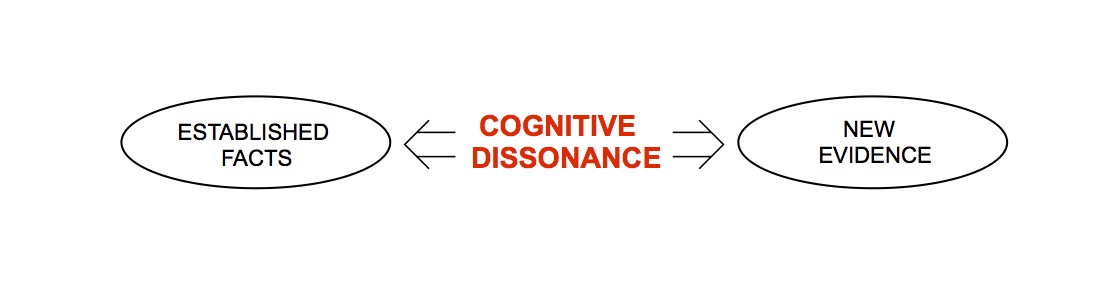
I get puzzled when I hear my graduate students confront me with the following: “You are saying something that totally contradicts what you told me about this problem x months ago”. Sometimes they get really upset about it, but I am at a loss! If I have indeed changed my point of view, I say, it is likely because I have been exposed to some new data that have changed my opinion. Isn’t it logical? In fact, I submit that we aren’t really scientists unless we constantly adjust what we think upon availability of new evidence that challenges our previously held views. But I have to confess: I am not always good at doing this.
 Image

While it is often possible to change one’s view, it is by no means a comfortable thing to do all the time. I would even go one step further and say that one of the common shortcomings of our reasoning is failure to reconcile new evidence that is in conflict with our strongly held views. This phenomenon is referred to as cognitive dissonance and it describes excessive mental stress when we are forced to hold two or more contradictory beliefs or ideas at the same time. The assumption is that we seek consistency between our expectations and reality. So we build a fortress of knowledge in a particular domain and consider everything there to be factual. When a contradictory piece of evidence is upon us, we have a natural tendency to dismiss it and find ways of convincing ourselves that there must be something wrong with the evidence. This is, of course, very dangerous. Here is a trivial example that happened to me before Christmas: I went to buy a new TV and I had a strong view that it is the plasma TV that I ought to get. When I was in the store and the sales rep listed several difficult-to-argue facts about the virtues of the LCD technology, I dismissed them and was looking for an excuse to brush off any argument aside (“this sales guy was kind of weird anyway, he was too pushy,” I said to myself). This unimportant encounter aside, I wonder how ready are we to accept evidence that destroys our cozy view or theory? There is a lot of food for thought here. So (I am talking to the students who run research projects), next time you come across an NMR spectrum that looks a bit odd and is nowhere near what you expected to get, do not put it aside and forget about it. Discovery is a study of conflict and I have seen it time and again in my own lab. The best students are able to get over cognitive dissonance and make interesting discoveries.

Unconventional cleavage

While solid phase peptide synthesis has reached impressive heights over the years, the predominant way of preparing peptides continues to be through the so-called C-to-N route. In this procedure, an amino acid is anchored to the solid support via its C- terminus. Subsequent steps amount to iterative coupling reactions with interspersed protection/deprotection steps. There are many advantages to the other mode of synthesis, which goes in the opposite direction: from N to C terminus. However, the corresponding methods are considerably less developed. I enjoyed reading the article published by Masurier and co-workers, wherein advances in the so-called pipecolic linker technology, were described. In the graphic below, I am showing a representative example showcasing this idea. To me, the most exciting part of this and related linkers is conceptual in nature. It is good to see methods that proceed through amide bond cleavage that is triggered by one of the amides (in this case, that of piperidine amide). This example underscores that under appropriate conditions, nearby amides can “bite” each other. For those of us who try to make peptides, this process is normally to be avoided. However, it can apparently be brought to good use. There’s something special about this pipecolic linker.

5http://onlinelibrary.wiley.com/doi/10.1002/chem.201201452/abstract

Paths less travelled

A lot of great science reported in the past was being pursued without an immediate application in mind. Earlier today, for reasons I cannot fully recall, I was thinking about a way of breaking the C-C bond of an epoxide. In doing so, I started reminiscing about some of Horst Prinzbach’s contributions to organic chemistry. Professor Prinzbach of Freiburg University has always been one of my scientific heroes, particularly after I met him some 20 years ago at one of the Loker Hydrocarbon Research Institute Symposia in Los Angeles. What stood out in my memory was Prinzbach’s paper published many years ago in Angewandte. In it, he and his students considered a thermally allowed [s2s + s2s + s2s] cycloreversion of a cyclic triepoxide that proceeded in good yields and selectivities. I am showing just one example below, but the scope is not limited only to epoxides. Mechanistically, this is one of those cases where it is easier to think of the microscopic reverse, rather than the forward process. You have to agree that the reaction shown below is not your mainstream epoxide chemistry.  Sometimes I wish chemists could continue working on problems that do not have an immediate application. Such challenges are self-fulfilling and are about pushing the frontiers of fundamental structure and bonding, rather than seeking an immediate application. Unfortunately, the synthesis community crossed that Rubicon a long time ago and there appears to be no way back to the “science for the sake of science” type of research… I do encourage you to think about how you would go about making the triepoxide starting material shown below. As you might imagine, this is not that straightforward!

Image

http://onlinelibrary.wiley.com/doi/10.1002/anie.197209421/abstract


Wrong things are not that wrong

Wrong ideas have contributed to the development of science in very significant ways. Take, for instance, the cyclol hypothesis. Dorothy Wrinch, a mathematician by training, has been the main proponent of this idea and advanced it rather ferociously. The book “I Died for Beauty” is a fascinating read. The centerpiece of Wrinch’s theory posits that protein folding results from covalent collapse of amides to generate cyclol-dominated structures. Below you can see a protein that has “folded” by way of cyclol formation (now all amide carbons are in their sp3 state). By the way, Dorothy Wrinch was a mathematician, which goes to show that one might want to be skeptical about a mathematiciain’s hypotheses related to chemical bonding, no matter how celebrated that person is. Indeed, any undergraduate chemistry student with knowledge of amino acid side chains should be able to run a “gedanken” (or “thought”) experiment and convince him/herself that it is not feasible to pack amino acid side chains according to the cyclol view of the world. But the theory had persisted until it was eventually discredited by Linus Pauling. While the cyclol idea was shown to be fundamentally wrong, its rejection had an enormous contribution to the discovery of hydrophobic effect. You can read about this in an excellent historical overview (see the link below). Image

http://www.ncbi.nlm.nih.gov/pmc/articles/PMC2143727/

Here is another twist: think about the green fluorescent protein (GFP). Maturation of its chromophore is due to a complicated cascade reaction that starts off a cyclol structure. Take a look below at how this happens. While here there are no multiple cyclol units similar to Wrinch’s folding idea, it is interesting that a significant protein (GFP) owes its function to a structure that has been forged through a covalent bond between two nearby amides. I think we should always remember Dorothy Wrinch!

Image