Uncorrelated properties

Association vs causation… While medicine is the domain of knowledge where one really needs to have a good grasp on whether or not two observations in question cause each other or are merely associated with each other, our daily forays in chemistry are filled with these same types of dilemmas, only the stakes are lower. Parsing out association from causation is where real science starts and ends. You might spend a lot of effort chasing after a parameter you think is important because your data analysis suggests that it is, only to find out that there is no causal connection to what really matters in your system.

Frustratingly, sometimes you know that you have no chance of establishing a causal relationship between two experimentally determined parameters, but you hope that there is at least an association. Then you find out that there can never be one because the two events are governed by uncorrelated properties. How frustrating is that? Here is an example that has to do with cyclosporine A, the molecule I mentioned a couple of times on my blog. Below you see its solution state conformation on top and the conformation in its bound state with cyclophilin, which is its cellular target (pdb code 2Z6W). It is easy to see intramolecular hydrogen bonds in the solution conformation. These linkages are the main reason for cyclosporine’s oral bioavailability. You do not see these bonds in the pose that corresponds to cyclosporine’s mode of action, do you? Indeed, all of the polar groups now engage the target. This is a frustrating end of science. You can learn all you want from this molecule and emulate its foldable polar surface area in your favourite macrocycle, yet when it comes to designing analogs to improve bioactivity you will be driven by entirely different considerations. How to avoid these sorts of pitfalls? Phenotypic screens, no doubt.fff

Something old and something new: boron-containing carbonyl compounds

Not long ago, we took a liberty to sum up the progress made over the years in the area of alpha-boryl carbonyl chemistry. I was asked to write a perspective on this subject, which meant that I suggested that my able co-workers Zhi He and Adam Zajdlik work on the manuscript. These guys did an outstanding job and the paper is now on the Dalton Transactions website. You might say: “Wait a minute, this is an inorganic journal, are you an inorganic chemist?” I tell you what: if there is one thing I learned from my one of my heroes in chemistry, George A. Olah, it is that divisions among the branches of science are artificial crap.

Coming back to the subject of our paper, I just want to point out that there are some really interesting examples of alpha-boryl carbonyls out there and I am showing them below. It is difficult to regard these intriguing reagents as the mainstream of chemistry as they are not, dare I say, bench-stable. But these molecules did pave a way to some of the ideas we are pursuing in my lab. I view all of the entries below as part of our honour roll as their often unusual structures attest to the imagination of chemists who conceived them. ooo

http://pubs.rsc.org/en/content/articlelanding/2014/dt/c4dt00817k#!divAbstract

The point of our Dalton paper was to sum up what had been done prior to our work on stable alpha-boryl carbonyl compounds and, of course, discuss our own inroads in this area. Unlike the O-boron enolates, which react primarily as nucleophiles, our C-bound tautomers contain an electrophilic carbonyl group next to the nucleophilic alpha-carbon. We like to refer to these molecules as kinetically amphoteric (to distinguish from the other type of amphoterism, which is driven by protons and is thermodynamic in origin).

Pretenders

Chemists are well familiar with the concept of umpolung, which describes a deliberate attempt to change the natural polarity of a functional group. Earlier today I was thinking about functional groups that “sneak” into known reactions and behave as if they were molecular components one is used to seeing in a particular process. These are not chameleons, and they are probably not even pretenders per se… But there has got to be a decent way of categorizing these functional groups. And, by the way, the title “pretenders” does not have any negative connotations. If anything, this is a compliment to a group that emerges as a replacement for something that is ingrained in the lore of a particular kind of reactivity. Take azide/alkyne cycloaddition as an example. The power of this process, and the reason it is likely to result in a Nobel Prize one day, is that azide and alkyne are considered to be unique in their orthogonality to almost everything out there, yet react very predictably and cleanly with each other under copper catalysis. Below is a case for a “pretender”, if you will. I refer to the phosphorous ylide molecule. The metal-free process you see allows one to make peptidomimetics containing triazoles as cis-amide bond mimetics. Among several notable features of this reaction, developed by Rademann and colleagues some years ago, is that it bypasses the need to use amino acid alkynes that are not always easy to make. For me, though, the most attractive feature of this chemistry is that identifies a functional group that does something that is “reserved” for another one.

hh

http://onlinelibrary.wiley.com/doi/10.1002/anie.200806390/abstract

Where the wild things are

I want to send a special thank-you to Professor Dean Tantillo of UC Davis (http://blueline.ucdavis.edu). In response to my call for molecules that are really odd, yet exciting, Dean brought up thiosulfoxides. Wow – these things are bizarre, aren’t they? Sulfur is like a box of chocolates, if you know what I mean… Take a look at the reference Dean sent me. Apparently, there has been a long-standing controversy with regard to which one of the two structures shown is actually the more stable one. The Schleyer paper below claims that the linear form is more stable. These are the outskirts of reality, they are here to show that there is little better than to be a chemist as nature has had very little reason to conceive such unusual structures. We’ll need to wait till Dean sheds some new light on this process. kl

http://onlinelibrary.wiley.com/doi/10.1002/jcc.540160410/pdf

Changing shapes

A fascinating study was recently reported by Hunter and colleagues in Angewandte Chemie. First of all, here is a bit of history. If you follow the classic work of Horst Kessler, you know that there is evidence-based model that suggests that the conformational preferences of a given cyclic peptide are dictated by the composition of its structural core elements. In other words, if you want to make a difference to a given molecule, side chains are unlikely to be of much use, unless, of course, you make bicycles, stapled peptides, and so on. But short of making drastic differences along these lines, what has really works well are changes in the absolute stereochemistry of the core residues. This way, one can really get profound structural changes.

The reason I enjoyed reading the Hunter paper is that it documents the effect of fluorine atoms (recall that famous guache effect) on the solution conformation of cyclic peptides. The authors used the natural product unguisin A as a model. The fluorine effect here can be traced back to what happens with dipoles in vicinal difluorides. The NMR analysis of NH chemical shifts (and a range of other parameters) led the authors to the conclude that the diastereomeric macrocycles shown below are drastically different in their conformation. You can see this in the patterns of intramolecular hydrogen bonds that I have indicated. This is a new strategy to change conformations of cyclic peptides. While I fully understand the challenges that are likely to arise if one intends to put this to wider practice (it is still not trivial to site-selectively introduce a fluorine atom into an organic molecule), this work is fabulous.

lll

http://onlinelibrary.wiley.com/doi/10.1002/anie.201403071/abstract;jsessionid

Some like it hot

Tonight I am happy to host my former student, Ben Rotstein. Ben is currently doing a postdoc at Harvard Medical School. I caught up with Ben in Boston a couple of weeks ago and was really glad that he agreed to write a guest post about his research, which I find not only fascinating, but also very applicable in the real world. Here is what Ben wrote:

“As my time conducting graduate research in Andrei’s lab was coming to an end, I was considering what sort of work I wanted to do in a postdoc and the idea of translational research, where I could apply the skills I had developed in organic chemistry to problems in other fields, strongly appealed to me. It’s no wonder then that I leapt at the opportunity to join Dr. Neil Vasdev’s nascent radiochemistry group in Boston, despite at the time having little familiarity with radioactivity or positron emission tomography (PET). Fortunately, Neil and my colleagues here took the time to teach me about these things, and I can now tell you about some exciting work that we have recently published.

Carbon-11 along with fluorine-18 is a mainstay of PET radioisotopes suitable for small molecule labeling. With a half-life of only about 20.4 minutes, any radiochemistry using this isotope is a bit of a race against the clock, especially if there is an imaging study planned for the product. Most radiolabeling with carbon-11 uses [11C]methyl iodide or triflate to make methyl ethers, esters, amines, or sulfides. These are all multistep processes, since one usually takes [11C]carbon dioxide from the cyclotron, reduces it to [11C]methane, and then converts that to [11C]methyl iodide. (The square brackets stand for “no-carrier-added”, which means we do not add any nonradioactive CO2 to the process, though there is always some present anyway.) Our group tries to develop chemical methodologies to use [11C]CO2 directly from the cyclotron for labeling, without resorting to strong organometallic bases such as Grignard reagents or alkyllithiums. These methods avoid inefficient chemical transformations of our radioactive reagents and also allow us to label a wider range of functional groups, particularly carbonyls. You can see a review we published on this last year at the link below.

http://xlink.rsc.org/?DOI=c3cc42236d

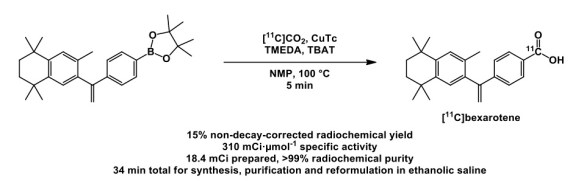
Our most recent contribution in this field uses a copper-mediated reaction for C-11C bond formation starting from [11C]CO2 and an aryl boronic ester to produce aryl carboxylic acids. It is important to note some of the differences between radiochemistry and “cold” chemistry with CO2. While many metal-catalyzed CO2-fixation reactions have been developed, most of them are run at high pressure. With [11C]CO2, this is not very easily done, since when we “scale-up” we are still working with well under 1 nanomole of 11CO2. We also need to have efficient trapping of [11C]CO2 in solution so the choice of an appropriate base that is also compatible with the labeling reaction is essential. What’s more, since the entire process should be done quickly and we prefer automation to “hands-on” manipulations, our purification usually consists of semipreparative HPLC and solid-phase extraction. We need these to be efficient and to limit the total mass of stuff used in the reaction. A good radiolabeling reaction is only part of the battle and does not necessarily amount to a practical method that can be used for PET imaging.

The molecule we chose to label is an approved retinoid drug called bexarotene. About two years ago, bexarotene was shown to clear cerebral amyloid plaques in a mouse model of Alzheimer’s disease by activating APOE. This represents an intriguing mechanism to exploit towards therapies for dementia. Accordingly, some families suffering from dementia rushed to get the drug for off-label use, and a clinical trial is also planned. However, it has not been established that bexarotene can cross the human blood-brain barrier, and the highly lipophilic structure suggests that passive permeability would be unlikely. For our study, copper-mediated [11C]CO2-fixation allowed us to prepare [11C]bexarotene suitable for PET imaging to evaluate drug biodistribution. You can find more details in our paper at the link below.”
rrr

http://pubs.acs.org/doi/abs/10.1021/ml500065q

Dream chemistry

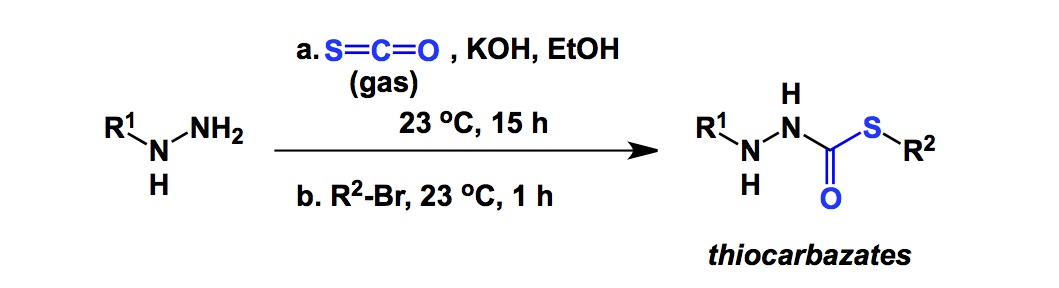
My list of weird functional groups grows by the day. I really do love this list and intend to write a review on the subject at some point (after we are done with all the other papers in the pipeline, which will be in… OK, forget it, this is too daunting…). To my liking, the stranger the functional group and the more esoteric it is – the better! Here is the one I read about today – a thicarbazate… I ran a quick search and, not surprisingly, there are only about 16 papers that deal with this concoction of heteroatoms. The reference I have added below describes a medicinal chemistry effort that has put thiocarbazates to good use by exploring their involvement in the synthesis of cathepsin L inhibitors. The molecules prepared by Smith, Huryn, and co-workers are meant to mimic the presentation of substituents in cathepsin L’s peptide substrates. Take a look at the synthesis – I am sure handling COS gas is a delightful lab experience.

Image

http://www.sciencedirect.com/science/article/pii/S0960894X08004563

OK, I can’t write anymore as my hands are trembling from all the fireworks outside. People in suburban Oakville sure know how to party. Happy Canada Day, everyone!