Encycle is now a verb

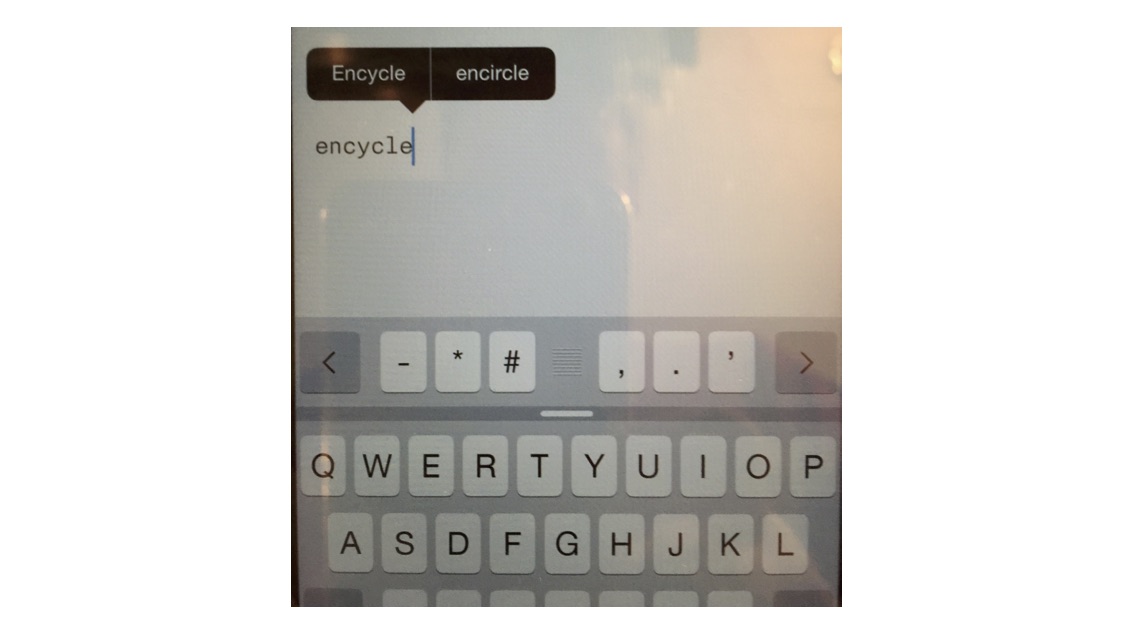
Here is a funny little correction I obtained when I tried to type the word “encycle” into my iPhone last week. Of course, this word does not exist and “encircle” is what iPhone wanted me to use. Correction! “Encycle” had not existed until about two years ago, which is when we started this science-driven drug discovery firm here in Toronto together with MaRS Innovation.
2

I want to emphasize that Encycle is very much a science enterprise that targets synthetic macrocycles and attempts to understand their drug-like properties. And, while my iPhone still corrects me as I type, Encycle’s drug discovery program is gaining momentum. I tip my hat off to Encycle’s CEO, Dr. Jeff Coull, Dr. Andrew Roughton (VP of Operations), and Dr. Jen Hickey (Group leader), who form the core of Encycle’s day-to-day management. Now we even have an outlet in Montreal, wherein the beginnings of a vigorous research program are being created. I would be remiss to omit the contributions of Professor Eric Marsault’s team of the U. Sherbrooke. Eric has been instrumental in our recent push to amass a collection of macrocycles using aziridine aldehydes. I am also very grateful to our collaborators from Merck, Pfizer, GSK, and AstraZeneca. These guys have made many tangible contributions to Encycle’s program.

If you want to see how serious we are about science – just take a look at Jeff Coull’s graduate work (below). This is one of his Nature papers from grad school (cited 674 times, which is not too bad…). Despite the fact that he is not a chemist by training, Jeff really understands what science is all about and is steering Encycle in the right direction. In fact, it is the synergy between different disciplines, including pharmacology, that will be key to Encycle’s future.

http://www.nature.com/nature/journal/v438/n7070/full/nature04223.html#close

In closing, I want to thank Marilyn Smith of the San Francisco-based Biocentury, who let me post a pdf file of a publication that appeared in Nature’s SciBx collection about a week or so ago. The piece was written by Mike Haas. I love the title, which suggests that my modest contamination of the English language is now a verb. The article details Encycle’s collaboration with Merck and also mentions the term “nacellin”, which we use to describe our macrocycles. You might wonder: why is that? Well, true to its name, “nacellin” refers to a molecule which, akin to a nacelle (French for “cradle”), protects its delicate polar groups from solvation/desolvation processes. I thought this word would be appropriate to describe what we are ultimately attempting to accomplish, which is why we use it.


Merck Encycles

Holistic properties

There are a few things that truly irritate me. When I go to McDonald’s (which happens about once a year), there is always that sheet of paper that sticks to my tray when I try to clean it at the end of the meal. It takes that extra second or two to get rid of the annoying sheet, yet it is enough to make me regret the whole experience. I can also mention the scarcity of holistic properties in our day-to-day science endeavors as something I am not happy about. When it comes to measurable properties that characterize a given molecule as a standalone entity (this is why I call them “holistic”), we do not have a lot to brag about. A melting point is holistic, although it is a bit low-tech. Really, there is not much a melting point offers by way of insights that can be translated into structural terms. A melting point is still an immensely important parameter that enables us to evaluate compound purity, but it is a bit primitive. As far as holistic properties that provide structural insights of some detail, I can only think of circular dichroism (CD) right now. If you have a peptide, its CD signature will quickly allow you to judge the relative amount of alpha-helix or beta-sheet contribution to the overall structure. Don’t get me wrong, “non-holistic” properties can be exceptionally important and useful. Techniques such as NMR allow us to view a given molecule as a collection of functional groups, which is a powerful abstraction. Having said that, I wish we had more holistic properties in our disposal, the ones that provide a snapshot of a molecule as a whole, preferably with a nice and teachable curve.

eee

Immolative strategies

Here is something we do not hear a whole lot about: immolation of atoms during synthesis. This happens when an atom literally disappears into thin air. Once a sigma bond that used to connect that atom to its neighbor is gone, a cationic center is installed. I am not talking about your classic Sn1 chemistry, by the way, as there are no remnants of any leaving group in solution. The leaving group just valishes. If you think this is some kind of gibberish, I can tell you that I am describing quite a nice way to synthesize carbocations and later trap them with nucleophiles. The link below takes you to an old review by Speranza in which he talks about this process.

55

http://pubs.acs.org/doi/pdf/10.1021/cr00024a010

The reaction amounts to radioactive beta-decay that is accompanied by helium release. By the way, this remarkably effective and barrierless C-H activation (well, it is C-T activation, I suppose) is catalyst-free as well. You are probably noticing that I have paid a tribute to those practitioners of synthetic methodology who, for reasons unbeknownst to me, continue to “beat the drums” as they free reactions of some key components. I salute them all here by giving them a reminder of leaving group-free Sn1 reactions. I suppose that the only thing that would have made it more appealing from their perspective is if the reaction above had been “green”. But, alas, folks are happy with neither beta-decay nor tritiation.

Linchpinning into the U.K.

Jeff St. Denis, pictured below, recently defended his fine PhD thesis and left behind a huge void. Our operations have benefited greatly from his expertise and we will miss his burly disposition. Jeff is a big guy, with a super strong arm, which might have turned him into a professional baseball player had he not chosen chemistry as his favorite pastime. Seriously – Jeff was heavily recruited into baseball while in college, but then something clicked and I became the beneficiary of his career choice. Jeff’s thesis turned into a clinic for how to pack useful functional groups into dense areas of space and turn them loose. Earlier this week his paper appeared in JACS. Below is a link. You will note that Joanne Tan is on this work as well, which is quite a story in its own right… Talk about raising the next generation of students! Joanne, who was trained by Jeff in the area of synthetic linchpins, started with us this past September and already made a big difference. There are other great folks on this paper – Adam, Piera, Frank, Shinya – who, together with Jeff, created a platform that now allows us to build small molecule fragments faster. You might ask: “Which fragments?” and I would tell you: “Hold on a bit, you will soon see crystal structures that show how some of the molecules which we have developed interact with proteins”. These are the fruits of our collaborative efforts with the SGC (Structural Genomics Consortium). These interdisciplinary studies aside, our research continues along the trajectory of a relentless pursuit of unusual intermediates in synthesis. In Jeff’s case, we have been exploring the chemistry of boron-containing enamides and found a way to stitch together oligoheterocyclic cores with notable efficiency. What’s next for Jeff? He just got a job at Astex (http://astx.com), a pioneer in fragment-based drug discovery. Jeff apparently did really well in his interview when those Astex folks flew him over to Cambridge, UK. I wish Jeff and his wife Megan the best of luck over there. It is nice that there are still cool job opportunities for freshly minted PhDs.

jeff1

http://pubs.acs.org/doi/abs/10.1021/ja510963k

Bridges that drive me crazy

There is a staggering amount of oxidants out there and their use in synthesis is very context-dependent. The redox potential reachable with a given oxidizing agent is the differentiating factor – one that establishes a unique footprint on molecules that act as electron donors. We had a series of student talks here at U of T earlier today and I was very intrigued by the lecture on hypervalent iodine derivatives by Brendan Peters of the Lautens lab. I thought I knew a lot about oxidants, but when I saw sodium perborate (commonly drawn composition: NaBO3), I realized that there might be a gap in what I know about its exact structure. This reagent is well suited for turning aromatic iodine derivatives into their oxidized forms. I looked things up later in the day and, as it turns out, the structure of NaBO3 formally corresponds to the dimer of two “O=B-O-O” derived units. The peroxide bridge is where this salt holds its oxidizing “mojo”. I started digging a bit deeper and looked for any structures with a B-O-O-B bridge. It turns out that not much is known! However, this is where I am weaving my story all the way back to last week, when Professor Warren Piers of the University of Calgary visited us and gave a superb talk on some novel iridium chemistry. He will probably kill me if were to disclose the unpublished work carried out in his lab, but I will not do that. Let’s keep amphoteros a respectable establishment. Instead, here is a published account from Warren’s recent past and it comes full circle to what I was fascinated with this morning when I pondered over NaBO3. It turns out that Warren published an awesome reaction that features a boron-based peroxy bridge, although in a completely different context. Judge it by yourself below, but I think this is super cool. After I read Warren’s piece, I went back to Scopus and searched for more papers specifically dedicated to sodium perborate. After 10 seconds I realized that all 800+ of them come from dentistry-related journals (toothpaste…), which reminded me about the bridge I got earlier this week after breaking one of my molars. At this point I am done with searching and will get ready for the ChemClub Christmas party, wherein I plan to forget about my pains while sipping one of them tasty Leffe beverages (remember Samuel L. Jackson in Pulp Fiction?) at the Beergarden.

gg

http://onlinelibrary.wiley.com/doi/10.1002/anie.200901217/abstract

Back to the basics

The field of physical organic chemistry has seen its ups and downs. Who can forget the foundational experiments done by Jack Roberts some 60+ years ago? These studies clarified the benzyne mechanism of nucleophilic aromatic substitution, which is one of our textbook favourites. This was certainly among the highlights in the illustrious history of this area of inquiry as researchers pushed the envelope in everything ranging from clever experimental design to the development of new spectroscopic tools. There were also a number of downs, one of the most notable ones going back to the 1970’s, when there were literally whole volumes of JOC dedicated to the non-classical ion problem. I do not mean any disrespect to this tremendously important area, but the funding agencies stopped funneling money into physical organic chemistry once they realized that the community went a bit too far in its overzealous focus on one set of problems.

taunton

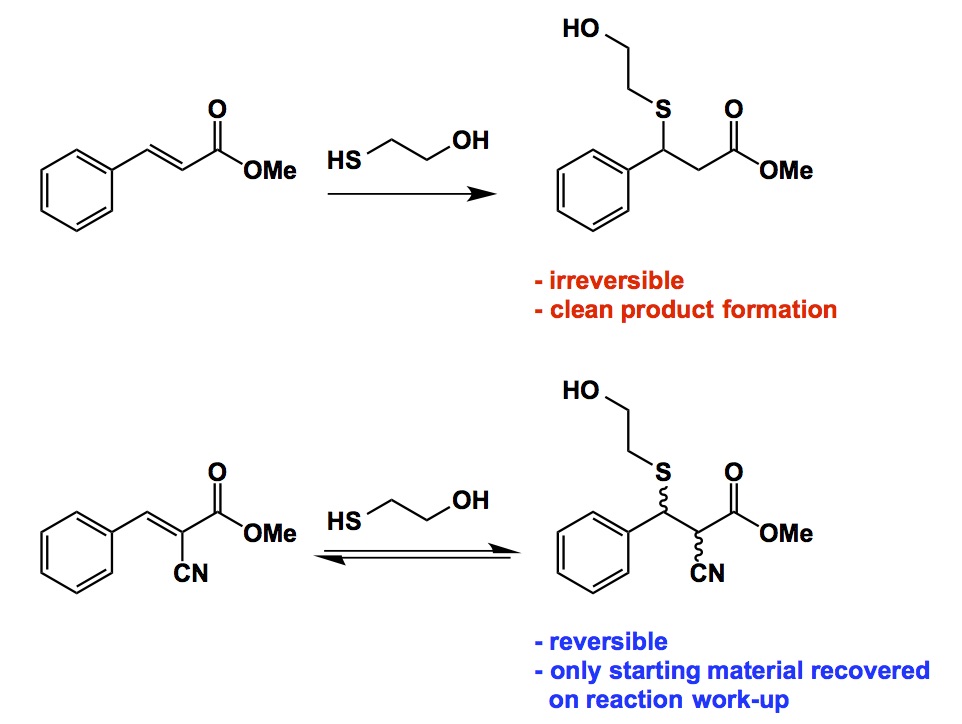
What I like are the papers in which foundational concepts rooted in physical organic chemistry of the type we teach in our chemistry courses are put to good use in chemical biology. There are many reasons why this is so and, honestly, the primary one is educational in nature: it is easy to tell students that, if they understand conjugate addition (for example), they would be able to rationally design bioactive molecules. On this note, here is a great paper in Nature Chemical Biology by Jack Taunton of UCSF. Take a look at the two acrylates shown above. As Jack points out in his paper, it is somewhat of a paradox that the nitrile functionality increases the reactivity of the electrophile, yet eliminates the formation of irreversible adducts with cysteine. On the basis of this nitrile-driven reactivity difference it was possible to design slowly dissociating covalent inhibitors of RSK2 kinase (pdb 4D9U
, below). This is the physical organic chemistry that I like…

uu

http://www.nature.com/nchembio/journal/v8/n5/full/nchembio.925.html

Let there be light

There has been some really creative photochemistry coming out of the Kutateladze lab at the University of Denver. I particularly appreciate their approach to highly reactive dienes using photochemical irradiation of aminoxylylene precursors tethered to pyrroles. Irradiation leads to photoinduced tautomerization, which in turn triggers the Diels-Alder cycloaddition shown below. I have drawn a representative example in which an alkaloid-like system is zipped up under UV irradiation. It is interesting to note the effect of concentration on the efficiency of this step. If you read the experimental procedure, the reaction is 0.16M in substrate, which is rather practical for a photochemical process. Another feature of this sequence is that the enamine formed during the Diels-Alder step can be trapped by tosyl azide. I don’t know about you, but I am impressed by the fact that photochemically labile tosyl azide is not leading to any unwanted premature reactions. The rationale for this curious finding is that sulfonyl azides do not absorb above 350 nm, which is why they are not affected by the irradiation at 365nm.

2

http://pubs.acs.org/doi/abs/10.1021/ja4042109

To beat a hydrogen bond

As the peptide community keeps talking about intramolecular hydrogen bonds and their significance in enforcing conformations that are pertinent to passive membrane permeability, it is useful to look at examples in which hydrogen bonds are directly involved in explaining the reactivity of a given compound. The chemistry that comes courtesy of Storz and co-workers (see the graphic below) is a testament to the importance of maintaining the right charged state in order to ensure acceptable chemoselectivity of acylation. One can extrapolate this further and reasonably conclude that pH might play an important role in dictating conformations of complex molecules such as cyclic peptides. It is also feasible to expect that pH-dependent conformations will be observed in many cases, particularly if tertiary amines are present in a macrocycle. One can anticipate that pH-dependent conformations might create a nightmare for this class of compounds during biological investigations. For example, I can bet that there will be reproducibility issues in many assays (we have already seen this behavior with our macrocycles). Oh well. I’d rather not think about it anymore and instead concentrate on the bottle of Bordeaux I am about to open for dinner…

55

http://pubs.acs.org/doi/pdf/10.1021/op0601464

Amino acid modifications: lab scale-up

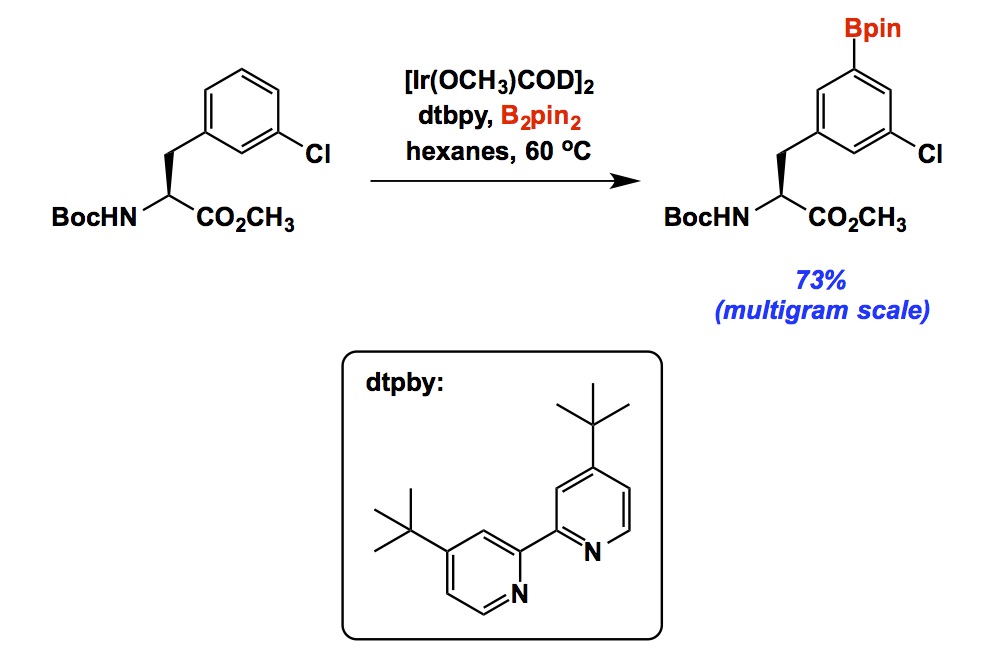
The question of late-stage modification of amino acid residues is the kind of stuff that interests a lot of people. In this regard, it is exciting to see studies in which C-H activation is accomplished in meaningful contexts, which to me implies that such reactions tolerate fairly polar amide functionalities. I am really interested in the chemistry that recently came out of John Hartwig’s lab at Berkeley. This is the kind of C-H activation I enjoy reading about because it is also scalable. To prove my point, here is an implementation of this methodology by Keith James and co-workers at the Ferring Research Institute in California. I heard Keith speak about this process during the ACS meeting in Dallas last Spring. The multigram scale on display here is what’s particularly impressive. As Tony Montana (from “Scarface”) would say: “That I like!”. The reason there is a need to block one of the meta positions in the starting material is to avoid low selectivity, of course. This is a powerful transformation and I wish there were more examples of scalable C-H reactions of this kind…

tt

http://pubs.acs.org/doi/pdf/10.1021/ol1015674

Using peptides to charge batteries

I just boarded the Westbound Toronto-Hamilton train. My battery is about to die, but I hope there will be enough juice to finish this post up. Fittingly, I plan to talk about… batteries. While attending the editorial board meeting of OBC last week in London, my wife and I had a chance to spend time with Kyrill, my old friend from elementary school days. Kyrill got his degree in economics back in Moscow and now lives in London. In fact, he literally lives in a building behind Westminster Abbey, which is a superb location. Now… I rarely have meaningful conversations about science with my non-chemistry friends. For instance, they keep asking me: “Hey Andrei, have you invented a new element?” What do you say to something like this? It used to drive me crazy, but I eventually found a way to counteract. In a recent chat with another one of my school buddies, Sergey, I asked him in response: “Have you invented a new octave?” He is a musician, and he got really irritated when I said it. Seriously, though, we do need to find ways to communicate science (or music) to those who do not have technical expertise… I am not great at it and I fully admit it. What’s remarkable is that, once in a while, I hear about some amazing advances in science and technology from unexpected sources. In this case, it is Kyrill. Last week, after one too many Lagavulins, Kyrill asked me about my current interests. Amongst other things (as far as I can recall), I told him something about peptides. This morning Kyrill sends me a link to StoreDot (http://www.store-dot.com). This Israeli start-up, backed by Roman Abramovich (the owner of Chelsey FC), has developed technology that allows one to charge his/her laptop or cell phone in a matter of seconds (http://www.mirror.co.uk/news/technology-science/technology/charge-your-mobile-phone-30-4687363). The most interesting thing is that this nanotechnological advance is enabled by peptides. The prototype is not yet ready for primetime, but it is on its way. All of this goes to show that you really never know what you are going to learn from your non-scientist friends. I now need to investigate the origins of this technology. Plus, it will be interesting to see if the inventors could come to our American Peptide Symposium next Summer. I think that a lot of people will be keen to learn about the role of peptides in batteries. For now, though, I need to be mindful of my train stop, which will hopefully come before my laptop battery dies.