Stereoelectronics of ester hydrolysis

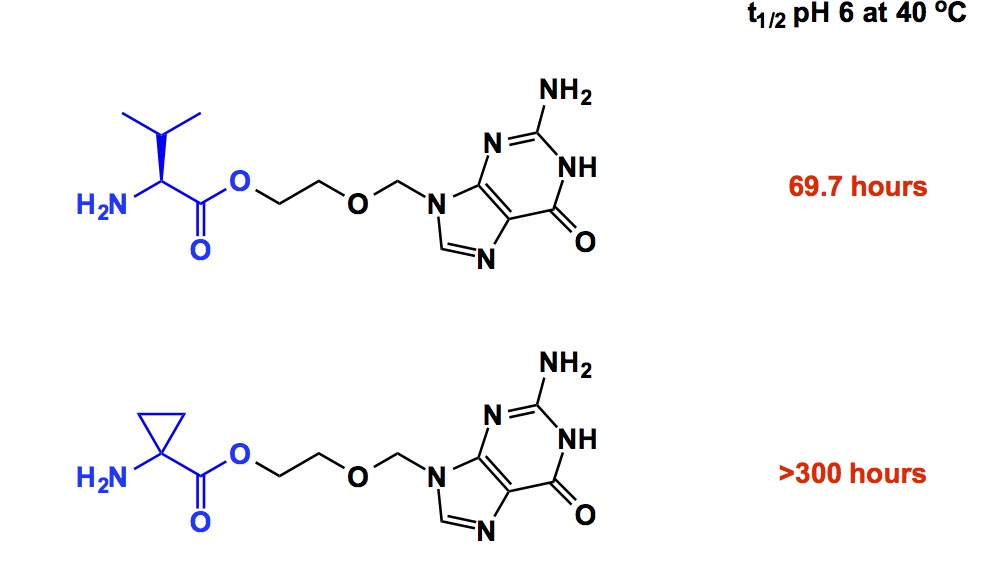
The stereoelectronic effect is behind a massive number of molecular properties, one of which is the propensity of certain groups to influence carbonyl reactivity. Some time ago, Houk and colleagues clarified the influence of cyclopropyl substituents on the pro-drug properties of esters. The half-lifes shown below are experimentally determined and speak for themselves: there is a profound effect of the cyclopropyl group on ester stability. But the main reason for my post is to bring up the value of isodesmic equations in evaluating relative reactivity (see Table 3 of the Org. Lett. paper). This straightforward tool is simple and effective in efforts to rationalize the role of neighboring substituents when a HOMO/LUMO interaction is evaluated. In the present case, the 2 kcal/mol stabilization of the cyclopropyl ester compared to the isopropyl one arises from hyperconjugative donation from the cyclopropane group into the pi*(CO) orbital. I think we should use this tool way more in our work (as we assess which molecules should be made and which ones should remain on our whiteboards).

yty

http://pubs.acs.org/doi/abs/10.1021/ol702892e


Our place on a continuum

Earlier today, during a day trip to Merck’s Kellingworth site in New Jersey along with Drs. Andrew Roughton and Jeff Coull of Encycle Therapeutics (http://www.encycletherapeutics.com), I kept thinking about the ever-expanding breadth of molecules big pharma is going after these days. We are indeed living in interesting times. Merck, which has been a citadel of small molecule chemistry for a number of years, is one of the major companies actively pursuing therapeutics that have traditionally been outside their focus. It is comforting that a full arsenal of tools – small molecules, peptides, macrocycles, antibodies – are being routinely deployed in efforts to go after targets of ever-increasing complexity. On the New Jersey side, Dr. Yusheng Xiong (Director, Medicinal Chemistry) was our host during this visit. We had a chance to talk about a gamut of options to bear on Merck’s targets of interest (I hope I will be able to discuss this at some point on this blog). Some time ago I formulated a position that seems to resonate with our industry colleagues. In brief, I like to think about a continuum of molecular sizes that exist in our daily pursuits. The way I illustrate it in my talks is by showing the following graphic:

trt

A protein of some significance (shown on the right) is usually our target, but the options we use range from small molecules to substantially larger macrocycles. The way I like to put this into perspective is to say that when we interrogate proteins with small molecules, we are drawn to the relative simplicity with which we can modulate enthalpic interactions. The middle ground in this continuum is occupied by macrocycles, which represent an intuitively clear connection to entropic penalties accrued in a protein/protein interaction. There indeed appears to be a certain entropy-centric “gut reaction” chemists have when they look at a macrocycle. This way of thinking becomes particularly meaningful when there is a need to “freeze” parts of a protein secondary structure.

I do think there is a conceptual continuum of sizes. I am also convinced that there is no need to be dogmatic about compartmentalizing oneself into a comfort zone in a narrow part of the spectrum. All options need to be deployed at the right moment. During our visit it was also great to interact with Tomi Sawyer of Merck, who was the head of chemistry at Aileron until not long ago (the stapled peptide company started by Greg Verdine). Tomi will be one of the lecturers at the American Peptide Society Meeting I am putting together with Ved Srivastava of GlaxoSmithKline (http://aps2015.org). I can’t wait to hear about Merck’s latest accomplishments.

Thank you, Yusheng, for a day full of insights!

Some news from London

Over the past several days I have been in London, England, where I attended the Fall Board Meeting of Organic and Biomolecular Chemistry. Richard Kelly, the Managing Editor of this RSC publication, has put this meeting together in the Mayfair district of London. Jeff Bode (ETH, Zurich) is stepping down as the Board Chairman and I will be taking over his responsibilities from January 2015. I have to tip my hat off to Jeff for his leadership over the past several years. I have thoroughly enjoyed my role of one of the Associate Editors. The difference now will be that I am no longer going to handle manuscripts, but will instead oversee some strategic areas for growth and improvement. I think this will be very exciting. Earlier this week, I had a lot of fun together with Jeff as well as Ashraf Brik of Ben Gurion University, Margaret Brimble of the University of Aukland, Tony Davis of the University of Bristol, Jonathan Clayden of the University of Manchester, Pauline Chiu of the University of Hong Kong, and Paolo Scrimin of the University of Padova. Unfortunately, Jin-Quan Yu of Scripps was not able to make it to this meeting. Along with Margaret and I, Jin-Quan is one of OBC’s Associate Editors.

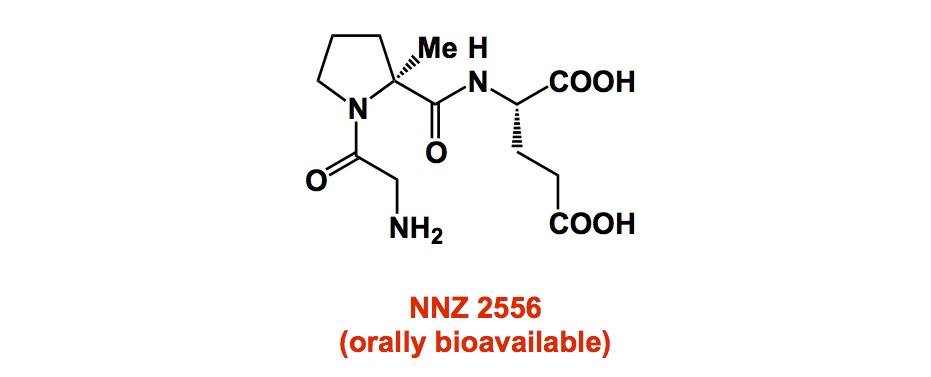
In terms of chemistry, I actually wanted to share something that relates to the work of Margaret Brimble (she flew in all the way from New Zealand to meet us). Margaret brought along some exciting news: NNZ-2566, a molecule developed as part of a collaboration between her lab and Neuren Pharma, was recently approved by the FDA, which has granted orphan drug designation to NNZ-2566 for treatment of Fragile X Syndrome. This tripeptide also demonstrates neuroprotective efficacy in models of traumatic brain injury such as concussion. Evidently, the U.S. Army is very interested in NNZ-2566, although not much is known about the mechanism of action of this exciting compound. What I found remarkable is that the tripeptide is orally bioavailable. The C-methyl proline residue makes this molecule considerably more stable than the corresponding non-methylated congener. The methyl group really “messes up” with the nearby amide bond, which apparently drives the logD down and improves the pharmacological profile of NNZ-2566. I have always thought that there is something special about C-methylproline…

uy

http://www.neurenpharma.com/irm/content/nnz-2566-in-rett-syndrome.aspx?RID=330

Macrocycles and what I think about them

This past Summer I was asked by the Editorial Board of Chemical Science to write a Perspective on macrocycles. At first I was not sure what I would do because there were so many detours I could have taken (from synthesis all the way to applications). No matter how hard I wanted to narrow in on one theme, I ultimately decided to focus on the evolution of this exciting field, using various landmarks to weave my story around. I chose to talk about many different, seemingly unrelated, subjects that bear on macrocycles as a class of molecules with tremendous upside in drug discovery. Overall, this turned into a fun exerience. As they say in Russia “anything new is a well-forgotten past,” which is certainly a good thing to remember when looking at a field of research that is interesting to so many people. One of the attractive things about a perspective is that its author is not expected to be comprehensive. The choice of material is up to you. Deciding on interesting examples is what I did on my train rides from home to work over the past several months as I was writing this paper. You will note that I am the only author. I suppose this is something that is much easier to do nowadays with software such as Papers3 that allows one to nicely organize manuscripts. I also think that it is also appropriate to write papers without graduate students or postdocs once in a while, especially when it comes to opinionated pieces. Actually, I think that perspectives should ideally be written by one person, otherwise the whole point is not entirely clear. I love writing papers with my students, but I also found this solo business to be satisfying. As a prelude to this work, I would offer this: it is really tough to control the so-called chi-space, the one that defines conformational movement of side chains. There is a big irony in overemphasizing the significance of new ways to form macrocyclic ring structures: these studies offer constraints over phi and psi dihedral angles, but they provide little towards control of chi-space, which defines the orientation of side chains. Many of the problems I have outlined in my article can be fixed if synthetic chemists think more about how to modify the existing rings, understand their conformational preferences, and control side chains in effort to make bioactive structures for protein targets.

yyy

http://pubs.rsc.org/en/content/articlelanding/2014/sc/c4sc03089c#!divAbstract

On reasonable C, N ratios

Carl Christie of the Edwards Airforce Base is one of my science heroes. My fascination with his work is due to his mastery of highly explosive molecules no one should be making in the right mind (but he does). I also love his fluorophilicity scale to rank Lewis acids, which is something that is both practical and interesting.

Take a look at one of the classics he published a while back together with Olah and Prakash: http://pubs.acs.org/doi/abs/10.1021/ja9714189. This paper talks about the structure of triazidocarbenium ion stabilized by the perchlorate anion… When perchlorate stabilizes an azide-rich ion, you know something special is in the air. What can be better? Perhaps a version of this compound (also made by Carl as I recall) that has azide as the counterion. This is even more exciting. This corresponds to CN12 stoichiometry and is not for sissies, so don’t try this in the comfort of your own fume hood. I recall a story from one of Carl’s former postdocs, Dr. Robert Gnann (who is turning 50 this year, by the way) in which he described violent decomposition of a crystal of one of these derivatives in an oil-filled X-ray capillary. Imagine a nice shiny object slowly descending down the glass tube and touching the bottom…

The exotic molecule mentioned above teaches a lesson that there is a fine line in the nitrogen-to-carbon ratio you do not want to cross. Perhaps CN12 is a bit extreme, though. Tipping the balance in favor of nitrogen is bad and is a well-known issue with organic compounds. As part of the material for my 4th year class, I was wondering if there are natural products that contain scaffolds in which there are more nitrogens than carbons. You might say – who cares? But this is the kind of stuff I like to think about… Interestingly, there is a very peculiar case of fluviol A. A total synthesis of this molecule was reported by Ross Kelly and colleagues in 2006. The synthesis features some awesome hydrazine chemistry, which I am a big fan of. So there you have it: Mother Nature has crossed the “C,N ratio” line too. I am not suggesting fluviol A is explosive, though. Maybe Mother Nature tried even higher ratios in other contexts and the corresponding molecules did not survive (no pun intended) the pressure of evolution. pop

http://pubs.acs.org/doi/abs/10.1021/ja060937l

Poking with phosphorous

Synthetic chemists have developed some nifty tricks to design catalysts that promote chemical transformations. Many of the corresponding reactions used to be close to impossible even a few years ago. But let’s just think about it one more time and address a question of whether or not we are better in catalysis than our biological colleagues. This is where it gets a little slippery. When we teach the foundations of catalysis to our first year students, we tell them that a catalyst lowers the transition state barrier of a reaction. It follows that, in order to design a catalyst for pretty much anything, one needs to think about ways to lower the transition state barrier. But let me ask you: how many times do you actually think about exactly what I just said? If you are a chemist who has been active in the area of catalysis, can you, in good faith, look at yourself in the mirror and say that you have designed a catalyst “ab initio” (I do not mean computation, I simply mean “from first principles”, as this latin term implies)? We draw intermediates, starting materials, and products. However, it is not easy to think and imagine what ironically appears to be the most important component in catalysis – the transition state. I seriously cannot think of one decent example. We think about substrate binding, we think about sterics, and we indirectly imply that we are “poking” at a transition state, but we never explicitly worry about that highest point on the energy landscape when we design catalysts. In this regard, enzyme chemists are way ahead of us. Think about the so-called transition state analog for a second. There is no such thing in small molecule catalysis, is there?

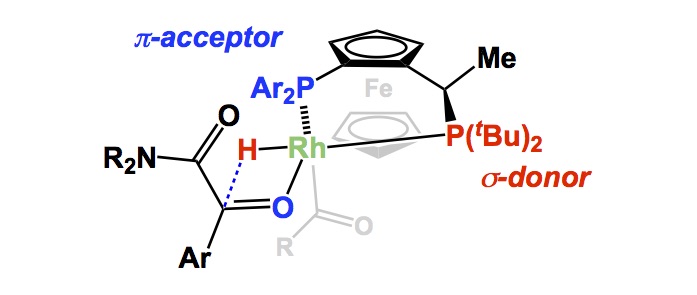
Earlier today, my good friend Professor Vy Dong was in town, to attend the PhD defense of her student Kevin Kou (sorry – Dr. Kou). Vy is now at the University of California, Irvine. Kevin gave a great talk, where he showed his mastery of catalyst design. I was particularly intrigued by some of the mechanistic details that suggested that the so-called trans effect was at play in his system. Below you can see the rationale for the observed catalytic efficiency: there is a nice electronic differentiation of the two phosphorus centers in the ligand, which is translated into the observed modulation of activity at the two sites where the action is taking place (I refer to the nucleophilically activated hydride and the electrophilically activated oxygen atom). Examples such as this offer a glimpse into the modern tools accessible to catalyst designers. I still note, though, that the techniques we have in our disposal do not (yet) allow us to design catalysts based on the definition we give in our first year chemistry classes. I am going to chuckle next time I tell my students “….a catalyst is a molecule that lowers the transition state barrier of a reaction...”.

Great job, Kevin!

gg

http://pubs.acs.org/doi/pdf/10.1021/ja504296x

Know-how and the concept of competitive differentiation

Earlier today, I heard some insightful student talks at the annual Québec-Ontario Minisymposium on Synthetic and Biological Chemistry. This year, the conference was organized by Professor Russ Viire of Ryerson University in Toronto. As I was listening to the lectures, I kept thinking about an issue I wanted to write about for a long time. I just could not properly verbalize it thus far, but here is an attempt to propose a new approach to shaping the careers of students who study synthesis and synthetic methods.

I was brought up to believe that the most important thing in a synthetic method is its “broad applicability”. There is this unwritten rule in academia about assigning the highest value to reactions and processes that are “practical”. I think you would agree that it is Barry Sharpless who started it all by ensuring that his reactions could be carried out in a very straightforward fashion and with great ease. This is important, but let’s go deeper. At a research university, professors are doing science in close collaboration with graduate students and postdocs. Therefore, the emphasis on “broad applicability” must be relevant to our students. But why is this necessarily important from their perspective? What a radical question! No one ever asks it. Putting aside the much-needed and useful cross-fertilization with other academic labs, the focus on practical reactions has been a consequence of our historical reliance on the pharmaceutical industry, who used to hire our students and would pad us on our backs, encouraging us to come up with reactions their chemists could use. There are even some folks who used to tell me “Andrei, if you develop a good reaction, we will use it, so do not patent it.” Oh yeah? Thanks. It is nice to feel needed…

You know that things are very different in the pharma sector now compared to the years past. For one, they hire way less than before. The jobs are there for our students, but these are not the same types of jobs. So why is it that we owe anything to these companies? Why is it that the validation of our work must come in the form of ensuring that reactions that come out of our labs could be widely used by their scientists? Give me a good reason. In fact, there is an argument I can make that, in this day and age of alternative (and often very exciting) career paths for our students, they ought to think about competitive differentiation. This entails pursuing one’s ideas and stressing the importance of know-how that emerges from one’s efforts. In other words – why not make yourself more marketable by developing a method or technique that requires specialized knowledge others would want to have, but would be unable to get out of papers? I am particularly convinced that this is an important part of one’s education because there is a very curious contradiction when I put on my hat of Encycle Therapeutics’ founder and talk to investors. These discussions are all about the so-called competitive advantages. It is amusing that negotiations with investors are dominated by their interest in technologies that cannot be readily replicated and require complex patents. This is diametrically opposite to what we preach to our students by continuing to imply that truly practical processes ought to be the pinnacle of their work (by the way, I am sick of reading the wording “broadly applicable”, even though my own lab uses it on occasion). And when it comes to listening to lectures, I really do not care how broadly applicable a given process is. All I want to see and hear are exciting scientific questions that are being pursued. By the way, I am not discarding the importance of practical reactions. I am just trying to remind people that this is not the only game in town. Science is indeed vast. Plus, we ought to keep in mind the big irony: unless something drastic changes, the emphasis on practicality as the metric of success is dated and goes back to when academics naively thought that their mission in life was to appease their industrial colleagues. Take that old and over-cited quote by Cornforth: “the ideal process is carried out in a disused bathtub by a one-armed man who cannot read, the product being collected continuously through the drain hole in 100% purity and yield”… I am tired of hearing this “wisdom”. As the pharmaceutical industry has shifted from their traditional hiring practices, so should we – from thinking that our main purpose in life is to develop methods that could be useful to some medicinal or process chemist at a big company. In this regard, I am sure you have seen a ton of lecture slides that show some therapeutic agent and the dollar amount (typically bolded in red colour) of how much revenue the molecule has generated to date. This goes to further support my observation of misguided attempts to find relevance in academic pursuits. If I were a student, I would spend more time with my advisor and think about joint IP or go after basic science, which should always be respected by the community. And why not start your own company and do something really new and exciting?

Cyclic peptides in Santa Cruz

Over the past several days, I have been suspiciously absent from the blogosphere. I was on a lecture trip to California, during which I visited the University of California, Santa Cruz and the University of California, San Francisco. The usual thing: you arrive in the morning, you give your talk, and you get exposed to the latest developments in other labs. Nothing can beat this way to spend time. I am very grateful to my hosts – Professor Scott Lokey in Santa Cruz (http://www.chemistry.ucsc.edu/faculty/singleton.php?&singleton=true&cruz_id=slokey) and Professor Jack Taunton (http://cmp.ucsf.edu/faculty/jack-taunton/) in San Francisco. Tonight I will talk about Scott. He and I share a common passion for macrocycles. I think you are all familiar with the byzantine difficulties in forcing cyclic peptide molecules to “behave”. I refer to the chasm that exists between small molecules and cyclic peptides when it comes to drug-like properties. Scott’s lab is well known for its findings that have been reverberating through the scientific community. In particular, I refer to his ongoing research that shows how important hydrogen bonds are in maintaining the conformations of complex macrocycles. Here is a cool example from the Lokey lab that tells you that we are still far from understanding this class of compounds. What you see is that the serine derivative has 96 mL min-1 kg-1 RLM clearance (RLM: rat liver microsomes), whereas the threonine-containing congener is substantially less stable (44 mL min-1 kg-1 RLM clearance). Oddly enough, the serine-containing peptide actually has an oral bioavailability of only 2% compared to the threonine-containing peptide which is 23.8% orally bioavailable. The difference between these two molecules is just one methyl group…

rr

Click to access c2md20203d.pdf

This example underscores the highly empirical nature of efforts to identify orally bioavailable macrocycles and suggests that finding a correlation between oral bioavailability and scaffold design is likely to be challenging. I think it will take us all a long time to understand the intricate factors that turn cyclic peptides into drug-like molecules. I have no doubt that it will eventually happen and, when it does happen, we will probably collectively quote Winston Churchill, who famously said: “We always come to the right decision, having tried everything else first”.

How important are chiral molecules?

On this Halloween night, let’s talk about something that has bugged me for a while. I recently realized that I tend to make contradictory remarks in my discussions with faculty colleagues and students. Most of these polarizing statements come out unintentionally. For example, I often talk about my lab’s interest in chirality. In doing so, I naturally imply and state the importance of asymmetry in drug design. Interestingly, as I switch to discussing some elements of my lab’s joint work with the Structural Genomics Consortium (SGC), I am forced to remember about our recent findings that chiral fragments are underperforming in our search for protein binders. Just to remind you about what we do: we run soaking experiments that are aimed at identifying small molecule fragments that bind to proteins. We literally take cocktails of small molecules, soak protein crystals in them, and occasionally get co-crystals. Peter Brown’s group at SGC is doing some really nice work in this regard. As I already mentioned, we have had comparatively little luck with the so-called “3D fragments”, or molecules that are more complex by virtue of having chiral centers. So tell me why should I, in a scientific discourse, continue to overstate the importance of chiral compounds? I have a contradiction here, ladies and gentlemen.

2

Molecular complexity is important, but mainly in process research, at a stage when one needs to prepare large amounts of a known (potentially complex) target. The corresponding molecule has likely emerged from iterative rounds of optimization that have inevitably led to increased molecular weight and structural complexity. On the other hand, the track record of chiral molecules at the discovery stage is not too impressive. What I just mentioned extends beyond fragment screening. In fact, if we go back 12 years, we find an interesting report by Hann and colleagues that suggests that collections enriched in very complex molecules generally have a low chance of individual molecules binding to protein targets. The authors suggest that it is far better to start with less complex molecules and increase the potency by increasing the complexity. These findings are correlated with experimental observations we have recently made in fragment screening (and may publish at an opportune time). For me, the implication is clear: avoid chiral centers and complex structures early on. Those who think that complexity favors discovery are profoundly misled. Here is that thought-provoking Hann paper:

http://pubs.acs.org/doi/abs/10.1021/ci000403i

There is an interesting consortium in the UK, called 3Dfrag (http://www.3dfrag.org), whose stated objective is to exploit complex chiral structures in fragment screening. I would be very interested in seeing publications that are hopefully going to come out of their work in the future. For now, I am not convinced that there is definitive data suggesting that chiral molecules enable discovery. So, let’s turn it down a notch with overzealous statements about asymmetric catalysis. Prove me wrong, though, by all means.

Viewing C-H bonds while getting annoyed

I was putting together some finishing touches on a set of notes for tomorrow’s class on heterocyclic chemistry. Over the past year I have developed a strong appreciation of aromatic heterocycles, which is mainly due to my lab’s current interest in how to put these systems together using boron transfer reagents. While I was doodling some thiazoles on a sheet of paper, I was thinking about the utility of these molecules as kinase inhibitors. Many heterocycles endowed with hydrogen bond donor/acceptor motifs are capable of establishing contacts at the kinase hinge region. Specificity is another question, but let’s set it aside for now. When you look at the thiazole core, it is tempting to ask a seemingly ludicrous question: “What about that CH bond next to the acceptor nitrogen? Can it interact with the protein backbone?” I brushed this thought away as heresy, but it kept coming back. So I said: “OK, let’s look at the literature. There is no way there is anything remotely close to this silliness out there”. Well, it turns out I was wrong – there is a very interesting report from Vertex, wherein the CH bond in question has been implicated in a hydrogen bond with the hinge region. This gives me a chance to vent about one of my pet peeves: do not publish papers in ACS journals unless you are willing to deposit the coordinates of your structures in the pdb! The example below can be a very useful and instructive tool in medicinal chemistry classes. As they say, a picture is worth a thousand words. However, if you are not willing to let us download the pdb file (due to patent considerations, of course), do not publish it in a chemistry society journal. Submit it to the Proceedings of the Transylvanian Society of Patented Inventions instead. I hope people at Vertex and other companies hear me. Instead of my usual picture with a visually appealing view, I am forced to offer a ChemDraw rendition of the interaction.

CH bond

http://pubs.acs.org/doi/abs/10.1021/jm0492249