Down the memory lane!

I was looking through some old photos and found this one from 1999!

From left to right: Alicja, Agniezhka, Juan, myself, Shahla, Omar, Jim, Tung, and Raju. Alicja, Juan, Omar and Agniezhka were among my first undergraduate students. Shahla, Jim, and Tung were my first graduate students and Raju – my first postdoc. Out of this great group of people I see Raju a lot these days. He works at OICR (Ontario Institute for Cancer Research) and is doing great. We should have a reunion with everyone at some point… Hope everyone else is doing well, although people scattered are all over the place (more on that later).

lab

A big void and a tudor domain…

We all got this really sad news earlier today: Professor Tony Pawson of Mount SInai has died.

http://www.thestar.com/life/health_wellness/2013/08/08/renowned_toronto_genetic_researcher_dr_tony_pawson_dies.html

Tony was one of the titans in the field of cell signalling and, in fact, one of the founders of this field. My own interest in pursuing disrupters of protein-protein interactions was, to a large extent, based on my interactions with Tony. Over the past three years Tony, Shawn Li, Jeff Wrana, and I have shared an ORF grant aimed at finding specific protein domain ligands. We will dearly miss Tony and his insights.

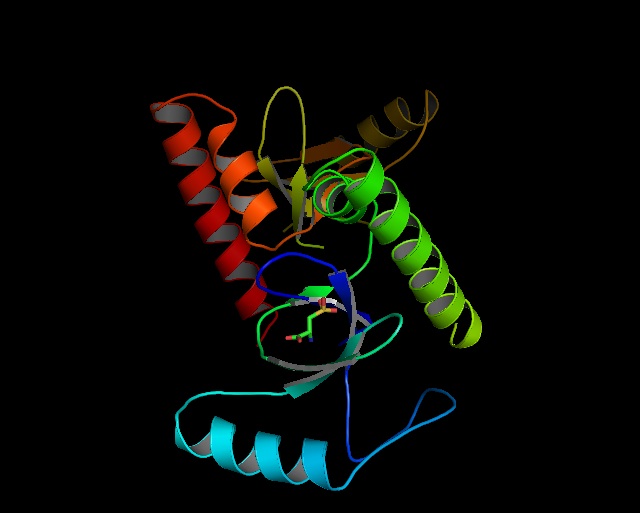
I am certain that my lab and I will take his legacy as an inspiration to go forward and continue pursuing science at the chemistry/biology interface. Ironically, today (as part of my sabbatical work at SGC) we got our second protein crystal (thanks a lot to Elena and Aiping, again!!!) and this is one of the ones Tony was really keen on. Below are the views and the crystal structure that shows (in yellow) the two aromatic cages that recognize lysine-containing fragments. We will remember Tony dearly and will work tirelessly toward some of the common goals we have shared…

Image

Soccer balls and macrocycles

Apparently, my PhD student Serge Zaretsky is not great at soccer… He emailed me yesterday from the Colby Sawyer College, where he is attending the Gordon Conference (Medicinal Chemistry). Those industry people (who form the majority of attendees at this GRC) are just too good… However, and more importantly, Serge got one of three poster awards and will present his work as a short talk tomorrow morning in front of the world’s leading medicinal chemists. It seems that there is a lot of interest in macrocycles (Serge’s area of expertise). No pressure there, Serge! Good luck!

New England travels… Serge and Adam

The lads (Serge Zaretsky and Adam Zajdlik) are at the Gordon Conference on Medicinal Chemistry this coming week. I am really looking forward to hearing how their research has been received. They both have really cool stories centred around boron-containing heterocycles and their biology (Adam) and peptide macrocycles made with our evolving aziridine aldehyde methods (Serge). It is almost 9pm now and I think I know where they are going to be soon after the talks are done! Below are Serge’s and Adam’s pics and a couple of snip bits about some of the science they are presenting.

guys.001

My first protein crystal structure

Here it is, guys. The structure is 2.4 Angstrom resolution, which is not too bad for a start. This happens to be a PWWP domain that recognizes methylated lysine containing peptides. The goal now is to design ligands on the basis of the small molecule fragment (you can see it) that has co-crystallized. I was talking to my PhD student Rebecca the other day and she is very keen to tackle this problem. Today I learned that another crystal might be sent out to the synchrotron soon. That will be awesome. Big-time thanks to Elena (who teaches me protein crystallography) and to Aiping Dong, who is the crystallography expert. He is amazing. I love chasing proteins!

Image

Boston, Novartis, and good times

I flew into Boston last night to give a talk at Novartis. I had a great time there today. Donovan Chin (Senior Investigator at the NIBR) was my host. I had a lot of fun hearing about their interests in molecules that are also dear to our hearts. I am talking about peptide macrocycles. Scott Lokey of the UCSC was also here at Novartis last week. Scott is doing some trailblazing work trying to understand the cell permeability of cyclic peptides.

It is clear that the industry appetite to macrocycles is high, particularly with regard to gauging their complex stereochemical preferences… It is eye-opening to talk to people in industry who do this for a living. When I hear that docking a small molecule takes a couple of minutes (I refer to computational docking into a binding site of a protein target), whereas the same process for a macrocycle is close to 18 hours, I really wonder how anyone will get the “heavy lifting” (to use the language of Dr. Andrew Roughton, the COO of Encycle Therapeutics, a company I founded in 2012) done in this space. It is, nonetheless, a fascinating problem and we are going to deal with it heads-on as a community. Naively, I asked Donovan about why does it really matter to be “right” in a complicated maze of conformations that are differentiated by a fraction of a kcal/mol. However, it is important to keep in mind that this thing is additive… To use Donovan’s analogy, it is like walking in the streets of Paris (or any other city with a complex web of streets): one wrong turn and your mistake is exacerbated such that the “real destination” will never be found… If we have a cycle that is composed of (say) 8 amino acids – once you add all the rotors, it is easy to see that this is a tough problem to crack computationally.

We needed to have some beers at the end of this day and went to this place called “Catalyst” right next to MIT. My former student Tim Rasmusson, who works at Novartis, came out – it was cool to see him! He is doing great. I hoped Ben Rotstein and Zhi He might join us (former PhD students who are now doing their PDFs at Harvard and MIT, respectively), but they were busy. I am at the airport now and will blog about my protein crystals tomorrow. The data is in!

Not making covalent bonds

So… I have a ton of work this weekend and it is mainly about making constructs for our next protein expression experiments. I gotta tell you: this is opening my eyes to entirely new challenges. See, I have been trained as a synthetic organic chemist, which means (more or less) that we think how to forge COVALENT bonds between atoms. Seriously, this is what we do in synthesis (in rough terms). Typically, good things that are new and interesting come from irreversible connections between atoms (in a way protein expression is still synthesis, but you think on a different level that does not involve worrying about how the bonds are constructed). I now must admit that there are really interesting challenges out there I have not considered seriously until now. The biggest difference from what I have been trained to do is that covalent bonds do not drive progress anymore. For example, this weekend I need to think of constructs for several receptor proteins that we will hopefully be able to express in E. coli. This is a different ball game altogether and it has its own unique challenges. Not only do we want to make clones but we also want to make sure we will be able to express the proteins. The ultimate goals are varied and range from crystallization to the production of antibodies. However, I catch myself thinking that: a. I am excited about what I do; b. it is new to me and c. whatever I do is NOT about carefully orchestrating covalent bond making. This latter point is important because I have never thought that I would be interested in science that does not, ultimately, result in making new bonds. But here I am – making constructs for expression and I do not think about gluing things together.  Kind of different and really interesting!

Proton/deuterium exchange

There are no protein reports today… I am waiting to hear on the news from the synchrotron (tomorrow). For a change, today I am going back to MUCH smaller molecules. I was thinking if I can come up with an interesting question involving some really well known reagents that seem almost too trivial. The venerable borohydride came to mind! Take a look at the equilibrium shown below. This process can be driven to the right, offering a means to make borodeuteride. The finding comes from a rather old paper (I can post it in the future). I did not balance the equation and decided to just leave the bare bones of the central idea. What do you think is the mechanism of this exchange process? Image

On protein synthesis, ligation, and expression…

Some of you know me – I love ligation technologies. As a chemist, it is exciting that synthesis can deliver a protein. Cool stuff. Now… Here comes a question I would not have asked had I not tried protein expression myself. In one of our recent experiments, Elena and I got about half a gram of a particular protein (more on that in the future) from E.coli in about 3 days. This technology is really unbeatable when it works. You don’t need to worry about epimerization (the way we do when ligations are considered), folding, etc. I am just curious – out of scientific publications that describe protein synthesis using modern chemical ligation methods, how many actually describe syntheses that CANNOT be performed using expression methods? Because — I tell you what (having done this myself) — you just cannot beat expression. OK, I understand that not all proteins express well and this is a good argument… But still – are you telling me that whenever people publish a chemical synthesis of a protein type of paper, they preamble their work by saying that this synthesis CANNOT be achieved using expression methods? If such synthesis can be done using expression, I honestly just do not see why you would use any method other than expression…

P.S. You want post-translationally modified proteins? Use insect or mammalian expression. From what I saw, folks at SGC do that routinely…

First protein crystals

Today we shipped a bunch of our newly prepared protein crystals to be analyzed on the synchrotron. The process of getting crystals is not exactly science… It is a form of art and I am in awe of all those people who have contributed (over the years) to streamlining this process. Below I am showing one of the results of today’s work. The size of the well is about 2.5mm, which makes the crystal about 0.5mm (I guess… Give or take…). We got this bad boy shipped out, the results should be back on Friday. This, by the way, is by no means the final product!

Image

In fact, we needed to painstakingly fish out this crystal with a micro-lasso sort of a tool (below), suspend it in special oil to get rid of water, and rapidly freeze it in liquid nitrogen (all the while trying to avoid the crystal from forming cracks).

Image

You can see the holder with mounted crystals immersed in liquid nitrogen in the photo below.

Image

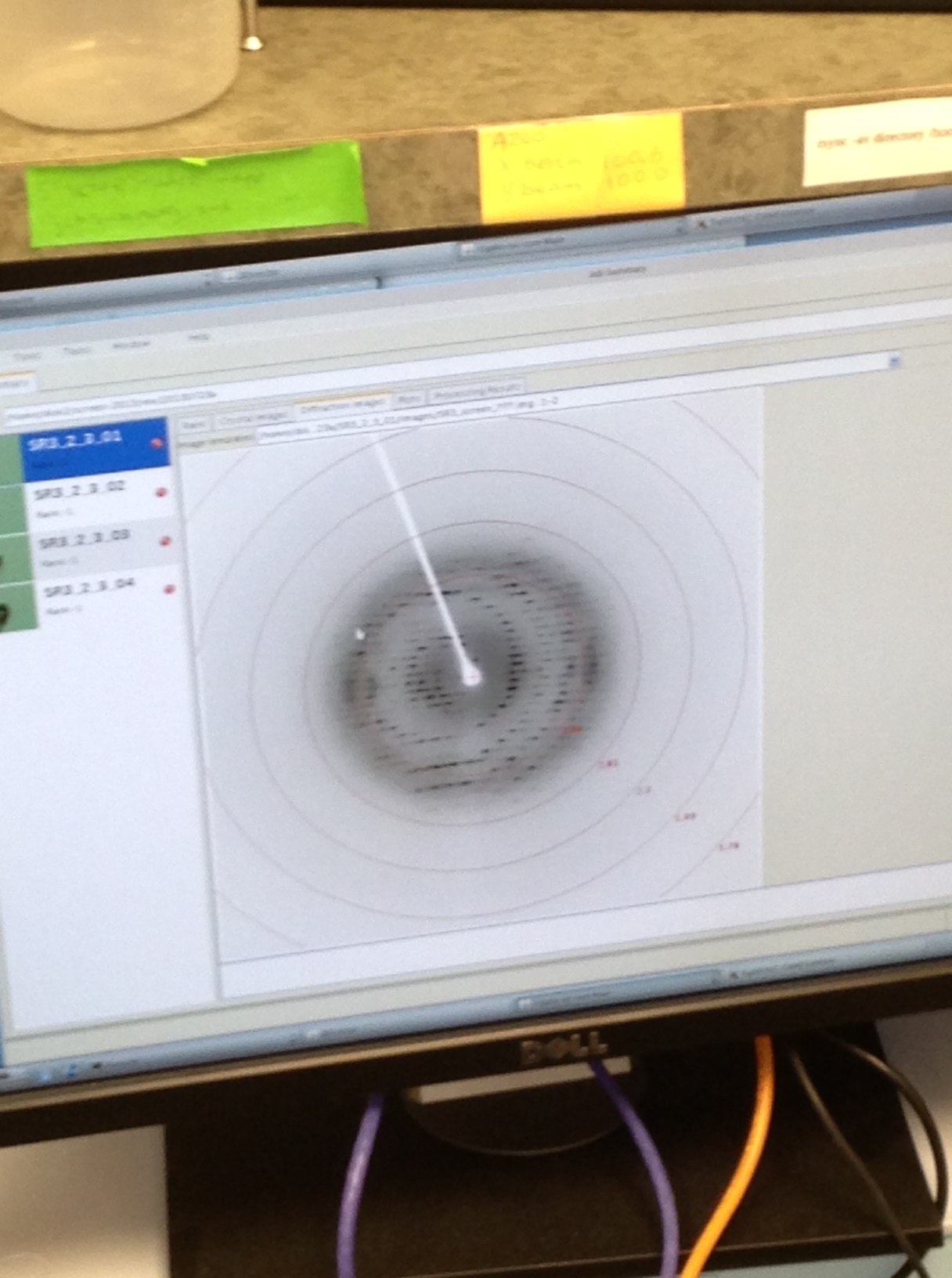
The beast diffracted on the SGC machine but we’ll see the news from the synchrotron beam!

Image

Of course I did not say what this protein is… Let me just say this: it is one of the trimethyllysine binding domains. I will elaborate on this in the future (and you will hopefully see where we are planning to take this from here).