Skeletons from the closet

There are many different ways of coming up with research ideas in organic synthesis. Broadly, chemists tend to be driven by either functional significance of their favorite molecules or by methods of synthesis. Some of us simply desire to reach a given target and then move on to the next one, without necessarily spending any extra time deciphering how molecules function. These are the three main types of research directions in organic synthesis.

I want to talk about a very frequently encountered and, judging by the amount of papers, fertile area of inquiry: studying the effect of solvent on reactivity. I cannot say that this domain of knowledge ever attracted me, although my lab does have a list of our favourite solvents that dictate our preferences for running reactions. However, I would never seek this to be a defining feature of a research project. It just isn’t my thing. But whatever rocks your boats, ladies and gentlemen! On the subject of solvent systems, many people feel passionate about all sorts of reaction milieu. Ionic liquids, fluorous media, biphasic systems based on water/organic solvents, you name it. Some of this research is purely Edisonian, but every now and then I see papers that go into my “skeletons from the closet” folder. This file grows from year to year and occupies a segment of my computer I am almost afraid to visit. I know each of these papers documents intriguing results, but I am just not yet prepared to fully understand the corresponding rationale.

Below is a typical example. It comes courtesy of Professor Zwanenburg. On a recent trip to the Netherlands I met several of Zwanenburg’s disciples who spoke very fondly of his contributions over the years. I am certainly one of Zwanenburg’s fans. Take a look at the graphic and a link below. The facts described suggest that nucleophilic ring-opening of the acyl aziridine ring (inset A) is not selective in dichloromethane, but improves to 100% in selectivity in water (inset B). There are examples of solvent-driven regioselectivity out there, but I am not aware of cases (and I urge you, reader, to draw my attention to prominent examples I am missing), in which a profound improvement in selectivity was recorded upon switching to a biphasic system. Of note is the rationale put forth by the authors of the Chem. Comm. paper. They suggest that the methylene portion of the aziridine is more “exposed” to the aqueous system when the reaction is carried out in the biphasic regime. Apparently, this accounts for the relative accessibility of the methylene group compared to the methane portion of the ring. Many years have passed since this Chem. Comm. paper appeared and I am still puzzled…

Image

http://pubs.rsc.org/en/content/articlelanding/2001/cc/b009294k#!divAbstract
Out West: good times and a paradox

I flew into Calgary last night and spent this Friday visiting the University of Calgary. I have not been to the Department of Chemistry here for over 10 years, the last time being for the PhD exam of one of Warren Piers’ students. Earlier today I gave a talk at the Department, met with the faculty and students, and just came back to the hotel after a great dinner with Warren, Todd Sutherland, and Thomas Baumgartner. Warren treated us to some awesome wine, which will be fondly remembered. To me, these kinds of visits always provide the best way to catch up on what goes on in other labs. I particularly enjoy hearing students talk about their research, and today was no exception.

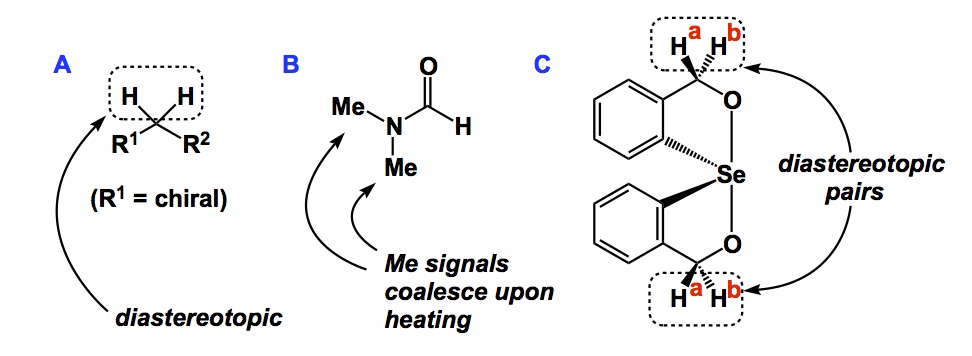
I want to mention one interesting piece of research that made me think (a lot). Take a look at the figure below. “A” represents a diastereotopic pair of protons in a generic RCH2R1 molecule. I can name many cases where VT NMR measurements have been employed in efforts to reveal the so-called coalescence temperature, which provides a measure of conformational preferences of a given compound. Dimethylformamide (inset B) is a simple achiral molecule that serves as a relevant example. In it, the methyl groups have different 1H NMR chemical shifts at room temperature, but coalesce at higher temperature. This property has important ramifications as it enables one to measure barriers to rotation, rate constants, etc. The example shown in inset “C” comes from Tom Back at the University of Calgary and teaches a peculiar behaviour seen in the 1H NMR of the depicted selenium compound. Apparently, the CH2 group appears as a AB quartet at 213K. Slowly but surely, this set of signals is transformed into a singlet at 291K. We might all be inclined to say: “Gotcha… This must be coalescence”. However, upon further heating, another AB quartet emerges at 377K! This appears to be a paradox, but only if we assume that coalescence of NMR signals of diastereotopic protons in variable-temperature experiments must be due to dynamic exchange processes. The danger of default assumptions… The re-appearance of the AB quartet at higher temperature (inset C) suggests that coalescence must attributed to coincidental chemical shift equivalence. In other words, the two diastereotopic protons that are shown display temperature-dependent chemical shifts that change in opposite directions, and whose coalescence is not to be equated with dynamic exchange. This is a fascinating finding suggesting that a lot of papers out there need to be reexamined (just heat beyond coalescence, baby, and see what happens).

aaa

http://pubs.acs.org/doi/abs/10.1021/jo301846a?m=102ivao&af=R&pageSize=20&searchText=PES

On this note, I am off to bed – I am catching a 7:30 plane back to Toronto. I hope not to see any nightmares related to overinterpretation of coalescence in our own work (as I write this note, I don’t think we did it, but the night is still young…).

Picking pockets

By now you have probably noticed that I have a lot of respect for cool publication titles. Earlier today I was thinking about some of the great ones. Who can beat Barry Sharpless’s “Vicinal Diol Cyclic Sulfates – Like Epoxides Only More Reactive”? I just love it. You can find this paper on the link below:

http://pubs.acs.org/doi/pdf/10.1021/ja00230a045.

Here is another one. It is a paper that comes “close to home” from the standpoint of our projects that are directed towards fragment-based interrogation of epigenetic proteins: “How Chromatin-binding Modules Interpret Histone Modifications: Lessons From Professional Pocket-Pickers”:

http://www.nature.com/nsmb/journal/v14/n11/abs/nsmb1338.html.

This manuscript details some of the intricate ways used by histone binding domains to differentiate among mono-, bis-, and trimethyllysine (to name a few) residues within histone proteins. Biologists might not yet know the rules that govern this complex process, but they are trying to find out. Chemists are uniquely suited to play an important role in this process by finding molecules that can disrupt the corresponding protein-protein interactions. To do this, we need two components: a well behaved domain that recognizes a post-translationally modified amino acid of interest and a method of making small molecules that disrupt this interaction with high specificity. Ever since I ended my sabbatical stay at the SGC in December of 2013, my graduate student Victoria (shown below) took over the reins and delved into various ways to produce and crystallographically characterize methyllysine-binding targets in collaboration with the SGC. Elena (shown below) has been her mentor in this undertaking. Last night Victoria made an important step forward: one of the key trimethyllysine-binding proteins succumbed to crystallographic characterization. Victoria was able to isolate and crystallize the molecule which is shown below on the right hand side (I made the images using PyMol). SGC’s Aiping Dong has been instrumental (as always) in solving the structure. You see two proteins side by side. On the left is the trimethyllysine containing peptide bound to the target, and on the right is Victoria’s domain that contains an empty pocket. Which molecules can get in and stay there? This is for Victoria to find out… We need to understand how these “professional pocket pickers” work.

Image

Happy molecules r us

Back in 2006, together with Ryan Hili we stumbled upon amphoteric aziridine aldehydes that defied logic due to a kinetic barrier imposed on the amine/aldehyde condensation. Ever since then we have been looking at expanding the scope of this chemistry, which allowed us to better understand how to put a wide palette of amphoteric reagents to good use. Together with Zhi He and Adam Zajdlik we have put together an account that sums up our work to date. Here is a link to this paper (it came out today).

Image

http://pubs.acs.org/doi/abs/10.1021/ar400210c

Below is a recent picture of my lab back in December, on our way to a wild night of playing ping-pong (a special thanks to Sai for taking the photo!):Image

More on boryl amines

There is a growing interest in boron-containing peptide and small molecule inhibitors of serine and threonine proteases (and a host of other targets). This interest drives research aimed at new methods of synthetic installation of the boroamine functional group. In the past, I mentioned some of my lab’s work in this area. My former PhD student Zhi He (now a postdoctoral fellow with Tim Jamison at MIT) and Adam Zajdlik (currently a second year PhD student in my lab) have laid a foundation for making boron-containing amines using amphoteric reagents. We are actively investigating this area and are collaborating with the lab of Ben Cravatt. We are also beginning what will hopefully be a productive collaborative relationship with Anacor in Palo Alto, CA. In July of this year Adam is going to San Francisco, where he will use his methods of boroamine synthesis in collaboration with Anacor.

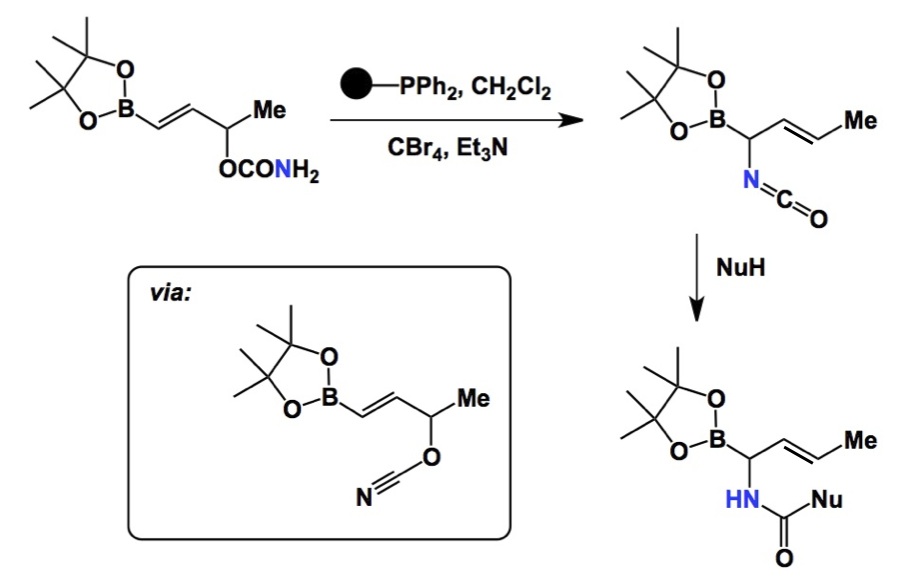
I pay attention to other labs’ advances in this area and want to mention an excellent Org Lett paper by Bernard Carboni and colleagues from Rennes, France. This work describes an imaginative new way to access alpha-boryl amines using [3,3]-sigmatropic rearrangement. Below is the main idea this work is based on. Given the widespread availability of vinyl boronate building blocks, the reaction constitutes a promising new way of installing B-C-N motifs into organic molecules. ww

http://pubs.acs.org/doi/abs/10.1021/ol401016x?mi=vx3ktd&af=R&page

A post-scriptum on fluorine…

Hi all, I am glad that one of the readers reminded me about a classic work by Jack Dunitz. In addition to my personal response, I decided to post a link so that everyone can see it and save in their folders of “important papers”. 

http://onlinelibrary.wiley.com/doi/10.1002/chem.19970030115/abstract

The title says it all: a contradiction to what the Linclau study suggests. However, the Dunitz paper is primarily a crystallographic study, which is an important distinction. One comment: people no longer come up with really great titles. There is a monumental inscription in the title of the Dunitz contribution: “Organic Fluorine Hardly Ever Accepts Hydrogen Bonds”! 


Against my intuition

I want to talk about some unexpected and counterintuitive findings that run against what we might anticipate as chemists: that the introduction of a highly electronegative fluorine atom into a molecule necessarily increases the H-bond properties of adjacent functional groups. I refer to the work by Linclau and co-workers, which was published in Angewandte a couple of years ago. The cyclohexane-bound hydroxyl group was investigated in this study. The focus was on H-bond property of the OH functionality, which was measured using a really nice method: by looking at the decrease in absorbance of the hydroxyl substituent’s IR stretching band upon complexation with N-methylpyrrolidinone (NMP). Very cool stuff. Importantly, the paper casts doubt on the assumption that fluorination always increases H-bond acidity. There is a simple explanation of the observed effect – just take a look at the two representative examples shown below.

Image

http://onlinelibrary.wiley.com/doi/10.1002/anie.201202059/abstract

The main lesson here is that fluorination can attenuate alcohol H-bond acidity in unanticipated ways. The intramolecular F···HO interaction can in fact be responsible for a decrease in H-bond acidity. Clearly, this intramolecular interaction can effectively outcompete the electron-withdrawing effect of fluorine which is expected to lead to increased acidity of the adjacent polar groups. The Linclau study opens doors for rational modification of acidity through site-selective fluorination and should have many applications in the design of bioactive molecules.

Too close for comfort: cleaving amides at neutral pH

The track record of man-made enzyme mimetics is not impressive. I previously commented that, time and again, we get beaten by nature’s enzymes in terms of catalytic efficiency. If we consider hydrolases, it is all about the spatiotemporal relationship between their catalytic amino acid residues and the peptide bond that is being cleaved. Things happen at the right place and at the right time. There have been many attempts to prepare synthetic hydrolase mimetics that were claimed to be close to their natural congeners in terms of catalytic efficiency. None of these examples have withstood the test of time: each was shown to be the product of sample contamination with some hydrolase. However, there is one really excellent example from the past that employs spatiotemporal arguments and proves that, once proximity has been secured, amazing efficiency for activating strong bonds can be achieved. A classic JACS paper by Fred Menger from 1988 describes a very curious amide that hydrolyzes fast at neutral pH with a t1/2 of 8 minutes, which corresponds to an effective molarity of at least 10l2M. Given the strength of the prolyl amide linkage, this classic example is remarkable.

www

http://pubs.acs.org/doi/abs/10.1021/ja00228a031

Is there an immediate use for something like this? It is difficult to think of an application, but there is a lesson here to those of us who are driven by small peptides that fold into compact shapes. First and foremost, I refer to cyclic peptides and peptidomimetics. The question about cyclic peptide stability has been raised time and again, yet one often assumes that it is all about stability against proteolysis. The proteolytic degradation is difficult for a cyclic peptide (to the extent that it is not even worth pointing out this feature as a cool attribute of cyclic peptides – it is obvious that they do not adopt the necessary extended conformations. Here is a great reference that discusses this property, by the way: http://pubs.acs.org/doi/pdf/10.1021/cr040669e). But chemical stability is another issue and I would predict that there are cases where amide bonds in complex macrocycles are unstable for reasons that operate in the case described by Menger 25 years ago.

The pentafluorosulfanyl group: obscure, yet intriguing

People often equate the presence of fluorine in organic compounds with increased stability and other unique properties. The trifluoromethyl group is sometimes erroneously equated with some “magical” stabilization. Honestly, I think we tend recall Teflon way too much. Tonight I want to talk about two fluorinated groups: one is well-known (CF3), while the other one is rather obscure (SF5). The reality is that the trifluoromethyl (CF3) substituent is not that stable (I did my whole PhD on it…). For instance, in some cases, you can quantitatively hydrolyze it under aqueous alkaline conditions into the corresponding carboxylate. But this is only part of today’s story. In terms of stability, I want to point to a lesser-known group – pentafluorosulfanyl (SF5) – which is poised to become a very interesting moiety with which to design materials and pharmaceuticals. At first glance, this thing just does not look right as there seem to be way too many fluorine atoms. But it is what it is: sulfur in the oxidation state “+6”. The hydrolytic stability of SF5-containing molecules makes trifluoromethylated analogs pale in comparison. Take a look at the reactions shown below! In addition, the van der Waals volume occupied by the SF5 group is slightly larger than that of the CF3 substituent. The SF5 group is also more lipophilic. This property, along with improved stability, ought to make SF5–containing compounds more and more interesting in drug design. In fact, there are examples of biologically active molecules that derive their properties from the unique characteristics of the SF5 substituent. There will be more on that in my future posts.

Image

http://www.sciencedirect.com/science/article/pii/S0040402000001848

What’s going on with Bro5?

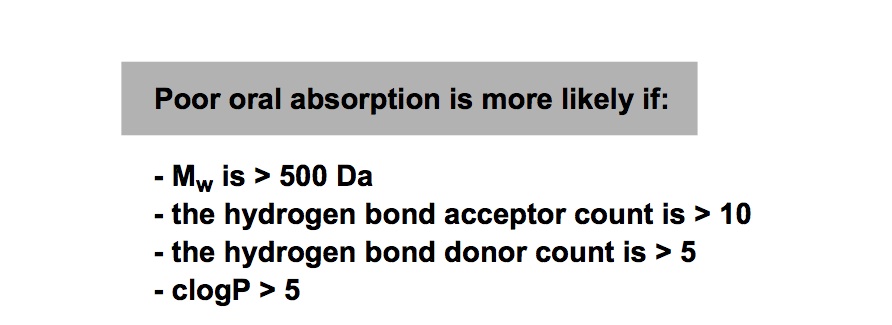
Some of you might wonder what this “Bro5” acronym stands for… Bro5, or “Beyond the rule of 5“, is meant to represent a vast chunk of chemistry space that is heavily populated by molecules that behave as drugs, yet do not satisfy the so-called Lipinski rule of 5 for drug-like properties. Here are the famous commandments from Lipinski:

 Image

As it typically happens, exceptions prove the rule. We don’t have to go very far: consider the case of taxol. This outlier is perfectly bioavailable, yet violates some of the Lipinski rules. The post-Lipinski period is characterized by trying to rationalize the behaviour of other outliers that emerge from drug discovery campaigns. More importantly, can we predict fairly large molecules with favourable oral bioavailability? When it comes to my lab’s research, the Bro5 considerations hit close to home as peptide macrocycles are among our favourite targets. The following paper, published several years ago by a team from Pfizer in the UK, contains a very nice discussion of Bro5. This manuscript also proves that it should be possible to rationally design orally bioavailable cyclic peptides. As you have seen in my older posts, formation of intramolecular hydrogen bonds is the main driver behind oral bioavailability of cyclic peptides. These weak interactions cooperatively shield polar functional groups and facilitate membrane permeability and intestinal absorption. One tantalizing question is whether or not it is possible to run simple predictions of intramolecular hydrogen bonds through modeling of the low energy gas phase macrocycle conformations. I have always thought that some of the coveted folded conformations of cyclic peptides might be fully predictable using such simple tools. The Pfizer work in MedChemComm supports this notion. So… Why painstakingly make a ton of macrocycles and screen them? Let’s make just one, baby…