Light in synthesis

Low quantum yield is just one of many troubles with conventional photochemical reactions such as isomerization of double bonds. In addition, scalability has been quoted as an obstacle that precludes many classic photochemical reactions from entering the mainstream of synthesis. However, when they work, these reactions can be marvelous. I tip my hat off to Mulzer and co-workers who used photochemistry at a late stage of their synthesis of 17-deoxyprovidencin. The key to success here is that the absorption maximum of the Z isomer (below) lies at 306nm, whereas the E isomer absorbs below 300nm. Irradiation with UV-B light resulted in the desired Z/E isomerization. This example highlights another point, namely the need to use the right gear in these kinds of reactions: Pyrex glass is absolutely critical as it cuts off UV wavelengths below 300 nm. Therefore, once the desired E isomer is formed, it has no chance to go back to the Z form. This is very crafty. In more general terms, I think it would be interesting to look at photochemistry in constrained macrocyclic environments offered by cyclic peptides. There’s got to be a lot of unusual reactions that will pop up there.

pp

http://onlinelibrary.wiley.com/doi/10.1002/anie.201400617/abstract


What can formaldehyde do for you?

Xenobiotic electrophiles are “taken care of” by glutathione, which is part of our primary defence mechanism against various kinds of toxic molecules (this is why you do not want to take too many Tylenol tablets as the metabolite of this drug would quickly chew up your glutathione reserves, making you vulnerable). We do not often think about what happens to glutathione as a result of this chemistry. We probably think that it must be trivial and uninteresting. Certainly, the thiol group must play its key role in glutathione transformations, but I don’t think one tends to worry about the details of glutathione modifications. I was reading the 2007 paper by Kevan Shokat and colleagues in Organic and Biomolecular Chemistry and got reminded about the fascinating effects of formaldehyde, one of the simplest electrophiles, on polyfunctional molecules such as glutathione. Below you see a serendipitous finding made in the Shokat lab as part of a study aimed at non-enzymatic reactions between glutathione and formaldehyde. Not only did the insanely looking bicycle form, it also got co-crystallized with the carbonyl reductase I enzyme (pdb id: 2pfg). If you are interested in heterocyclic chemistry, this example of formaldehyde-driven construction of complex heterocycles should be of interest. I have always been fascinated by the increase in complexity that can be ascribed to the “stitching power” of this seemingly trivial molecule.

pic

qw

http://pubs.rsc.org/en/Content/ArticleLanding/2007/OB/b707602a

Amide enolates – still rather rare, I suppose

I was glad to see a nice amide alkylation reaction as part of a total synthesis of (+)-bermudenynol recently reported in Angewandte by Kim and co-workers from Seoul National University. The natural product, the structure of which is shown below, contains an 8-membered ring. We all know how difficult it is to build these kinds of scaffolds. In fact, the authors failed miserably in their attempts to use the ring-closing metathesis, which is the workhorse of medium ring construction. Instead, they turned to a much riskier proposition, namely an attempt to develop a route to the allyl bromide-based substrate shown below and subject it to amide enolate-induced cyclization. Surprisingly, the reaction worked really well, which is interesting considering how infrequent amide enolate alkylations are. There are other interesting features in this synthesis, but amide alkylation is the centerpiece of the approach. The polyhalogenated structure of (+)-bermudenynol also reminded me of some interesting molecules shown by Prof. Chris Braddock (Imperial College) in his talk here at the University of Toronto a couple of days ago.

pop

http://onlinelibrary.wiley.com/doi/10.1002/anie.201308077/abstract

Living the dream

When I first heard about the four quadrants of science, I was instantly captivated by the clarity with which three distinct philosophies can be compared and contrasted. There are indeed three different ways of doing relevant science (1, 2, 3 below): the Bohr quadrant (1) amounts to pure science without contemplation of downstream utility, the Edison quadrant (3) pursues empirical science and does not aim to understand the underlying causes, whereas the Pasteur quadrant (2) involves fundamental research with consideration of use. While I have no comment on the remaining quadrant (I am not even going to mark it because no one wants to be associated with this sort of activity), I would argue that almost all of us want to belong to the Pasteur quadrant. Indeed, it appears to be the most meaningful segment that balances utility with fundamental significance. Having said that, time and again important discoveries are made by those researchers who are perfectly happy to have their work associated with either quadrant (1) or (3). Thus, it is somewhat short-sighted to say that we must strive to be in the Pasteur quadrant at all costs and that not being there is a failure…

yt

The wonders of alkyl chains

Earlier today, my friend and colleague, Professor Dwight Seferos (http://www.chem.utoronto.ca/wp/seferos/), gave the 2014 John Polanyi lecture. The talk showcased the Seferos lab’s command over conjugated materials based on heterocyclic frameworks (mainly seleno- and tellurophenes). One particular structural piece that seems to be central to this kind of research is the alkyl chain-containing repeating unit shown below.

lll

As you might imagine, all of the electronic properties of such polymers are ascribed to the aromatic nucleus, whereas the aliphatic side chain is there to ensure packing, ultimately controlling the interchain interactions and material morphology. I just wanted to comment on this “alkyl chain business” as I think some folks might have a tendency to trivialize the unique structural aspects of straight alkyl chains. Indeed, many practitioners of synthesis view them as fairly boring bystanders that, while central to function, are really not that exciting. All they do is pack parallel to each other, so what’s the big deal, you might say? Well, not so fast… While I was listening to Dwight’s expertly delivered presentation, I remembered one of my favourite old papers by the one and only – K. Barry Sharpless (my mentor). This manuscript hails from 1975 and describes a property that makes you realize that there is nothing remotely boring when it comes to straight alkyl chains. In the graphic below you can see the craziest separation ever performed (in my humble opinion). The two long chain alcohols differ by just two methylene units, yet are separable upon shaking the mixture over calcium chloride. These are the real wonders of chemistry, ladies and gentlemen. I am curious if subtle effects such as this can exert an influence on properties other than alcohol separation.

ttt

http://pubs.acs.org/doi/abs/10.1021/jo00897a015

Surprises in the Midwest

This past Monday night I flew into Indianapolis, where Prof. Mark Lipton met me at the airport and took me to West Lafayette, home of Purdue University. Mark organized this trip for me, and I am truly grateful for it because I got to see people whose work I have known and admired for a long time. I also got to meet new faculty members, whose science I discovered only recently. I previously blogged about some nice chemistry coming out of Prof. Mingjie Dai’s lab. This time around I also met Chris Uyeda, another Assistant Professor at the Chemistry Department, whose cool catalysis will undoubtedly grace the pages of a top-level chemistry journal some time soon (he has a great story to tell, and it is too bad that I cannot mention any details as this is still unpublished…).

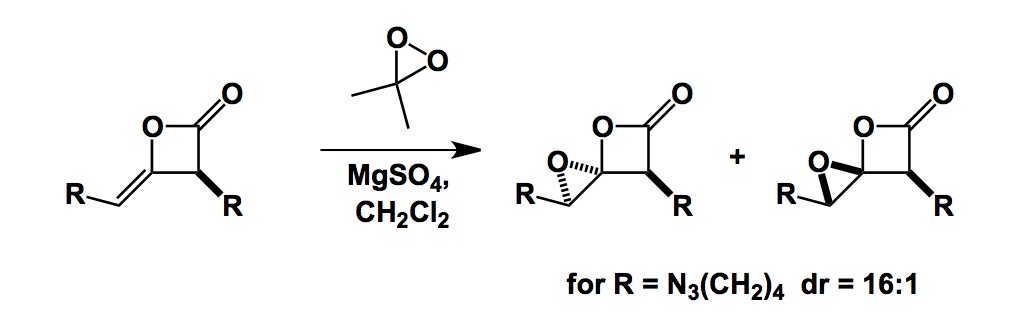
There were some really interesting science vignettes I was exposed to and there was a theme to my visit: I kept getting pleasantly surprised while learning about methods I had known very little about. Take, for instance, a very nice paper by Prof. Alex Wei. In it, an attempt is made to rationalize the remarkably high level of relative stereochemistry observed in the following epoxidation:

oo

http://pubs.acs.org/doi/abs/10.1021/ol0617401

This system was subjected to a thorough DFT analysis, but neither of the two diastereomeric transition states revealed specific enthalpic interactions that could account for the observed differentiation. Upon further analysis, the authors came to the conclusion that the early transition state and low activation energy might allow for an intrinsic polarization in pi-orbital reactivity. They employed PPFMO (Polarized-pi Frontier Molecular Orbitals) approach, which is a perturbation method that desymmetrizes 2p orbitals by introducing s-functions near each lobe… This method provides an important clue that suggests that facial selectivity is predetermined by the polarized-pi model. Very interesting stuff, in my view.

There is another notable rarity I got exposed to. If you are aware of the USA map, you would know that West Lafayette, Indiana, is not exactly the place where one would expect to find good sushi. However, I was amazed by the quality of food at the Heisei restaurant, Professor Negishi’s favorite place. Mark took me there last night, along with Mingjie and Chris. Apparently, there is a good explanation for the outstanding quality of fish: there is a Subaru plant nearby. Their management wanted to make sure that Subaru employees had access to top of the line sushi. Apparently, Prof. Negishi ordered a take-out from that place on the day he received his Nobel Prize in 2010…

P. S. There was another surprise today: one of my readers alerted me that there are some weird ads that appear next to my posts from time to time. Upon further digging, I realized that I have to pay extra so that my readers do not see this stuff (by the way, as the writer of this blog, I never see any ads). This was a rather unpleasant surprise, the one I just fixed by paying a significantly higher annual fee. Let me know if you still see those stupid things. I will kick someone’s teeth in at WordPress if I hear about these ads again. The gospel of science must be spread without commercial interruptions.

On stability

I just came back from Moscow, carrying with me some fond memories of the MCMC-2014 conference. There is one particular presentation I would like to comment on. Last Thursday, I heard a very interesting talk by Professor Terent’ev of the Zelinsky Institute for Organic Chemistry, who showed some mind-numbing examples of organic peroxides that are stable despite what their oxygen-rich frameworks might signal. Below is one of the molecules that possesses an impressively high melting point.

gg

http://pubs.acs.org/doi/abs/10.1021/jo071072c

While it is possible to speculate on the origins of this unusual stability, I think a fundamentally important caveat needs to be clarified. This point goes back to my PhD years with Prakash and Olah. If you recall, one of the central discoveries of Olah’s career were the so-called stable ion conditions, which enabled isolation and characterization of carbocations in solution for the first time.

gg1

In contrast to their carbon congeners, the corresponding trivalent silicon species (above) have eluded characterization for a very long time, which might seem counter-intuitive given the fact that silicenium ions are considerably more stable thermodynamically. But this is precisely what I wanted to mention: the silicon species is more stable thermodynamically, not kinetically. In terms of kinetics, trivalent silicon is so electrophilic that the barrier to covalent bond formation with some of the weakest nucleophiles is exceedingly small. Coming back to peroxides, there are probably a number of causes (metal impurities?) that might trigger violent decomposition, despite the apparent kinetic stability of some notable cases. I do encourage you to look at the papers by Terent’ev as there are some real gems there.