Strange rate laws

You might have noticed a certain trend in contemporary approaches to mechanistic investigations using computation: the (over)use of water. It is curious that 10 years ago people rarely considered water and now it is the fixture of almost every other paper, seemingly to patch holes in mechanistic arguments.

Jokes aside, molecular-level involvement of adventitious molecules is an interesting topic. Of course, experiment is the “real deal” and I pay attention to studies that reveal strange rate laws that hint at solvent involvement in transition state assemblies. Several days ago I came back from Halifax, Nova Scotia, where I heard a great talk by Joseph Moran of the University of Strasbourg. He described a system that reveals the enabling role of nitromethane in catalysis (http://pubs.acs.org/doi/abs/10.1021/jacs.5b06055). While listening to his talk, I took note of a peculiar paper by Berkessel, which is not something I was familiar with. In this work, there is experimental evidence for the involvement of 3 HFIP molecules in the rate-limiting step of olefin epoxidation. This reminds me of Ryan Hili’s studies of aziridine aldehyde dimers, where we always noted an important role of trifluoroethanol. However, our kinetic work has not allowed us to conclude that something remarkable was happening on a “molecular level”. In the Berkessel case, the kinetics clearly point at the involvement of 3 molecules of HFIP in the transition state. Do let me know if you are aware of other interesting cases that implicate adventitious molecules in rate-limiting steps.

2.jpg


A tribute to some key players in heterocyclic chemistry

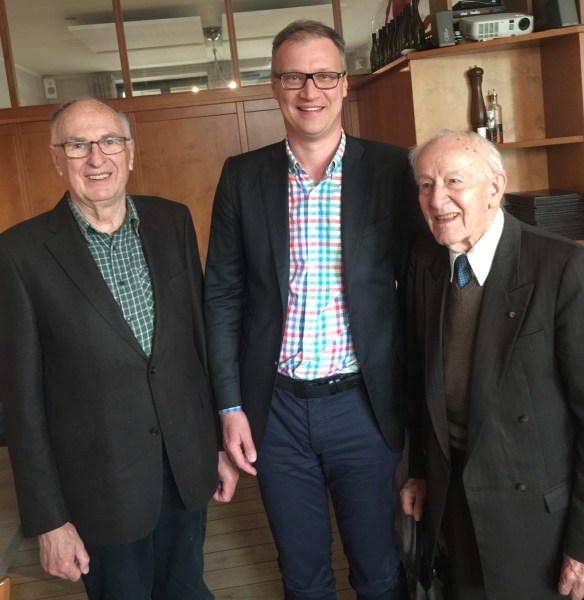
The central role of heterocycles in modern chemical synthesis cannot be overestimated. Last week, I had a chance to appreciate the role of some of the fathers of modern approaches to heterocycle use and construction. As part of a trip to Germany (superbly organized by Professor Herbert Mayr) I visited the Ludwigs Maximilian University in Munich. The highlight of this trip was a meeting with the two gentlemen featured on the picture below. On my right hand side is Professor Wolfgang Steglich, the discoverer of DMAP (among many other things), while on my left side is Professor Rolf Huisgen. As the founder of dipolar cycloaddition chemistry, Professor Huisgen needs no introduction and I really want to wish him a happy 96th birthday, which will be celebrated on June 13.

2.jpg

My host, Professor Mayr (a former PhD student of Huisgen), continues to push the boundaries of chemical reactivity. I already mentioned his work in the past and I am glad that he continues to educate the chemistry community on how one can predict selective reactions between various functional groups. With the help of my students, we will soon be collaborating with Professor Mayr to better understand the reactivity trends of our  own molecules. The Mayr scale has served as the go-to tool in teaching organic reactivity. The following contribution features what I call “the real rule of 5” and I enjoy discussing it with my students.

http://pubs.rsc.org/en/Content/ArticleLanding/2012/SC/c2sc00883a#!divAbstract

The danger of additivity

When one embarks on the treacherous journey in organic chemistry research, proper planning of experiments is of utmost important. Nothing is more dreadful than going from one experiment to the next while changing two different parameters at a time. If you are a chemistry professor mentoring graduate students, I am sure that you wholeheartedly agree with me and may recall cases when this happened to beginning students in your lab (for example, an attempt to concurrently change a concentration and temperature in a reaction). The core of our work is to ensure that we take a rational approach to incremental learning, which is based on looking for cause/effect correlations while focusing on one variable at a time.

The idea of incremental changes goes beyond running experiments and affects our reasoning by implying that additivity should be the guiding light in reaching sound conclusions. I will provide evidence where being too dogmatic about additivity is counterproductive. As you can see, Klebe and co-workers make an excellent point: if you modify the inhibitor on the top left with a methyl group, you will get a molecule, whose binding affinity to thermolysin is improved only marginally (2.2 kcal / mol gain). If you then modify the same starting point with a carboxylic acid, again there is nothing remarkable (1 kcal / mol gain). But if you now do both of these changes (methyl and acid) at the same time, the result is profoundly better than the starting point (6.7 kcal / mol gain). While the underlying reasons for this sort of behavior are complex, this set of examples speaks to the non-additivity of functional groups and suggests that it is wrong to think about molecules as Lego-like agglomerates of functional groups. Every molecule is in its own class and simple functional group additivity is not always a sound guiding principle. You might then ask: does this imply that the vast majority of medicinal chemistry research is misguided? I don’t know. Maybe it is.

2.jpg

http://onlinelibrary.wiley.com/doi/10.1002/cmdc.201200206/abstract

Remote control

Remote control of chemical reactivity ranks among the most fascinating aspects of chemistry, particularly if a network of non-covalent interactions is involved. During a recent discussion, one of my graduate students, Joanne Tan, presented an interesting paper detailing one such effect. I asked Joanne to write a summary for my blog, so here it is:

“Ever since my undergraduate years, I have always been turned off by carbohydrate chemistry. It is difficult to functionalize a carbohydrate at a specific hydroxyl group without the need for extensive protecting group manipulations. That is why I like reading about methods that allow one to perform regioselective modification of carbohydrates.

A recent JACS paper by Richard R. Schmidt and coworkers describes “the cyanide effect” – a method for the regioselective O-acylation of carbohydrates. In a typical acylation of a carbohydrate-derived diol, equatorial hydroxyl reacts preferentially. However, in the presence of cyanide anion, the axial OH is acylated instead, furnishing the kinetic product. On the basis of an NMR study, cyanide anion appears to hydrogen bond to the more acidic axial –OH, which increases its nucleophilicity. Particularly interesting is the double hydrogen bonding from the equatorial hydroxyl group to the axial oxygen atom, which serves to stabilize the resulting anion upon deprotonation by cyanide.”

2.jpg

http://pubs.acs.org/doi/abs/10.1021/jacs.6b02454

Planarity is overrated

Every now and then I pause and wonder about the role of unnatural amino acids in chemical biology and drug discovery. Apart from obvious gains in accessible molecular diversity of peptide collections, the structural value of some of the commonly used unnatural amino acids it is not immediately clear, at least to me. While diversity is an extremely important consideration, one has to wonder about the molecular-level significance of, say, cyclohexyl alanine. Apart from general hydrophobicity, what would the cyclohexane chair “glued” to a peptide chain impart when thrown into the medley of more mundane amino acids? How will it fare?

I was surprised to find out that the chair I just mentioned does just fine when it comes to stacking. In a thought-provoking study, Gunaydin
 and Bartberger point out excellent stacking abilities of cyclohexane. It appears that unsaturated rings found in drugs may be replaced with their saturated counterparts without losing potency even when it comes to stacking interactions with the side chains of aromatic residues. This should give us a lot of food for thought. What about asymmetric catalysis? Recall the importance of stacking interactions there. When we consider some widely used partially hydrogenated BINOL ligands, invoking stacking interactions in transition state assemblies might not be that outlandish if we think about Gunaydin
 and Bartberger’s eloquent study in structural biology.

33.jpg

http://pubs.acs.org/doi/abs/10.1021/acsmedchemlett.6b00099


The wonders of arsenic

Some years ago (circa 1995), I learned about the magic of arsenic trichloride. I think it was Karl Christe (when he was still at the Edwards Air Force Base in California), who told me about this wonderfully “benign” material. At that time, I was desperately trying to dissolve a polycyclic aromatic molecule. Apparently, when nothing else works, arsenic trichloride is supposed to solve all your problems, particularly when it comes to dissolving polyaromatics. For many years I have been trying to find the original source describing this wisdom and, as luck would have it, accidentally came across the paper I have been looking for. Here it is, so put it to test if you are brave enough. According to the authors of this old work, arsenic chloride is cheaper than deuterated chloroform. I am not sure about that, but I know several people who swear by the unique properties of this liquid. You might ask: “So did you give it a shot?”. Nope, I did not. I am not that brave after all!

http://www.sciencedirect.com/science/article/pii/S0040403900721101

Greasy affairs

For as long as I can remember, I have been told that silicone grease on glass joints is a bad idea. I remember taking this advice to heart because the alternative was to see an IR-like mess in the aliphatic region of my proton NMRs. The benefits of cleaner spectra outweighed an occasional frozen glass joint, although now that I think about it, Teflon tape on the inside had similar lubricating effect (and turned into my preferred way of avoiding frozen joints during grad school). Later on, I would tell this same story about grease to several generations of my doctoral students. The silicone nightmare is part of our synthetic folklore and efforts to avoid it represent a broadly accepted laboratory practice. However, we have a bit of a dilemma here, especially if we look at the review article quoted below. The title has “grease” and “serendipity” in it, so you can see where the paper is headed. We are conditioned not to use grease in reaction setup because we do not want to see garbage in NMR spectra. But it is possible to make things a bit too sterile, isn’t it? Otherwise certain serendipitous findings, such as the nickel example on display, will never be made. I am not saying that this particular carbene complex is noteworthy as a catalyst precursor, but who knows? There may very well be a niche for “OSiOSiO” bridges out there. They are interesting and largely underexplored. Unless generated unintentionally, that is… The “OSiOSiO”-based ligand was observed during an attempt to run what many would consider a fairly standard inorganic prep to make nickel-carbene complexes. I do think that the wording “greased Schlenk” might be a bit much, but I am here to faithfully reproduce what I see, ladies and gentlemen. I note that this review by Saito is not his first paper on the subject (this is more of a “Grease 2.0”). I salute you, Professor Saito, and I am glad that grease is developing a faithful following.2.jpg

http://www.sciencedirect.com/science/article/pii/S0010854515002349

A water mop

There are nuances in terminology, culture, and default assumptions among different branches of science. What appears natural in one area often goes against the grain and intuition in another, particularly when it is difficult to put forth well justified arguments at a molecular level.

In the past, I commented on the peculiar properties of PEG (polyethylene glycol). In my discussions with colleagues in protein crystallography, I have always found it odd to hear references to PEG as the “dehydrating agent”. It is especially uncomfortable when PEG is administered in an aqueous buffer to a vessel containing protein crystals. But our biological colleagues have no trouble with this concept at all. Below is a reference to the propensity of PEG to exert “extreme dehydration” on protein crystals. I used this paper in my talk (IRTG conference here in Toronto) earlier this week. While no one has issues with heterogeneous molecular sieves as water mops, many a chemist cringe at the thought of dehydration in water, given the homogeneous nature of one of the parties to the interaction. While this sounds like an oxymoron, dehydration of this sort is something protein crystallographers are rather comfortable with. In the paper below, PEG-driven dehydration is called upon to drastically alter the quality of protein crystals.

mop.jpg

http://scripts.iucr.org/cgi-bin/paper?S1744309111048706


A bold way to make guanidines

During a recent trip to the ISACS Conference in Irvine, CA (organized by my friend Vy Dong), I came across what I think is the craziest synthetic sequence I have had a pleasure of seeing in some time. This work is now more than a year old, yet it was still very invigorating to hear Seth Herzon describe it in detail. The reaction sequence depicted below is the pivotal cascade in Herzon’s synthesis of (+)-batzelladine B. In this process, deprotonation of the acetylene intermediate with n-butyllithium followed by the addition of lithium benzyl octanoate triggers 1,2-addition to the β-ketoester, retro-aldol ring-opening, and proton transfer to afford the enolyne intermediate. Subsequent to that, isomerization to the acylallene takes place, which is followed by Michael addition and neutralization of the resulting enolate. The role of DMPU is notable: this additive was found to be necessary to promote the retro-aldol ring- opening. This sequence takes the top prize in how chemoselectivity is achieved in an environment with multiple basic sites.

2.jpg

http://www.nature.com/nature/journal/v525/n7570/abs/nature14902.html


What phenol can do for you

I came from Hong Kong about a week ago, where I gave a talk at the Hong Kong Institute of Science and Technology (HKUST). During this trip, Professor Jianwei Sun was my host and he managed to put together a superb visit. It is too bad that I was not able to stay longer: due to my teaching commitments I ended up going 12 times zones away for only 3 days. As usual, I got exposed to some really inspiring science. In the past, I mentioned Jianwei’s imaginative research, so today I want to talk about a paper from one of his colleagues, Professor Rongbiao Tong. I was really interested to hear about his approach to the cephalosporamide family of natural products. To me, the coolest aspect of Tong’s method lies in his handling of phenol’s aromatic framework. Below I am summarizing the key transformations of the phenol skeleton in Tong’s synthesis. The sequence starts by dearomatization with PhI(OAc)2, followed by desilylation. If you track the rest of the steps in Tong’s Org. Lett. paper, you will learn how tosic acid-promoted oxa-Michael cyclization ultimately leads to the formation of the tricyclic ether core indicated below. It is fun to think about the origins of the blue string of carbon atoms in the product. The fact that all of them originate from the aromatic scaffold of a para-substituted phenol derivative is pretty remarkable.

2.jpg

http://pubs.acs.org/doi/full/10.1021/ol402913m?src=recsys