Weird amides

I was intrigued by a recent paper from the Stoltz lab. In it, the authors describe their ongoing efforts to generate and characterize strained amides. For years, Kirby dominated the landscape of unusual amides characterized by the lack of C/N overlap. Then came Stoltz and his imaginative use of the Aubé-Schmidt reaction. This area of research has been a race toward the most strained amide structure. Stoltz’s recent addition to the list of weird amides (see the structure shown below) is the front-runner at this point. Notable spectroscopic features include a C=O IR stretch of 1877 cm-1. The X-ray analysis holds the most interesting result: the ξ angle of 5.8o. The authors propose to use “ξ” to refer to the O-C-N deviation from 120o degrees. For clarity, I am exaggerating the ξ value in my drawing below. The explanation for the deviation offered by Stoltz has to do with the p-like oxygen orbital and its interaction with the C-N σ* orbital. In my view, there is an interesting connection here to the “n-to-π*” interactions popularized by Raines. I talked about it the past and raised a point about the “infamous” rabbit ears (https://amphoteros.com/2015/06/25/rabbit-ears/).

2.jpg

http://pubs.acs.org/doi/full/10.1021/jacs.5b11750


Unanticipated confounders

The burden of proof varies depending on the branch of science. When we establish causal relations in organic chemistry, we beat the drums and open up champaigne. Fundamental mechanistic insights enable us to formulate reliable hypotheses and pursue the next round of questions. Not long ago, I was reading a piece from The New England Journal of Medicine (my wife subscribes to this journal). I came across a most peculiar statement. It was something along these lines: “now that the causality has been established, really meaningful randomized control studies can commence”. That’s right: for those guys causality is just the tip of the iceberg. The reason is that, with causality demonstrated, one needs to balance the unanticipated confounders. The only way to do it properly is to design a double-blinded randomized controlled trial. Serious studies in medicine are unthinkable without analysis of large data sets. Imagine if chemistry were held to this standard. It might involve a respectable journal such as Org. Syn. sending 1000 referees a paper along with blinded bottles for each reagent used, asking them to repeat the experiments. What would a placebo for n-butyllithium be? I am not sure… Wouldn’t that be fun though? Of course I am joking, but elimination of subjective factors is the powerful feature of a double-blinded randomized controlled study.

Reversible covalent interactions

Happy New Year, everyone! I am back.

There are many types of reversible covalent interactions but the one I am most curious about these days is the one between two nitrogens. I learned about it from Professor Jim Wuest (http://www.wuestgroup.com) while visiting Université de Montréal just before Christmas. Jim and his lab leverage the reversible coupling between nitroso compounds to make materials of controlled porosity. Being a small molecule guy, I am intrigued by the pair of reactions I saw in his nice Chemical Reviews account (http://pubs.acs.org/doi/abs/10.1021/cr500520s). Why is it that a 6-membered ring is not formed in the naphthalene case? There are a couple of lessons about aromaticity and strain here, among other things. This fascinating type of N=N bonding also takes me back to some of my earlier claims about the rarity of heterocycle construction using heteroatom-heteroatom bond formation. Here it is on display. However, these heterocycles are metastable.

2.jpg

Weaker bonds

Over the past two weeks I attended the Pacifichem meeting (http://www.pacifichem.org) in Honolulu and took a vacation with my wife. Several days ago I could not sleep because of the howling wind from the Pacific. Last night here in Oakville, it was a thunderous thump of a different kind – that of freezing rain – that kept me awake. Strangely, I have no longing for the tropical paradise my wife misses so much now. I feel in place in the midst of our barren winter landscapes, most likely because it is the climate I grew up in (granted, several thousand miles to the East of here).

3.jpg

Pacifichem was great, as it usually is. In the next few days, I will share some notable vignettes.

Due to my lab’s general interest in weak amide bonds, I have been trying to read about the imide functionality. The vast majority of known methods involve strong base-mediated acylation of NH amides. While attending the peptide section at the Pacifichem, I was intrigued by the presentation of Craig Hutton, who described his lab’s interests in building peptides. While Craig makes imides with the ultimate goal of hydrolyzing them post-coupling, my lab has been keen to study imides for a different reason (more on that later, I hope…). Craig’s method of synthesis involves a reaction between a silver carboxylate and an amide. The evidence collected by the Hutton lab points toward intramolecular attack shown below. The relatively weak linkage here is put together at the expense of the stable Ag-S bond. It remains for me to add that this peptide bond-forming method works in the so-called N-to-C direction, which is way less common than the other way around.

2.jpg

http://pubs.rsc.org/en/content/articlelanding/2014/cc/c4cc07601j#!divAbstract

Type A problems

Here is something I have been ruminating over for quite some time. It relates to the pitfalls of interdisciplinary research. I will talk about collaborations with biologically minded colleagues, but you might probably find analogies in other cross-settings that involve chemistry.

If you look at the diagram below, you will see squares that correspond to four intersections between “type-A” and “type-B” chemistry and biology. I will define what I mean. Inevitably, exciting advances in synthesis are associated with interesting molecular structures (I refer to synthetically oriented students). If you think about synthesis, there is no doubt that these individuals are likely to be more excited about molecules that are complex and structurally intricate. Those who study method development are more likely to be interested in reactions that enable construction of relatively sophisticated structures. Let’s call this “type A” chemistry. Biologists would have their own “type A” problems and these might correspond to some exciting new proteins or a cellular pathways. The caveat is that biologists can address many of their “type A” challenges using molecules that are completely uninteresting to our students (they are in the “type B” category). For instance, thinking about a simple amide structure will not keep synthetic chemists up at night, although there is plethora of biological probes that are built around this trivial bond (and no other chemistry is involved in their syntheses, just “Acylate your amines, baby!”). There is a good explanation for this phenomenon from the standpoint of a biologist, who is the end user of chemical synthesis here: there is little reason to employ something elaborate if simple molecules do the trick. There are many landmark advances of this kind, yet our synthetic students have way more “firepower” as a result of their training. Consequently, they have no inclination to view these advances as interesting.

Conversely, there might be some complex and structurally interesting chemistry (“type A” chemistry) out there being applied to biological problems that are not exciting to biologists (“type B” biology). Typically, these proof of concept studies serve to highlight the perceived value of synthesis, yet they do not advance biology far enough.

I am not going to talk about the marriage of “type B” chemistry and “type B” biology because it is not interesting.

So herein we have a problem: an ideal scenario would combine exciting chemistry with exciting biology, but the corresponding examples are exceptionally rare. I am not sure what to do about this. I think that each of the three crossings I described has its reason to exist, but synthetically trained students surely prefer to be in the top left corner.

2.jpg

A bit of an overkill

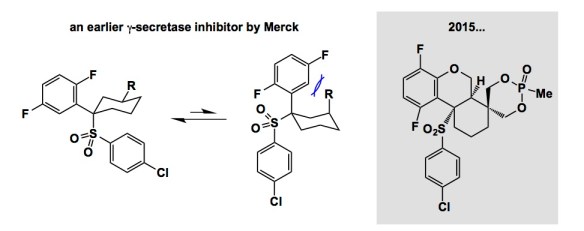
gamma-Secretase is an enzyme complex that is linked to the formation of amyloid plaques. This is why gamma-secretase is an important target for therapeutic intervention. The trouble is, known inhibitors of gamma-secretase interfere with cell-surface receptor called Notch, and inhibition of its processing is understood to be detrimental. Earlier, Merck had developed a series of gamma-secretase inhibitors, whose activity was attributed to equatiorial placement of the sulfone substituent (the axial congener was found to be inactive). There is an interesting paper in J. Med. Chem. that documents recent efforts in this program. The newly created analogs are much more effective in forcing the sulfone to occupy the desired equatorial position. How is this accomplished, you might ask? Take a look at the compound in the grey box below… When it gets close to impossible to draw a neat looking structure in ChemDraw, I know that I am dealing with one ugly molecule. I refer to how the C-F bond is depicted (if drawn straight down, it would encroach on the sulfone unit). Putting trivial matters aside, this compound is a really interesting example of problem-solving in conformational analysis. That is on one hand… On the other hand, this polycycle proves that there is just so much room for improvement in organic chemistry. I specifically refer to the dearth of atom-economical methods to enforce conformational states.Those who think this area of inquiry has matured are dead wrong. The monster in grey box features an interesting nugget: the phosphorus-containing ring. As a matter of fact, I was drawn to this paper due to this unusual heterocycle, an area that is of great interest to my lab at the moment.

33.jpg

http://pubs.acs.org/doi/full/10.1021/acs.jmedchem.5b00774

A most curious peptide bond formation

There is a Gordon Research Conference dedicated to the Origins of Life. Without a doubt, this is the most eclectic gathering of some of the oddest people in the science community. I have always wanted to attend one, but never had a chance. I can only imagine the types of heated discussions that go on there. The trouble with this branch of science is that we will, of course, never be able to run control experiments to prove or disprove any hypothesis. Thus, ideas about how life emerged are relegated to conjectures. But people keep trying and I really enjoy reading about attempts to explain how some of the primordial forms of life might have emerged.

Replication and molecular evolution using trivial (pre-RNA and pre-DNA) molecules has been shown in models, but never convincingly enough. We don’t even need to go as far as replication: thinking about how peptide bonds might have been created in water is tough enough! This allows me to bring up a curious paper by Ghadiri and co-workers, published in Astrobiology (this is not something I read all the time…). In it, the authors make a suggestion that carbon disulfide (CS2) might have acted as the coupling agent. I like this idea and I think the experiments are convincing, especially the fact that this peptide bond formation works in water. Besides COS, CS2 is certainly one of the cheapest and most readily available coupling agents, which might have been in abundance when all those sparks were flying on earth several billion of years ago.

2.jpg

http://online.liebertpub.com/doi/abs/10.1089/ast.2015.1314

Vinylogy: a force to be reckoned with

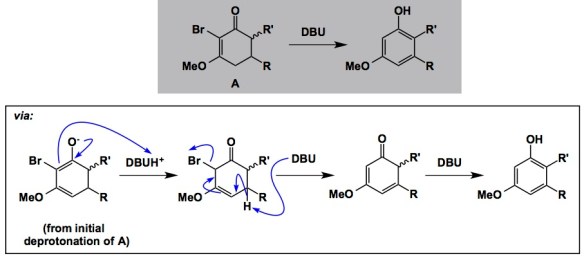
I have always been interested in mechanisms that lead to unusual elimination outcomes. Not that a decent leaving group is lacking in the reactions I am thinking about. On the contrary, a fairly middle-of-the road leaving group is, in fact, present. It’s just that the bond that is being broken is not the one you would typically expect to break. Consider the example that features an sp2 carbon-bound bromine (below). I learned about this interesting case from Professor Derrick Clive of the University of Alberta. I was in Edmonton over the past two days, attending a PhD exam of one of John Vederas’s students, Shaun McKinnie. The defense went really smoothly (it was an excellent thesis) and my long day culminated in a nice dinner with John and Shaun. But I kept thinking about the elimination sequence discovered in the Clive lab. You have to agree that it represents a peculiar reaction. The process features a tautomerization and aromaticity-driven removal of the sp2 carbon-bound bromine. While some might think that this is no miracle, especially once you consider how the double bond “dance” places bromine in a perfect position to eliminate in a vinylogous manner, I think this is the point here. The sequence offers a useful trick to make unusual phenols, among other things.

3

http://pubs.acs.org/doi/abs/10.1021/acs.joc.5b00192

Towards 2D diversity

We recently decided that there is a real need to make some new aromatic bis(heterocycles) that contain boron (http://pubs.acs.org/doi/full/10.1021/acs.orglett.5b02741)… This sounds rather random and you might ask – why?

I have a theory that the idea of diversity-oriented synthesis has been widely misused by the organic community. Below you see a slide I like to show in order to make my point. This harkens back to something I already mentioned in the past, namely that chiral centers really hurt discovery of novel protein binders (once you have a target, I am not discussing phenotypic screens). I primarily refer to fragment-based binders that are useful in finding bioactive molecules. There is nothing inherently wrong with having chiral centers, but they must enter the picture at the “right time”. This corresponds to the point when target specificity needs to be built (this is development, not the initial discovery). When chiral centers are considered too early (think of all those collections that contain obscure compounds with complex 3D structures), there is too much bias and chances to discover binders to a particular protein target are smaller. The idea of diversity-oriented synthesis has been a blessing to countless chemists by allowing them an easy way to defend reporting obscure compounds in their papers, but I don’t think there are many examples of utility against a chosen biochemical target. One might even propose that molecules can be chiral and less chiral. Don’t laugh: any oligo(heterocycle) devoid of chiral centers is, of course, bound to its receptor in a chiral conformation. In this case, I like to think of “weak chirality”.

p1

If you agree with the view that achiral molecules increase the chances of discovery, how might we innovate in 2D? One might surmise that there is no room for discovery as the vast majority of small aromatic heterocycles have been made. While this is technically not true, there are indeed real problems in designing something that is flat, composed of heteroatoms and carbons, yet novel. Enter boron. This element allows us to consider bis(heterocycles) that are unusual and totally novel from the standpoint of dipole arrangement. Are they stable across a wide range of physiological conditions? This is something we are trying to understand at the moment. For now, I would like to thank my students who have been involved in this project, primarily Dr. Shinya Adachi (now back in Tokyo, working with Professor Shibasaki) and Sean Liew (who is still with us).

2

The influence of reaction exothermicity on kinetics

The principle of microscopic reversibility (PMR), Curtin-Hammett principle (CHP) and Hammond postulate (HP) are the three pillars of organic reactivity. PMR enables us to construct a reasonable reaction path if the mechanism of the reverse process is known. CHP tells us that stability and reactivity do not necessarily correlate, whereas HP allows us to infer about the transition state structure using intermediates that are sometimes detectable and/or isolable. It is difficult to see what we would do without these fundamentals.

I am teaching my first year organic chemistry course and, while we do not go into the details of PMR and CHP, we do discuss the main elements of HP. The reason HP is useful is that it allows us to weed out the pervasive fallacy “Compound Z must be the reaction product because Z is more stable than the alternative Y”. While I have a habit of saying that it is generally incorrect to state that more stable things are kinetically preferred, it is not necessarily true and here is an example.

Professor Alabugin (http://www.chem.fsu.edu/~alabugin/), whose great talk I just heard at the conference in Moscow, recently published an influential paper in which he re-examined the course of some anionic cyclizations. It appears that there must be a major re-evaluation of some stomping grounds of cyclization mechanisms involving alkynes. The 4-endo/5-exo comparison presents a particularly interesting scenario: the reason for the lower barrier to form the 5-membered ring lies in the exothermicity of the reaction. In other words, the transition state that leads to the formation of the 5-membered ring is lower because the product is more stable. This is an important application of the Marcus theory to polar mechanisms.

2

http://pubs.acs.org/doi/abs/10.1021/ja203191f