A matter of control

There has been a lot of discussion about Perola’s claims that 60% of drugs do not bind their targets in a local minimum conformation (http://pubs.acs.org/doi/abs/10.1021/jm030563w). Many people have challenged this viewpoint, saying that it is as an artifact of errors of crystallographic analysis. While I am still not sure which side of the debate I am on, it is good to remember that innate conformations of organic molecules are governed by a few well-understood principles. Let’s talk about allylic strain and its relevance to biological activity. Earlier today I was wondering about cases that display powerful, yet subtle, “allylic control” over bioactive forms. If such occurrences could be traced to (hopefully) one correctly positioned substituent, a particularly good lesson might be served. I looked through my vault of papers and retrieved a classic on dihydropyridines, which are celebrated calcium channel blockers (http://onlinelibrary.wiley.com/doi/10.1002/anie.199115591/abstract). Take a look at Scheme 12. Here we have an awesome manifestation of A1,2-strain that “pushes” the nitrophenyl group in axial orientation. Incidentally, the NO2 portion of the molecule is not some innocent by-stander. This group enforces adoption of the desired conformation, which is why I love this example: the conformational control can be attributed to a small group.

2

To move the sweet spot

I just came back from KOST-2015, an international congress on heterocyclic chemistry in Moscow, Russia. The conference was superbly put together by my friends, Profs. Nenajdenko and Vatsadze in memory of Prof. Kost (http://www.kost2015.ru). Of all the scientific vignettes I was exposed to, one particularly thought-provoking insight comes to mind. It deals with the inner workings of Prof. Togni’s electrophilic trifluoromethylation reagents (http://pubs.acs.org/doi/pdf/10.1021/cr500223h). In his talk, Togni described the genesis of this research program and commented on a variety of nucleophilic partners that can be trifluoromethylated with the help of his hypervalent iodine-containing molecules. I am showing one of them below without any intent to dwell on the specific reactions. Two forms exist: the parent and the protonated one, with the latter being the desired electrophilic trifluoromethylating species. In order to maintain high selectivity of CF3 transfer, one needs to avoid decomposition by way of premature cleavage of the Cphenyl-I bond. If one maintains the oxygen atom in its protonated form, this detrimental pathway is avoided. The question is: why? This is where frontier orbitals come to rescue. I am not going to show their symmetry as it would be rather tedious. In the aforementioned Chem. Rev. article, you can see all those red and blue blobs. The key is that protonation changes the area where LUMO is localized, offering a compelling rationale for why the non-protonated form is labile at the Cphenyl-I bond. I thought this is a great example of using frontier molecular orbitals to explain the reactivity preferences and I hope students take this lesson to heart. There is no way there is anything terribly complex in some of these computations.

If you wonder where those hypervalent iodine species come from, they are derived from TMSCF3, whose chemistry I had a pleasure of working on in Professor Prakash’s lab a while back (http://pubs.acs.org/doi/abs/10.1021/cr9408991). It is curious that, among many different areas of use, the nucleophilic trifluoromethylating reagent (TMSCF3) has found application in efforts to generate electrophilic trifluoromethylating reagents.

2

On formyl hydrogen bonds

We had a lively discussion regarding the ene reaction at our weekly group meeting today. This was done as part of a synthesis problem set and reminded me of an under-appreciated principle that should remain important in attempts to understand aldehyde reactivity. I refer to formyl hydrogen bonds, the likes of which are on display in a recent paper by Krische and Houk in JACS (http://pubs.acs.org/doi/abs/10.1021/jacs.5b04844). The appreciation of this interaction goes back to the foundational studies by Corey and co-workers. Here is a link to a great overview that covers some of the structural aspects of the formyl hydrogen bond: http://pubs.rsc.org/en/Content/ArticleLanding/2001/CC/B104800G. I have also included the accepted transition state model for the Lewis acid-catalyzed ene reaction developed by Mikami and colleagues. This constitutes a particularly striking example of the capacity of aldehydes to participate in hydrogen bond formation. There have been several X-ray structures that provide atomic level evidence for formyl hydrogen bonds. On various accounts, it is estimated to be worth between 6 and 9 kcal/mol, which is not insignificant. By all means, Lewis acid coordination to the aldehyde oxygen atom enhances the acidity of the aldehyde CH functionality.

2

Synthetic edge

We had Silas Cook (Indiana University) visit our department earlier this week. This occasion presented an opportunity to learn about both his iron catalysis and total synthesis efforts. Silas’s imaginative route to artemisinin appeared in JACS several years ago and it remains a landmark of synthetic efficiency. You can see the paper in its entirety if you follow the link below, so I am just going to comment on one step – the Wacker oxidation to generate the ketone precursor. The reaction was done on a 9.4g scale. The search for the optimal condition had attracted my attention. Everything else went fairly miserable, but the hydrogen peroxide-mediated version of the Wacker process delivered the product with good yield. I appreciated hearing this story, particularly during the week when we heard about the Medicine Nobel Prize for the discoveries of artemisinin and ivermectin. As you may also know, Jay Kiessling of UC Berkeley has received a ton of attention (and tens of millions of dollars worth of funding) for his synthetic biology effort to find a production route to artemisinin, yet the jury is still out in regards to the economics of that method. Silas, on the other hand, is offering something really reasonable and inexpensive. My vote is with his synthesis.

2

http://pubs.acs.org/doi/abs/10.1021/ja3061479

Nobel Prize for Medicine

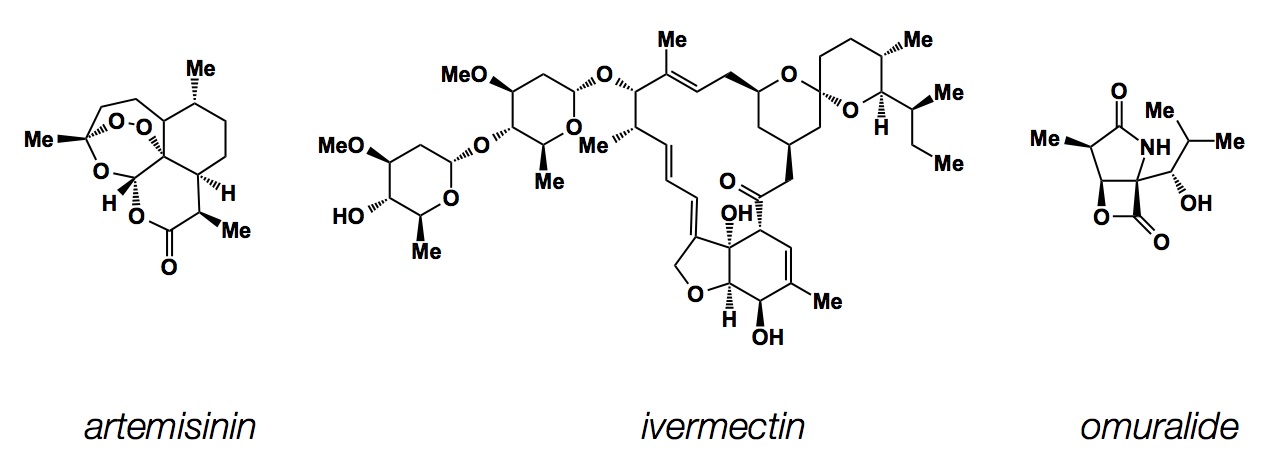
I was really glad to see the Physiology/Medicine Prize go to the natural products researchers Tu Youyou, Satoshi Omura, and William Campbell (http://www.nobelprize.org/nobel_prizes/medicine/laureates/2015/). Tu’s work decades ago had led to the discovery and development of artemisinin, which then went on to save countless lives. I was interested to learn that the anti-malarial program was launched by the Chairman Mao in response to the abysmal loss of life to malaria during the Vietnam war. Countless scientists, including Tu, were mobilized to evaluate the traditional Chinese pharmacopoeia with the goal of finding the “magic bullet”. This was an all-out effort that culminated in an amazingly simple insight on behalf of Tu: to extract qinghao’s active ingredient using cold, not typically prescribed hot, solutions. Of course we know that artemisinin is distinguished by the presence of a peroxide bridge, which makes the molecule heat-sensitive. Omura and Campbell were in turn recognized for their work on ivermectin. This is a great story in itself as it also highlights Merck’s timely attention to the discovery of life-saving therapeutic therapeutics by academics. Professor Omura is well known for many other natural products, including impressively selective proteasome inhibitor omuralide (it is easy to see we where that name comes from).

ttt

Catalyst precursors from blood

My wife is a hematologist, so we talk about blood disorders all the time. Since she has a biochemistry background, it is easy for us to communicate on a level that is somewhat molecular in nature. I lose her when we start considering clinical aspects of blood disease – this is way over my head.

In regards to molecular components of blood, I was glad to hear Professor Rudi Fasan’s advances in the area of cyclopropanation while in Rochester last week. Myoglobin is what links Rudi’s work with my post-dinner discourses with Jovana. In his Angewandte paper, which was published at the beginning of this year, Rudy and his team were able to show that myoglobin catalyzes cyclopropanation of olefins. Coupled with its function as oxygen carrier in the heart and skeletal muscles, this cyclopropanation business makes myglobin ever more interesting. Scalability and surprising robustness (up to 46,800 TON) are the most remarkable features of this system. I particularly liked the rational approach to improving catalytic efficiency through site-directed mutagenesis. As you might imagine, there are just so many reactions out there that involve activation of diazo compounds using transition metals. I think that the future for atom transfer processes using the constituents of blood is a bright one.

4

http://onlinelibrary.wiley.com/doi/10.1002/ange.201409928/abstract

The crystal ball of chemistry

I concluded my productive trip to the University of Rochester yesterday, but not before I had a chat with Professor Damien Krysan. Damian has an interesting background, having worked at Abbott (medicinal chemistry), before doing an MD degree, which led to a faculty appointment at the University of Rochester. He is interested in antifungal agents and high-throughput screening, but this is not what crystallized my thoughts on the subject of today’s post. When Damian described his Abbott days, he reminded me of the early phases of using the AD (asymmetric dihydroxylation) process in industry. The development of the AD reaction was one of the truly exciting periods in the Sharpless lab and, although these developments predate my postdoctoral stay with Barry, I fondly remember some of the first-hand accounts of how the reaction evolved from the original pyridine effect defined by Criegee in the 1930’s (http://pubs.acs.org/doi/abs/10.1021/cr00032a009). The AD process acquired its rock-star status in the 1990’s, such that there was hardly an issue of JOC or JACS that did not contain an application of this technology in synthesis. The reaction was widely adopted in industry and, one might argue, ultimately defined many drug synthesis campaigns. This exemplifies a fascinating aspect of synthesis as it enables synergy between industrial needs and academic science. I want to make an argument that, in the ideal world, there must be a “perfect storm” of factors that lead to an explosion of interest in a particular synthetic process.

Just think about it: what were the biochemical targets at the very top of pharma’s wish list at the beginning of 1990’s? Undoubtedly, many of them were HIV proteases. Logically, sp3-righ frameworks decorated with vicinal heteroatom arrangements can be seen in a ton of protease inhibitor structures. This helped to popularize the AD process as it opened a clear path to molecules of that type. You do not see comparable levels of utility of this reaction nowadays, do you? This is because pharma has moved on and targets of today differ substantially from those of yesterday. As a corollary to that, one of the best things a synthetic chemist might want to do is anticipate the upcoming biological targets. I do not think anyone does this sort of stuff, but I can see how the knowledge of relevant chemotypes that tend to hit promising biological targets can only help those who want to stay ahead of the curve and make their chemistry widely used. I think that metal-catalyzed amination of aryl halides is another great example. Here we have a reaction whose development coincided with an explosion of interest in kinase inhibitors. Having said that, there was no biological “foreshadowing” of the fundamental studies by Buchwald and Hartwig (and I am not saying that there should have been one – it all worked out perfectly anyways).

Of course, an equally fascinating suggestion is that a simple-to-run process might influence the direction of drug discovery in industry. Indeed, synthetic chemists who work in pharmaceutical companies emerge from academia with unique preferences (there is a reason that Lipitor contains a pyrrole ring: Bruce Roth, the discoverer of this cholesterol-lowering agent, worked on pyrrole chemistry as part of his PhD). You might then say that it is a pity that reaction developers rarely care about biological relevance of their work and are not necessarily attuned to the latest trends of drug industry. However, perhaps none of this makes sense any longer because pnenotypic screens tend to drive industry as opposed to target-driven work. I don’t know.

The demons of entropy in cross-coupling reactions

I have been absent for some time. Last Friday I gave a talk at Xerox in Mississauga and, ever since Sunday night, I have been at the University of Rochester as their Chambers Memorial Lecturer for 2015. This visit has given me an opportunity to learn about a ton of new chemistry and, thus far, my visit has been tremendously satisfying. Because I was asked to give three different lectures, I anticipated that this experience would be more intimidating than my typical visit to a school. At the end, I think I was able to find my groove and prepared three different talks.

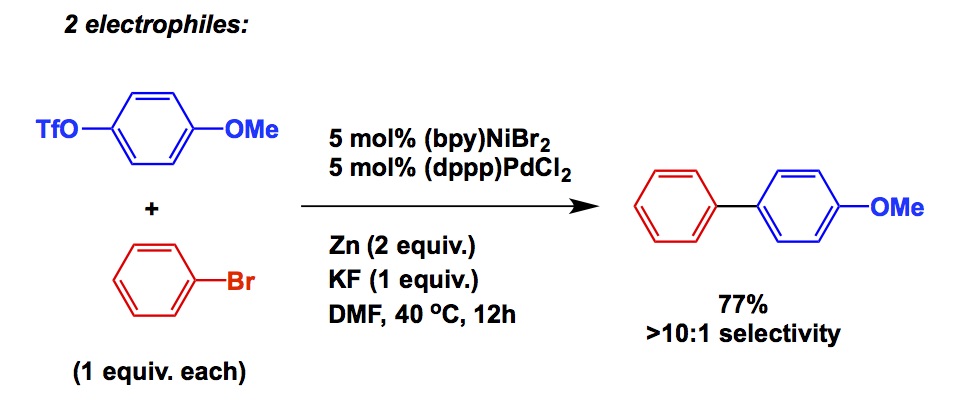
I have followed the work of Daniel Weix for some time and was keen to learn about his lab’s recent advance published in Nature. This paper is interesting for several reasons. First of all, it describes a solution to the problem of making unsymmetrical biaryls from two different electrophiles, which runs counter to the conventional way of joining a nucleophilic species (e.g. a boronate) and an electrophilic one (e.g. an aryl halide). The solution offered by the Weix lab has come in the form of a multimetallic system comprising nickel and palladium. While the idea might seem transparent on paper, the devil is in the details and the realization of unsymmetrical coupling has been elusive and took years to develop. Apart from some really interesting scope study (just look at compound 19), there are notable mechanistic lessons in this paper. In my view, the most important of them relates to confronting entropic factors (in other words, reducing the possible amount of products you might imagine here). It turns out that the palladium intermediate formed does not react with itself, is stable, and accumulates in solution. On the other hand, the nickel intermediate is “hot” and transient. It has capacity to react with itself or with the aforementioned palladium complex. Understanding the relative concentrations of these species in solution holds the key to attaining high selectivity of this reaction. When Daniel described this system to me, I was also left with the impression that potassium fluoride played a very important accelerating role in this imaginative catalytic process.

bb1

http://www.nature.com/nature/journal/v524/n7566/full/nature14676.html

Homologing reactions

Tonight I want to talk about reaction homologs. This is one of those enduring ideas in chemistry, representing what is consistently coming to the minds of those who are interested in developing new reactions. “Homologing” is when you have a process that gives a product that differs from its established predecessor by formal insertion of a one-carbon unit somewhere in the framework. For instance, in the case of a Diels-Alder reaction, a version that results in a seven-membered ring would be a homolog. Paul Wender did some really nice work in this regard, resorting to vinyl cyclopropanes in place of dienes. In the case of a pericyclic process, there is just no way that the homolog formation proceeds by the same mechanism as its “origin”. It just can’t happen. However, polar reactions are not that stringent and one-carbon “insertions” are often tolerated. The caveat is that those are almost obvious and not that interesting.

I have always been attracted to interesting workaround solutions to homologing reactions that proceed via polar mechanisms. I do not see too many of them these days, but there are many examples that were developed in the past. Below is an example of a homo-Robinson annulation. The venerable Robinson annulation to make fused rings is the permanent fixture in advanced undergraduate classes, but what if you want to form a seven-membered ring instead? About a decade ago, Sam Danishefsky developed a really nice way to carry out this transformation. Below is the way it works. The reaction served Sam well in the synthesis of guanacastepene.

2

http://www.sciencedirect.com/science/article/pii/S0040403905007264

The ugly fourth state of matter

Take a look at the molecule shown below. It looks innocent and fairly drug-like, wouldn’t you say? It is in fact perfectly soluble in buffers and does not contain any electrophilic “red flags”. But if you are equipped with a DLS (differential light scattering) instrument, you will discover the ugly truth that lurks behind the veneer of innocence here. It turns out that at 4 micromolar concentration, this molecule is a nasty aggregator, one that forms gigantic (well, relatively speaking) colloidal particles of 2312 nm in radius.

Many small organic molecules form aggregates in aqueous solution, which has long had a rather perilous effect on drug discovery. Proteins you are trying to assay tend to stick to the surfaces of these particles rather well, which leads to nonspecific inhibition or, curiously, enzyme activation. This results in major aggravation and supplies a never-ending list of false positives in drug discovery. The behaviour of colloidal particles is so “outside the box” that they are often referred to as the fourth state of matter (besides liquid, gas, and solid).

There are additives such as Triton-X100 one can use in order to disrupt aggregation, but Brian Shoichet and colleagues at UCSF recently developed something better – a computational method that uses lipophilicity and similarity to known aggregators to inform on the likelihood that a candidate compound is an aggregator. In my view, this is a very timely study (there are many previous papers on this subject from the Shoichet lab). If not a complete solution, this work reminds us that there are factors other than inherent structural properties of those nicely docked molecules on our computer screens that might be responsible for the effects we observe.

2

http://pubs.acs.org/doi/full/10.1021/acs.jmedchem.5b01105