Too engineered?

Click chemistry has been a major force behind the development of innovative technologies in materials science and chemical biology. The general accessibility and ease of protocols has been a welcome bonus point, especially for those who are not trained in chemistry. If one can figure out how to place an alkyne and azide components where they need to be, this kit-like approach to building molecules from simple blocks can be tremendously enabling: all you need is to add a copper catalyst. There are also copper-free protocols for running triazole synthesis. These surrogates often hinge on the idea of strain relief (Caroline Bertozzi has been one of the pioneers in this area).

When I attended the 2016 Gordon Conference on Peptide Chemistry and Biology a couple of weeks ago (this meeting was superbly organized by Phil Dawson), I got to hear a thought-provoking talk by Jim Heath of Caltech. He uses click chemistry in order to discover macrocyclic ligands for epitope targeting. Because the presence of copper adversely affects biology, Heath uses the copper-free protocol. However (get this), he is not using any strained alkynes… When I heard it, I got really curious about the underlying reasons for how might a pair of molecules react in a [3+2] fashion at room temperature without any “extra help”. I asked Jim this question and found out that there are, in fact, no miracles here: his yield is abysmally low. While I appreciate that this is not a preparative reaction, I really wonder: why would one want to use the azide/alkyne cycloaddition here to begin with? I would hazard to guess that this constitutes the least interesting of all processes that could be run in the Heath format. Personally, I would be much more interested in looking at some of the pillars of chemistry (amide bond formation?) under his conditions. Sometimes truly interesting things might arise from more conventional processes, and it might also be easier to put together the starting materials. But this is just my view.

http://onlinelibrary.wiley.com/doi/10.1002/anie.201505243/full

Uncommon nitrogen sources

There are a lot of nitrogen sources in chemical synthesis and they come in great variety, serving the insatiable appetite of reductions, oxidations, and redox neutral transformations. It is good to see how bond-breaking and making events are orchestrated around the needs of some reagent that contains the “active” form of nitrogen. I particularly like reading about cases wherein nitrogen transfer stems from nitrogen-heteroatom bond breaking. In these instances, I turn a blind eye on low atom economy. Who cares? All I want to see is “molecular gymnastics”. Below is an instructive recent transformation, whose sequence I abbreviate for clarity’s sake. My appreciation of this synthesis of a fused pyridine ring system has to do with how an azo compound undergoes in situ transformation into a diaziridine oxidant, which leads to the eventual scission of the N-N bond during electrophilic aromatic substitution. What we see here is a fairly rare side of azodicarboxylate, which is a common component of redox condensations such as Mitsunobu reaction.

33.jpg

http://pubs.acs.org/doi/abs/10.1021/acs.orglett.6b00456

Exotic enolates

I have been away a lot – first at the Gordon Conference on the Chemistry and Biology of Peptides (Ventura, California) and then at the Royal Society of Chemistry’s Editors Meeting in London, UK. Now I am finally back and have some time to write.

I want to talk about unusual enolates today. The one implicated in Haufe’s anti-selective aldol reaction that was captured in his recent Org. Lett. publication is as good as it gets. There are many people who are interested in the SF5 group these days. There are myriad reasons for this surge and I mentioned some of them in the past, particularly the materials science angle. Haufe’s work suggests that ester enolates that contain an SF5 substituent are subject to some fairly reliable aldol chemistry, which is interesting because this represents a nice way to “plug” SF5 into a chiral, sp3-rich environment. Up until now I have mainly seen the “aromatic” aspects of SF5.

The starting ester used by Haufe is prepared on scale using a really cool reaction between SF5Cl and a ketene. This process has been known since the 70’s, so check it out (reference 16 in Haufe’s Org. Lett.). I should mention that Professor Haufe of the University of Müenster is no stranger to fascinating transformations of organofluorine compounds. He has been at it for a number of years and is currently one of the Regional Editors of the Journal of Fluorine Chemistry.

3.jpg

http://pubs.acs.org/doi/full/10.1021/acs.orglett.6b00136

Cryptic intermediates

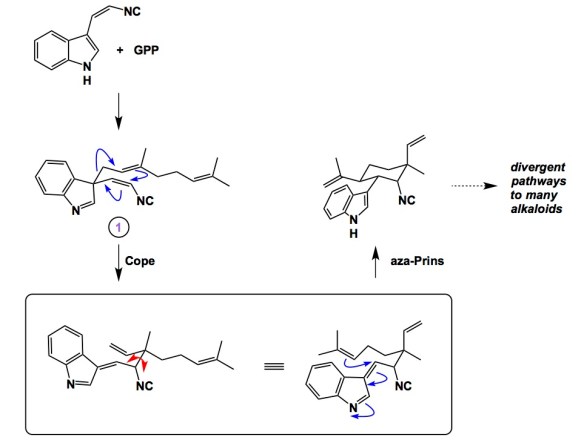
Here is an interesting and teachable case that seamlessly merges the elements of biosynthesis and fundamentally important classic organic chemistry. Liu and colleagues report indolenine 1 as the “cryptically conserved” intermediate in the biosynthesis of hapalindole-type alkaloids. It all starts with the magnesium-dependent formation of 3-geranyl 3-isocyanovinyl indolenine from cis-indolyl vinyl isonitrile and geranyl pyrophosphate (this process is enzymatically catalyzed by AmbP1). What ensues is an interesting Cope/aza-Prins cascade, which ultimately leads to divergent pathways to hapalindole-type alkaloids. Besides an intriguing biosynthetic route, this work is important as it opens doors for understanding the molecular basis of the metal dependency of prenyltransferases.

Hapalindole alkaloids have received their fair share of attention in the synthetic community, but only Ang Li et al’s work (http://onlinelibrary.wiley.com/doi/10.1002/anie.201406626/abstract) foreshadowed the Cope/aza-Mannich biosynthesis put forth by Liu. While it is nice to read such stories, I am not suggesting that the present case is an exception. The most famous case of “foreshadowing” is perhaps Stork’s classic work on enamines, which had appeared way before type I aldolase mechanism was elucidated.2.jpg

http://pubs.rsc.org/en/content/articlehtml/2016/cc/c5cc10060g

Remodelling the Schmidt reaction pathway

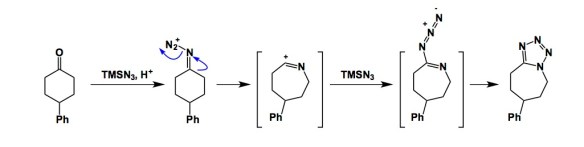
Not long ago, I talked about the power of the Aubé-Schmidt reaction in the synthesis of unusual amide structures. I just saw a JOC report by the Aubé lab that details a rather unusual outcome of this process when TMSN3 is made to react with ketones in the presence of triflic acid (TfOH) promoter. In the course of this reaction, tetrazole formation turns out to be the predominant pathway. This outcomes stands in contrast to established protocols in which one typically expects to see lactams or amides through formal NH insertion into the C-C(O) bond. This mechanistically distinct process hinges on the prior discovery that 1,1,1,3,3,3-hexafluoroisopropanol (HFIP) acts as the catalyst and reduces the number of equivalents of acid needed for good conversion in the Aubé-Schmidt reaction. In the most recent embodiment, the sequence of iminium ion formation / isonitrilium ion formation / ring-expansion, is observed. To sum up, the reaction between azides and carbonyl compounds continues to have an enduring impact on the synthesis of small molecules.

2.jpg

http://pubs.acs.org/doi/abs/10.1021/acs.joc.5b02764

Looks like dementia might be in decline

Here is an important paper that will likely cause a lot of interest and debate. The work published in The New England Journal of Medicine (NEJM) describes the Framington Heart Study, participants of which have been under surveillance for dementia since 1975. This is an extensive analysis of 5205 persons 60 years of age or older. The main conclusion here is that the incidence of dementia has declined over the course of three decades in high-income countries. In the interest of full disclosure, I am not saying that I have read the manuscript carefully. The description of methodology in a typical NEJM paper is above me. However, the conclusions are exhilarating because recent projections have suggested that there would be a significant burden of dementia over the next four decades owing to longer life span and associated higher number of older persons at risk. The actual decrease reported by Sephardi and co-workers (up to 44% per epoch of the surveillance period) is quite interesting. The understanding of the underlying phenomena is clearly incomplete and delineation of possible causes is needed in order to accelerate the beneficial trend. These kinds of findings go against expectations and show that we really do not have a clue when it comes to cataclysmic predictions. At the dawn of the 20th century people thought that horse manure would be the biggest environmental threat. And then cars came around… Incidentally, NEJM has the highest impact factor – higher than Science or Nature – which is kind of remarkable because this is, in fact, a rather specialized medical journal.

http://www.nejm.org/doi/full/10.1056/NEJMoa1504327

Polycycles galore

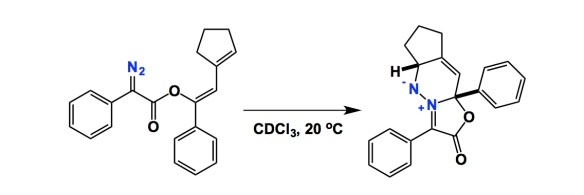
I don’t want you to think that I have been reading only Diels-Alder literature of late, but I found the recent JACS paper from Michael Doyle’s lab to be quite remarkable. The authors report a mild conversion of diene-tethered diazo compounds to the corresponding [4+2] cycloaddition products. Prior to the Doyle work, diazo compounds were not known to partake in cycloadditions of this kind. When I read stuff like this, I inevitably ask myself: how many times such a reaction happened (unbeknownst to the experimentalist) in the past? You have to agree that people must have studied metal-catalyzed intramolecular cyclopropanation processes in which a diene was evaluated as the carbenoid acceptor. But then maybe no one bothered to evaluate dienes in that capacity. Otherwise, how can one possibly imagine that a room temperature pathway to the Diels-Alder adducts shown below has remained veiled for so long? There is some gold-based catalysis described in this paper as well, but it is the room temperature transformation in chloroform that is surprising.

2.jpghttp://pubs.acs.org/doi/abs/10.1021/jacs.5b12877


Going after riboswitches

Non-coding RNA structures called riboswitches are known to regulate gene expression. As opposed to proteins and nucleic acids, riboswitches have remained a largely underdeveloped class of drug targets. A team from Merck recently reported the discovery of ribocil, a compound that selectively modulates bacterial riboflavin riboswitches. The small molecule was identified as part of a phenotypic screen. Ribocin was found to inhibit bacterial cell growth by repressing ribB gene expression. Specifically, this new molecule competitively mimics the natural ligand of a bacterial riboswitch, namely flavin mononucleotide (on the right hand side of the graphic below is a representative riboswitch complexed with flavin mononucleotide). I think it is exciting that small molecules can now target non-coding RNA structural elements. One cannot help but notice structural similarities between ribocin and a number of well known kinase inhibitors, which begs a question about the possibility of repurposing some of those “usual suspects”.

3.jpg

http://www.nature.com/nature/journal/v526/n7575/full/nature15542.html

A cool new reduction of amides

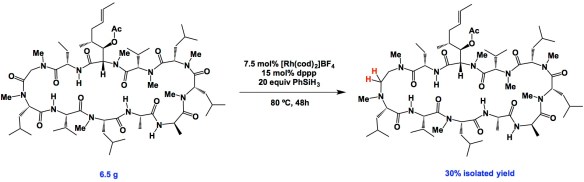
Beller and co-workers recently published a superb new method for reducing tertiary amides into amines. The reaction is tolerant of a wide range of functionalities including ester, thiomethyl, nitrile, secondary amide, and hydroxyl groups. This post is timely from my perspective because we just had a group meeting discussion about what is new and what is old in the area of reduction technologies. My point at that meeting was that, while there are some incredibly innovative and functional group tolerant methods in contemporary literature, it is important to keep in mind some of the more obscure and less known processes. But old and obscure will be the subject of another post (when we reduce some of our ideas to practice – no pun intended).

Back to Beller’s innovative new chemistry: the most useful aspect here is that no air-sensitive reagents are involved. The reaction uses readily accessible phenylsilane and a rhodium(dppp) catalyst. A fairly extended portion of the paper is dedicated to just one experiment that describes selective reduction of one of cyclosporine A’s tertiary amides (the O-acetylated version of the molecule was used in this process). I am really curious who was brave enough to use 6.5 g of cyclosporine A in this reaction (Sigma Aldrich charges $180 per 25 mg). This has to be connected to the fact that one of the co-authors of this paper is from Novartis (in Basel). Given the continuing interest in cyclosporine A and related compounds, it would be interesting to find out the cellular permeability of the partially reduced version.

2.jpg

http://onlinelibrary.wiley.com/doi/10.1002/anie.201503584/abstract


The right place at the right time

I am in Ottawa at the moment, attending the 2016 CHRP (Collaborative Health Research Projects) grant review panel. I wish all of the grants I had to read would get funded! The level of science is quite high. Now is our coffee break, so I have some time…

Today is a second post in a row where I mention some kind of azide chemistry. That’s ok because, as someone who has been interested in aziridine chemistry for a while, I can’t let the recent Angewandte paper by Shen and colleagues from Changzhou go without due notice. Below you see a graphical summary. While there is nothing new in intramolecular Diels-Alder reactions, it is always good to see cases in which a particularly unstable dienophile is created. In the present case, the authors show how vinyl azides undergo thermal transformation into azirines, which are then positioned at the right place and time to undergo [4+2] cycloaddition. Good luck making the resulting tricycles by any other means! I think the “latent azirine concept” is quite neat and should find many applications in alkaloid synthesis, among other things. Someone should come up with a quantifiable metric for how rapid complexity increases in a single transformation (maybe it already exists, but I just can’t think of it at the moment). The Shen paper is really impressive in this regard, although (there is always this “although”…) one has to make some fairly obscure starting materials.

2.jpg

http://onlinelibrary.wiley.com/doi/10.1002/anie.201510096/abstract