Shifting sigma bonds in concert

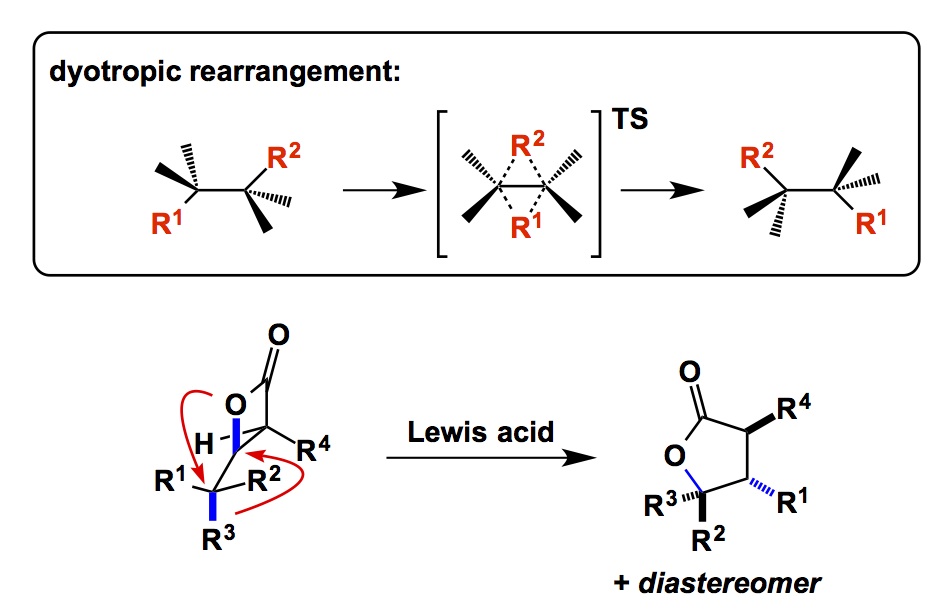
Nowadays, when one talks about discovering new reactions, one quickly realizes that there’s not a whole lot of fundamentally new elementary processes that remain unknown. As a result, novel reactions tend to be “composed” of different permutations of well-known elementary processes. Every now and then a mechanistically distinct transformation pops up. I keep an eye on reactions of that sort. Daniel Romo’s elegant experimental work coupled with Dean Tantillo’s theoretical approach provide a glimpse at some useful, yet fairly uncommon, types of reactions – the so-called dyotropic processes (see the graphic below). In sigmatropic rearrangements, a pi/sigma-system undergoes a transformation that results in a net translocation of one sigma bond and concomitant shift of the pi-system. In contrast, dyotropic rearrangements describe simultaneous migration of two sigma-bonds.  Evidence in the JACS report cited below suggests that, depending on the nature of the Lewis acid, a concerted or stepwise mechanism takes hold. While reactions of this kind have been known for some time, they have not reached the mainstream of synthesis. I think there is a lot of room for reaction discovery using this mode of reactivity in the context of complex electrophiles.

Image

http://pubs.acs.org/stoken/beta/select/abs/10.1021/ja303414a

Displacement of ice rings

Small molecules come in all sorts of different shapes and are capable of wonderful things. Of particular significance are those privileged types of small molecules that interact with their protein targets with high ligand efficiency. I will dedicate a future blog post to the concept of ligand efficiency, but I am sure that we all “feel” what it means without any formal definition. Ligand efficiency is a measure of how well a given molecule engages its innate features when it interacts with a protein target. Understanding the balance of enthalpy and entropy in this type of molecular recognition is paramount in probe/drug design. Great strides have been made in explaining (through docking simulations) how and why organic molecules interact with their targets. A lot of the developed algorithms work extremely well (Schrodinger’s Glide package is my favorite at the moment). The simulations may not have the best predictive power, but they are certainly capable of explaining experimental facts. Or are they?

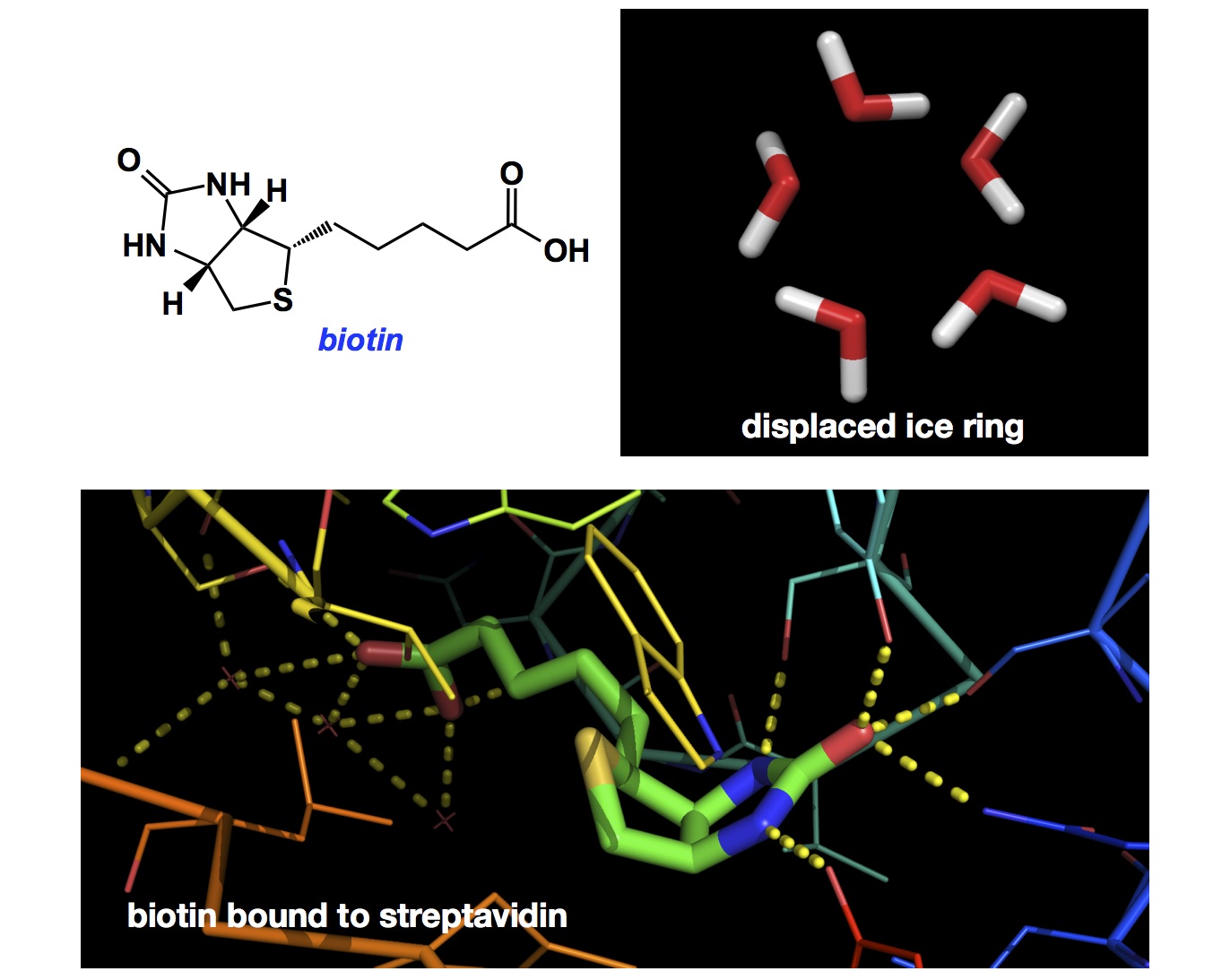
I give you one of the workhorses of molecular biology: biotin/streptavidin interaction. Everyone is aware of the significance of this non-covalent “glue”. There are many examples of affinity experiments that utilize the strength of biotin/streptavidin pair. Personally, I have been in awe of this system because I just don’t get it: how the heck is such tight binding possible? You look at the dinky little biotin molecule and there is just no way to expect that its binding interaction with streptavidin would be on the order of 10-14 mol/L (I mean the dissociation constant, Kd). It turns out that sophisticated modern simulations have a heck of a trouble predicting this extreme ligand efficiency. The experimentally determined binding affinity is ORDERS of magnitude higher than predicted. So what is the basis for this impressive affinity?

Image

It turns out that the reason likely lies in the amazing five-membered, ice-like ring of water molecules that is present in the binding site of streptavidin. Biotin is uniquely geared towards displacement of this “ice-ring” arrangement from the binding site, which generates a huge entropic driving force (see the graphic above showing the ring and the ultimate structure where biotin is in its place). There is still no way to predict this kind of behaviour computationally, I am afraid. The lesson here is that displacement of ordered waters is a VERY attractive way towards designing super-ligands. Berne and co-workers have published a very insightful PNAS paper on this subject several years ago (I thank Robert Campbell of Queens University for bringing this work to my attention):

http://www.pnas.org/content/104/3/808.long

On controversies in chemistry

As you have probably noticed, I am not using this blog as a forum to dwell on controversial, if not scandalous, topics pertaining to research. My goal is to comment on the exciting aspects of chemistry using current literature and some of the classics from the past that may have gone unnoticed or are being forgotten. We do need to have a system for our students to keep in mind that certain areas, despite claims by some overzealous practitioners of modern synthetic chemistry, were not actually discovered in the past 5 years. Instead, they might have remained under the radar for a while. I can speak from my personal experience in the field of trifluoromethylation. When I was working on my PhD aimed at silicon-based trifluoromethylation reagents with Prakash and Olah, very few people were involved in it (apart from the tightly knit fluorine community). Nowadays, everyone and their uncle is running trifluoromethyl group transfer processes and I notice, with surprise, that Burton’s, Prakash’s, Chambers’ papers are often not cited at all. Alas, rediscovery is a common irony of chemistry.

There is a lot to be said about scientific scandals that erupt from time to time. These scandals are sometimes caused by a report of an alleged attempt to manipulate data. I don’t even want to rehash this right now – you all know some of the recent cases, I will not turn my blog into a tabloid. I do think that deliberate mispresentation of data is wrong for many reasons. But discrepancies eventually get caught and mechanisms for catching fraud are more sophisticated now compared to 20, or even 10, years ago. Publishers are becoming irritated with those in the blogging community, whose goal is to seek and disclose fraudulent research. In the opinion of many journals and their editorial boards, exposure cannot be left to bloggers because there is little accounting for what is put in the public domain using this mechanism. Chembark (http://blog.chembark.com) is an interesting example. Recently, its owner Paul Bracher wrote a long rebuttal to the editorial that appeared in ACS Nano. You can take a look at it yourself. While I agree that spreading news about research misconduct using blogs is far from an ideal mechanism, we should remember that some people’s passion is to find faults in others’ papers. This activity is going to be difficult to regulate. However, if someone equates exposure of mistakes to the advent of internet, I would direct them to Caltech’s Richard Marsh. The phrase “getting Marshed” was coined in the 80’s when Dr. Marsh would periodically publish a paper in which he would comment on the mistakes he has found in published crystallographic group assignments. I can tell you: everyone was wary of getting Marshed.

Ryan Hili – the group page is live

Earlier today I was bouncing ideas about updating our lab webpage with my student Adam, which reminded me to check out how Ryan Hili was doing. I was happy to find his lab’s web page. Check it out: http://www.hili.uga.edu. A few words about Ryan, now an Assistant Professor at the University of Georgia. He did his PhD in our lab and laid the foundation for our inroads in the area of amphoteric reactivity, particularly with regard to the chemistry of aziridine aldehydes. I described some of this work in my previous posts. Upon graduation, Ryan accepted a postdoctoral position at Harvard and spent time with Professor David Liu. While in the Liu lab, Ryan developed an imaginative approach to evolve unnatural polymers. This experience has further shaped his interests for an independent program, which he initiated this past September. It looks to me that Ryan already has a lively group of students and his lab is up and running. My group and I will follow the direction of Ryan’s research and we wish him luck in his independent explorations!

It is 11:30pm and my wife and I just landed in Calgary, Alberta. We are about to drive to Banff through all these beautiful mountains. I should have listened to my student Sean who told me to drive during the day and enjoy the scenery!

On selective sulfonamide transformations

Chemoselective ways of making amines have been and continue to be a special type of craft in organic synthesis. I have heard several people say that adding one nitrogen to a molecule a graduate student is working on adds a year to his/her PhD… I suppose this is why I have a deep admiration for Fukuyama’s seminal studies in nosyl chemistry.

We had a group meeting a week or so ago when Frank Lee, a first year graduate student in my lab, put together a problem set dealing with a neat new way of deprotecting mesylates. This reaction comes from an Org. Lett. paper published in 2010 by Urabe and colleagues from the Tokyo Institute of Technology and it involves the N-mesyl functionality. The mesyl group has always been a bit of an outlier. Even the mechanism of mesylation is distinctly different from the one that we teach in the case of tosyl chloride. In Urabe’s case, it turns out that you can (almost) take advantage of the reverse process upon hitting a mesyl-protected amine with a strong base. You need a couple of equivalents of BuLi, along with oxygen sprinkled in between. Taken together, these steps offer a really nice base-promoted way of chemoselective removal of the mesyl group. Very significantly, other sulfonyl protectiong groups (such as Ts) survive these conditions because they do not possess acidic hydrogens. I can sense some far-reaching possibilities for chemoselective polyamine synthesis here… Thank you, Frank, for locating this useful paper!

Image

http://pubs.acs.org/doi/abs/10.1021/ol100086j

Clockwork

Reaction selectivity comes in many different forms (regio-, chemo, stereo-, you name it). Factors that affect various types of selectivity are, should we say, complicated… Temperature is the oldest and most reliable way of achieving selectivity because of a direct relationship between it and the kinetic barrier of a given reaction. Here is a paper in JACS that came out quite a few years ago. In it, Chang and colleagues prepare a library of substituted triazines using nucleophilic aromatic substitution. The point of the paper is not the chemistry used by the authors. Indeed, the cornerstone of the process has been worked out in other labs before this paper. In Chang’s example, it is all about how they ran their synthesis. The authors achieved high levels of selectivity by sequentially ramping up temperature. In my view, this is quite remarkable. For the life of me, I cannot think of another example that approaches this one in terms of simplicity and clarity of execution of three distinct operations! Check it out: 0 oC, 60 oC, 120 oC… If you read the experimental section, you will note that base is added only in the last two iterations (the 0 oC step does not involve added DIPEA). You have to admit that a system that allows this type of control is special. The flip side (there is always one, isn’t there?) is that this kind of aromatic substitution has been beaten to death in library development, making the resulting class of compounds over-represented in many collections. However, this should not take anything away from the value of the present process. It would be good to have more examples of this kind of reactions as they would allow one to take a common scaffold and sequentially decorate it like a Christmas tree with all sorts of appendages using… temperature as the enabling parameter.

Image

http://pubs.acs.org/doi/abs/10.1021/ja026720i

Boron in Québec

Last night my second year PhD student Adam Zajdlik came back from Sherbrooke, where he attended the QOMSBOC meeting (Québec-Ontario Minisymposium in Synthetic and Biological Chemistry). This is an annual event that gathers together students, postdocs and faculty in either Québec or Ontario (alternating years). This year it was Québec’s turn and from what I hear Guillaume Bélanger did a great job organizing the conference. The format is such that it is mainly students who give talks and posters. Two invited academic faculty members and one industrial lecturer are also included in the program. I organized one of these conferences in Toronto back in 2008. It was a blast working with the students on the logistics of the conference.

Image

Adam gave a talk and received one of the prizes for his oral presentation, which made us all very happy. I also commend him for waking up early on Sunday to deliver his talk (at 8:30am). I recall the amount of alcohol consumed by the participants at our own event back in 2008. I was happy to see people walk the next morning, let alone think about science! Adam and I salute all of those students who had the strength to get up and show up in the early Sunday hours. In terms of chemistry, Adam is continuing his inroads in the area of boron-containing bioactive molecules. We remain committed to exploring the potential of boron. Boromorpholinone is one of Adam’s favorite scaffolds. On particular boromorpholinone he developed is a nanomolar inhibitor of proteasome 20S (this finding comes from our joint with Professor Aaron Schimmer). We are still debating on the mode of action of our compound and are currently leaning towards in cellulo linearization. A view is shown above. This covalent docking result was obtained using Glide and we will be trying to get a co-crystal now. You can see that, due to its oxophilicity, boron binds to the hydroxyl group of Thr1 (boron is green). This finding has enabled us to start a collaboration with Professor Ben Cravatt of Scripps (http://www.scripps.edu/cravatt/). I hope to disclose the details of this work one day soon, when the paper is ready. Suffice is to say that there are some really interesting leads Ben and his student Micah have been getting.

Again, congrats to Adam!

Which heterocycles should we go after?

This is an odd question, isn’t it? The answer largely depends on who’s answering. A natural products chemist will have a vastly different opinion from someone who is more interested in small molecule probes. Some people might even be taken aback by the “should” in this question. Many of us are guided by sheer curiosity, rather than by the inherent value embedded in the function of molecules we make. Still, though, it is fun to make molecules that are both novel and useful. Some really nice strides have been made in employing well-known heterocycles to solve well-recognized problems of modern biology. As an example, please consider the isoxazole core shown below.

Image

http://pubs.acs.org/doi/abs/10.1021/jm301588r

Drs. Stuart Conway and Paul Brennan of Oxford University have developed several potent inhibitors of the so-called bromodomains, whose main function consists of recognizing (or “reading”) the acetylated lysine side chains off histone proteins. The isoxazole scaffold is a clever mimic of the N-acetyl group found in N-acetyllysine. By interacting with the acetyllysine binding site, isoxazole-containing small molecules outcompete natural peptide-based partners of bromodomains, resulting in interesting downstream events. This is because “readers” such as bromodomains are involved in many epigenetic signalling pathways.

In the picture above, I am showing a view of the co-crystal structure between BRD4 and its isoxazole-based inhibitor. The structure was solved at SGC-Oxford. The view shows how the isoxazole core interacts with the water framework (red spheres) in the protein structure. I am going to visit Paul in Oxford in about 2 weeks in order to discuss a collaboration that will seek to employ our own molecules in this vein. It will be fun to evaluate something completely new, namely heterocyclic cores that have not been considered before. Back in Russia they say “anything new is a well-forgotten past”. Indeed, some might say that it is not easy to imagine a stable aromatic molecule that has eluded isolation and synthesis. But I disagree… There is ample room for ideas aimed at aromatic scaffolds that have never been contemplated before. Apart from our own efforts, examples that demonstrate a viable approach to this sort of science can be found in a fairly recent report by Pitt and co-workers (see the link below). The title of the paper is outstanding: “Heteroaromatic rings of the future”. There are clearly many new ways of putting together stable aromatic scaffolds that have remained unconquered to this date! I am sure that some of them might be brought to bear on difficult problems of biological probe design.

http://pubs.acs.org/doi/abs/10.1021/jm801513z

Simple and powerful experiments

Let’s admit it, all scientists have secrets. There is a simple and elegant experiment (or two) we wish we had thought of, or had performed ourselves. For me, the Urey-Miller experiment fits the bill. A two-page Science report published in 1953 shook the world and became an instant classic in the history of science.

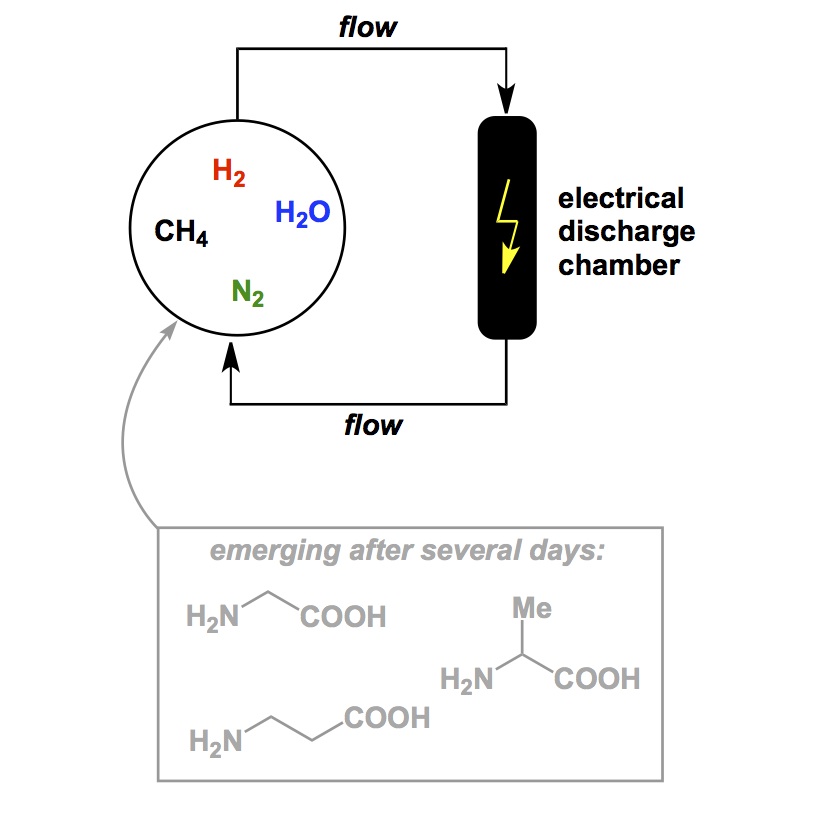
In order to test plausible conditions on the early Earth, Miller came up with an ingenious idea: to circulate a mixture of four simple compounds (nitrogen, water, hydrogen, and methane) that were likely present back then, through a chamber where electric discharge was constantly applied through the gaseous mixture. This discharge was designed to simulate the rough primordial times. After several days, mercury chloride was added to the reaction mixture in order to ensure that bacteria did not have a chance to grow, thereby polluting the results. The analysis of the reaction mixture indicated the presence of amino acids such as alpha-alanine, beta-alanine, and glycine. This was a milestone in our understanding of how protein building blocks are formed. You might argue that this experiment does not prove how chirality emerged, which is true. In a way, the Urey-Miller experiment is a “low hanging fruit” that catalyzed our search for the origins of life. There is even a Gordon Conference dedicated to this subject. As you can imagine, there are some interesting, if not eccentric, folks who attend that gathering. Regardless, I wish I had thought of this experiment…

Image

http://www.sciencemag.org/content/117/3046/528.short

Eat your heterocycles

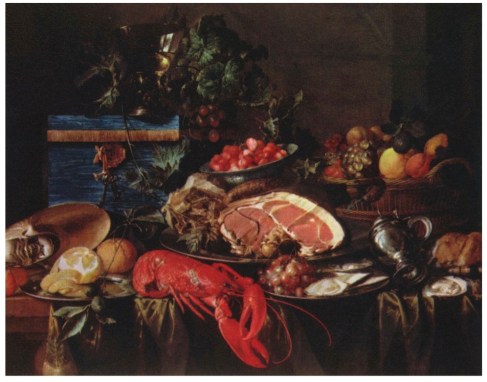
Humans have celebrated food since the dawn of civilization. We are what we eat. For centuries, painters have been drawing inspiration from all manner of cooked and uncooked specimens. Here is Jan Davidszoon de Heem’sStill Life with Fruit and Ham” from 1648.
Image

Today I have my PhD student Ben Chung as a guest on this blog. Ben gave an inspiring talk about chemistry of cooking last week. Here is what he wrote on the subject of heterocycles your mother wants you to eat…

Ben:

“Heterocycles are cyclic compounds with one or more elements other than carbon within their ring structure. One of the earliest examples of heterocycle synthesis in the lab was the isolation of alloxan through uric acid oxidation by Brugnatelli back in 1818. However, humans have been making heterocyclic compounds long before then… by cooking food! Through my adventures in learning about food chemistry and molecular gastronomy, I’ve stumbled upon many interesting molecules that are formed through cooking. These molecules are mainly produced by the Maillard reaction, which describes the reactions that occur between sugars and amino acids upon heating.

Image

Using a generic aldose (1) as an example, the amino group of an amino acid (2) reacts with the aldehyde to generate N-glycosides, which then undergo an Amadori rearrangement to generate an amino-functionalized ketose, known as the Amadori compound (3). The net transformation is N-functionalization of the aldose as well as transfer of the carbonyl oxidation state from the terminal end to the middle of the molecule.
Image

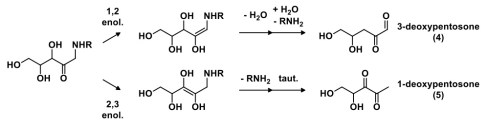
The Amadori compound then undergoes additional transformations, generating a class of compounds known as deoxyosones (e.g., deoxypentosones 4 and 5). The regioselectivity of the enolization determines the type of deoxyosone that’s formed, and deoxyosones are named by the chain length and the carbon number at which deoxygenation has occurred.

Image

It is these deoxyosone intermediates that can be further dehydrated, cyclized, and functionalized by ammonia, hydrogen disulfide or methanethiol (derived from amino acid degradation pathways) to generate a large variety of heterocyclic flavour molecules. An example of 3-deoxypentosone degradation is shown above; analogous pathways can occur for 1-deoxypentosones as well. The structures of a few heterocyclic molecules derived from the Maillard reaction are shown below, as well as the aromas they have.

blll

Of course, the variety of different sugars and amino acids present in any given sample of food means that, following Maillard reaction, it is possible to achieve an almost infinite combination of aromas and flavours. Who would’ve guessed that chefs possessed such mastery over heterocyclic synthesis?”

Here is a good read:

http://pubs.acs.org/doi/abs/10.1021/ar8002078