Electrophiles that seemingly defy logic

Here is one of my favourite subjects: electrophiles. They are often used as reactive intermediates in synthesis, which is common knowledge.  The vast majority of electrophiles are toxic to humans for a very clear reason: our bodies are largely composed of nucleophiles. Indeed, it is difficult to name an amino acid residue in our proteins that is electrophilic in nature. Apart from the ones that are neutral (leucine, alanine and the like), amino acids are nucleophilic (cysteine, arginine, lysine, serine, etc). Therefore, one should expect irreversible reactivity between exogenous electrophilic species and proteins. In fact, there are many drugs that act by way of covalent modification of the nucleophiles found at protein active sites. We are also told (rather emphatically, in all sorts of MSDS sheets we get from Aldrich!) to avoid contact with electrophilic chemicals. Alkyl halides are on top of some of those lists and many of these chemicals are banned by the Montreal Convention. It may come as a surprise, therefore, that some odd balls pop up here and there and, on the surface, there is no explanation for their relatively benign nature. Take Splenda as an example. This artificial sweetener contains sucralose, whose structure is shown below. This stuff is served at Starbucks, not to mention a ton of other establishments. One look at this molecule was enough to make me cringe when I first saw it. I instinctively considered all of my cysteines as potential targets! However, sucralose is benign and does not covalently inactivate cysteines. In fact, it is an alosteric modulator of T1R receptor, which explains its effect as a sweet taste-enhancing additive. There was a great PNAS paper on that some years ago (see the link below).

There is another lesson in this story and it relates to the foundation of Sn2 chemistry, the rate of which is rather sensitive to steric bulk around the reactive site. This is why we teach our students that neopentyl systems are lousy electrophiles. So, there you have it, folks: Splenda is quite ok for you despite the chloromethylene and chloromethyl groups in it. Next time you put it in your coffee, rest assured that your cysteines will remain intact due to relative rates and the good old physical organic chemistry.

Image

http://www.pnas.org/content/107/10/4752.long

Boron in aromatic molecules

Here’s my Monday, October 7, 2013’s two cool facts about boron heterocycles.

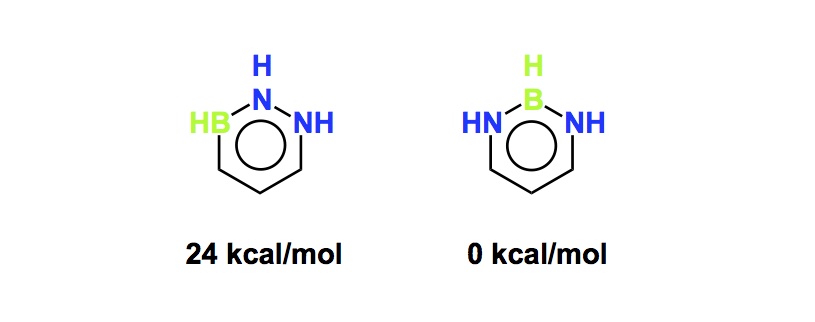
First of all, boron is tricky and it is not always obvious which factors control stability. Take, for instance, a recent theoretical JACS paper by Professor Roald Hoffmann of Cornell University. The manuscript contains a lot of very interesting data on boron heterocycles and is, in many ways, a call to arms for those who are interested in this subject. However, how would you predict the whopping 24 kcal/mol difference in stability (calculated relative energies) between the following two molecules? I realize they are not the same, but 24 kcal/mol? This means that NBN motifs are special…

Image

A lot of really imaginative work in the area of aromatic boron heterocycles has been done by Prof. Liu of Boston College (formerly of the University of Oregon). I am not going to say anything about his nice synthesis of aromatic boron-containing heterocycles. Instead, I will focus on properties and showcase a co-crystal structure between azaborine and T4 lysozyme. The hydrophobic cavity of this enzyme accepted azaborine, a view of which I made using PyMol (pdb code 3hh3, below). It can be clearly seen that the azaborine molecule binds in two conformations which relate to each other by way of a “flip”. Given the amount of aryl groups in biologically active molecules, these boron heterocycles are certainly interesting! How about using them as fragments? Someone should…china

Image

http://onlinelibrary.wiley.com/doi/10.1002/ange.200903390/abstract

The economy of means in targeting complex interfaces

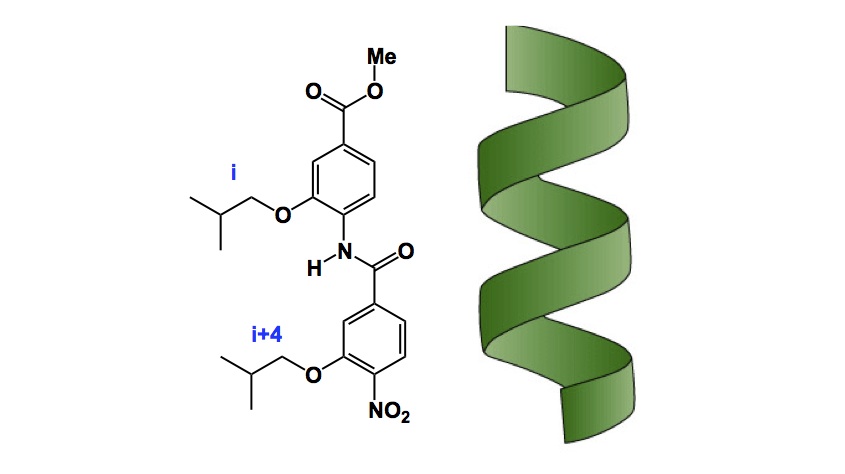
Who says that molecules have to be complicated in order to effectively interfere with protein-protein interactions in cells? Here is a fascinating recent example of a small molecule developed in the lab of Professor Ahn at the UT Southwestern, Dallas, Texas. This paper, published in Nature Communications by Ahn and his collaborator Ganesh Raj, is a lesson to all of us who think that mimicry of complex epitopes using small molecules is a lofty goal.  Well, it certainly is a lofty one, but it is also reachable! This and other examples (Hamilton’s great work on polyaromatic molecules comes to mind) exemplify the state of the art in reductionist systems feasible with smart design. Look at the helical pitch (below) and its mimicry by a trivial amide compound. I am willing to bet there is a lot of completely unexplored molecules that are also small, perhaps a bit more architecturally advanced than the one shown, yet capable of interrogating non-helical epitopes, including disordered ones. In Ahn’s example, the IC50 of 40nm was achieved in efforts to disrupt specific protein-protein interactions involving LXXLL motifs. The use of such simple molecules in targeting androgen receptor-coreceptor interactions has been demonstrated to have clinical value. Kudos to Ahn and co-workers who designed these wonderful molecules!

The most important lesson I learned from my mentor, Professor Barry Sharpless of Scripps, is that complex problems do not require complex solutions (as opposed to what many people in synthesis preach). The present case certainly underscores this notion.

Image

http://www.nature.com/ncomms/journal/v4/n5/full/ncomms2912.html

Macrocycles vs linear molecules: not a clash (yet)

As I get further and further into fragment-based screening using protein crystallography/small molecules, I have been developing ideas about a rational way of constructing linear oligomers of heterocycles. There will be way more on that in my future posts. But first, some people might ask: “What? You? Thinking about the virtues of linear compounds with your long-standing interest in macrocycles? What is going on?” Well, hear me out. I am not suggesting that we abandon some of our favourite peptide-based rings. No way, we are fully committed to the cyclic peptide deal and we will stand by them.

Having said that (as Larry David of “Curb Your Enthusiasm” would say – check it out: http://www.youtube.com/watch?v=ENHVQ2gslp8), there are some things to consider in terms of how we design our molecules to interact with protein targets. Here is something I mentioned at my lab’s meeting 2 days ago: we simply do not think about enthalpy hard enough. This is happening for a good reason: this is a tougher nut to crack. The history of drug discovery tells us that the first, and often most obvious, thing to do in an effort to make a molecule that selectively interacts with a protein target is to consider entropy. Macrocycles, of course, provide a gateway to address this problem. Researchers would typically consider a peptide ligand, identify their favorite beta turn or helix (think about stapled peptides), and then go on to make a cyclized version that hopefully recapitulates the bent epitope. But take a look at how drugs in a particular class evolve over the years. I suggest the following paper:

http://www.nature.com/nrd/journal/v9/n1/abs/nrd3054.html.

It is curious, isn’t it? Figure 1 shows (and rather emphatically) that the entropic contribution (which forms the basis for our instinctive thoughts about making macrocycles) dominates at the beginning, when first molecules in a given class are being discovered and developed. After some time, the sophistication increases and you can see how enthalpy contribution “grows”. The underlying reason is that enthalpy is more difficult to address. The reasons are manifold with solvation/desolvation sitting at the center stage. To sum up, I am not thinking about abandoning macrocycles. I am just under the influence of some of the fragment-based crystallographic work we are involved in and I think that we might often be better off improving the enthalpic contribution in our molecules when we consider linear shapes. I am falling in love with those.

Amazed by microscopic reversibility

Here’s a synthetic post, dedicated to the talented folks in total synthesis who have a lot of really cool tricks up their sleeves. I am going to talk about just one (or two) steps in Tohru Fukuyama’s fairly recent lyconadine synthesis. The sequence goes through one of my favorite processes – a microscopic reverse of an electrocyclization… I mentioned a similar reaction in the past when I referred to our own work in electrocyclic ring-opening of bromoaziridines. Take a look at a clever use of electrocyclization (its microscopic reverse, that is) in efforts to create a complex 7-memebred ring. First of all, please note the dibromocyclopropane preparation. Wait – before we go any further: do you know whose process this is? If you are thinking of Prof. Makosza from Poland, you are correct as he is the man! I already commented on his vicarious aromatic substitution mechanism. The phase transfer-catalyzed dibromocyclopropanation hails from his lab as well. The yield here is not great, presumably since we are dealing with a fairly challenging substrate… Then comes the key step, which is carried out in pyridine at reflux. A ton of fun, no doubt, but the result is impressive – the ring system is set up and the benzyl group is gone… There is an elimination pathway that competes, but these are minor details. It is still an elegant sequence. I think one nice lesson here is to always remember the principle of microscopic reversibility, which is not simple when thinking about retrosynthesis, in my view!

Image

http://pubs.acs.org/doi/abs/10.1021/ja312065m

Good old condensation reactions

We have finished our grant proposal and managed to submit it on time. As I mentioned yesterday, this grant deals with the chemistry of boron-containing heterocycles and their biological properties as serine protease inhibitors. A preliminary account of our borocycle chemistry driven by boryl isocyanides, appeared earlier this summer (see my July 21 post). Besides what I think is an interesting structure-driven means to optimizing the cellular permeability and activity of these molecules, we have an approach to place boron in heterocycles using simple condensation reactions. As I was thinking about condensation chemistry, I recalled to mind some of my favorite papers from the past. A lot has been said about enamines in recent years, and for a good reason. Originally developed by Stork, enamines are the engine of many innovative synthetic approaches, including organocatalysis. Yet, if you think about the parent “NH2” enamine, it has remained a curiosity due to its highly unstable nature. Back in 2001, Novak and colleagues published a thought-provoking paper that trapped these species in a radical-mediated polymerization. This publication has always been one of my all-time favorite papers. The way to generate the parent enamine shown below is not through condensation (can’t really use thermodynamically controlled reactions). Instead, the authors used transition metal-catalyzed isomerization. Afterwards, they cleverly co-polymerized the enamine under radical  conditions before it had a chance to undergo tautomerization. To me, this is super cool.

Imagehttp://pubs.acs.org/doi/pdf/10.1021/ja011609i

P.S. I am sure my lab might notice the wording “simple enamines” in the paper title…

The APS 2015 website is now live

Right now I am in the middle of grant writing with my student Adam Zajdlik… The deadline is tomorrow and we are trying to get the last remaining items in order. This is a joint grant with Dr. Aaron Schimmer of the Princess Margaret Hospital here in Toronto. Our idea is to use boron-containing heterocycles as proteasome inhibitors. Adam has become quite a pro at making them. Plus we now have Victoria Corless in our team, which will provide further momentum to the effort. Due to this deadline I am not going to post my usual scientific blurb, but I am going to give you what I promised on Friday… Please bookmark the website that has a bit more information about the American Peptide Conference in 2015:

http://aps2015.org

Peptides in Orlando

Had anyone told me 5 years ago that my lab would be heavily engaged in peptide chemistry, I would not believe a word… Fast forward to 2013 and here I am, together with my man Ved Srivastava of GlaxoSmithKline, organizing the next American Peptide Symposium. What a turnaround.

Here is an early-bird invitation to everyone who is interested in peptide science. Come to Orlando in June, 2015! We will have a splendid conference prepared for you. Our logo is below and a link to the website is forthcoming. So, bring your significant others and have some fun in Orlando with us. Besides the scientific program, Ved and I will work hard to ensure that entertainment is taken care of. I will bet that there will be some nice Cuban food, cigars, and so on. This past APS meeting was held on the Big Island of Hawaii and it was awesome (kudos to Marcey Waters and David Lawrence). The only downside was that it was a bit too far and many people could not make it (especially industry folks who just could not convince their upper management that there is science in Hawaii). Orlando, on the other hand, is strategically placed to embrace both the European and American contingents.

larsa

I will also start spilling the beans about some special features we have in store for your amusement… As part of the conference, we are preparing a cool new 2-hour section called “rapid-fire”. At the beginning of the conference, the attendees will be given a chance to email the organizing committee two slides with their latest results. Of course, you need to consider the pros and cons of this disclosure. We will then select speakers and give them 5 minutes each in the rapid-fire section. 2 slides, that’s it! This is going to be a new mechanism to give floor to young researchers such as students and postdocs who may have a cool result, but perhaps not enough material for a full-scale oral presentation. This lack of a full story is often the reason for one’s reluctance to submit an abstract for a talk. The rapid-fire section will not have a pre-announced program. We plan to call the chosen speakers from the audience during the allotted time. These are our plans and we’ll see how they materialize. We certainly hope they do!

Anti-chaos

We fight entropy every day but it costs us in enthalpic terms… Whenever I notice papers where order emerges from chaos, I pay attention. Here is a really fabulous example from the lab of Michael Rubin (Kansas University). This is coming from another one of the talks I heard while attending the Heterocycles conference in the south of Russia last week. Take a look at what’s happening – it is a neat trick: you start with a racemate, you don’t make your life any easier at the next step when you create an awful mixture of diastereomers while installing the amide bond. However, the subsequent step clears it all up as the base does two things: it eliminates HBr and creates the ring system. The coolest thing is that all the unwanted diastereomers converge onto a simple symmetrical sub-structure that is ready to undergo addition. The addition step is not as trivial as one might think because you do not have a typical conjugated olefin. Strain drives it, though (all 52 kcal/mol of it). Michael presented some compelling evidence showing favourable orbital overlap during the addition step (what is it, by the way, endo addition? exo? trig? dig? what? not so straightforward…). Diastereoselectivity is high and is governed by the conformational preferences dictated by the chiral amide. I think all students will appreciate examples of this sort: you have an awful-looking TLC that goes clean towards the end!

Image

http://pubs.acs.org/doi/abs/10.1021/ja900634m

Try to skip your Wednesdays

I think one of the most important things scientists need to do is know how to rest well. Going to the gym is hugely important, yet not always possible. I think that the best thing I have ever done in my career was to adopt something Prof. Ian Manners (now at Bristol) taught me several years ago, namely not to go to office on Wednesdays. Just work from home, he said. This simple change has made a world of difference because it has turned into a mechanism to work on manuscripts, grants, and to read at home. I feel the need for this extra time now that I am on sabbatical and actually do go to work on Wednesdays! What an irony. I really miss my Wednesdays off and there is definitely a feeling of being overwhelmed with all the stuff such as administrative responsibilities, writing reference letters, and so on.

So, if you read this, trust me because this is well tested: if you become a Prof. (which, sadly, will mean that you will spend way less time on thinking about research compared to your time as a postdoc or as a graduate student): skip work once a week. When I was in Russia last week, I talked to Valery Fokin, my old friend (now a Professor at Scripps), who told me that he has now also adopted this method. Valery does it even better, I have to say: he does not open email at all on Wednesdays. When I am back from my sabbatical in January, I will give this a shot, there is no question about that.

It took me a while to find this method (thank you, Ian Manners!) and it works… You know what Churchill said: “We always come to the right decision, having tried everything else first”.