The role of Iceland in the search for Alzheimer’s disease treatment

I was thinking about this subject for a while, not the least because my mother suffers from Alzheimer’s. In this disease, aggregation of amyloid-β peptides is widely thought to play a key pathological role. It is clear that prevention of the amyloid-β plaque formation would prevent memory loss. This strategy represents a potential for therapeutic intervention through a disease-modifying mechanism. A question arises regarding the biochemical path to the formation of amyloid-β peptides. Several enzymes contribute to the build-up of plaques. Of these enzymes, gamma- and beta-secretases have received a significant amount of attention from the research community. The enthusiasm in the early days of this research was grounded in the idea that inhibitors of gamma- and beta-secretases might block the production of amyloid-β plaques. Recently, however, gamma-secretase research has suffered a serious blow because a phase III clinical trial testing the inhibitor semagacestat failed (http://www.sciencedirect.com/science/article/pii/S009286741401304X). This led to closure of promising investigations aimed at inhibiting gamma-secretase and leaves behind beta-amino secretase as the best currently available target to prevent the formation of amyloid-β peptides. A seminal study by Stefansson et al. recently identified a missense mutation (A673T) in the amyloid-β precursor protein (APP) gene that protects against Alzheimer’s disease (http://www.nature.com/nature/journal/v488/n7409/full/nature11283.html). The mutation was identified by the analysis of the genome sequence data of 1795 Icelanders. I am truly amazed by the enabling features offered by the genetic makeup of this unique population. Interestingly, the A673T missense mutation reduces cleavage of APP by the beta-secretase BACE1. This finding supports the hypothesis that abnormal processing of APP causes Alzheimer’s disease. Significantly, the Stefansson paper further validates BACE1 as the legitimate target in search of treatment against Alzheimer’s disease.

Apart from achieving blood-brain barrier penetration by BACE1 inhibitors, minimizing the inhibition of cathepsin D (CatD) is the obstacle that faces this research. CatD is an aspartyl protease with high sequence homology to BACE1 at the active site. It has been shown that the inhibition of CatD gives rise to toxic side effects. Once these two hurdles have been overcome, there will likely be a cure for the Alzheimer’s disease. Below, by the way, you can see a picture of the first report of BACE1 co-crystallized with a peptide inhibitor some 15 years ago (pdb id 1FKN).

1

Protic virtues

Over the past few days I was at the Vanderbilt University in Nashville, TN. Jeff Johnston (http://www.johnstonchemistry.org) put together a mini-symposium consisting of Professor Viresh Rawal of the University of Chicago (http://rawalgroup.uchicago.edu) and myself. Everything was sponsored by Sigma-Aldrich and I fully enjoyed this opportunity to visit the South and learn about what goes on at Vanderbilt as well as in Viresh’s lab.

I learned a lot by hearing about the imaginative research programs led by Viresh and Jeff. Proton management turned into the common theme of the visit. One interesting piece of history I was not aware of was Margaret Etter’s work from 25 or so years ago. In it, the urea-driven activation of carbonyl compounds is described, which is foundational to many organocatalytic reactions. I think students should be aware of this work. Viresh’s talk reminded me about his remarkable discovery that TADDOL ligands are excellent catalysts for a range of asymmetric reactions. The activation here is derived from the enhanced acidity of the OH functionality that is augmented by the nearby OH in organic solvents. Over the years, Viresh’s lab has characterized several co-crystals formed between carbonyl compounds and TADDOL, which support the lowered pKa of the OH functionality. Last but not least, I want to mention one of Jeff’s cool recent uses of his chiral proton catalysts. In a JACS paper that appeared not long ago, he showed how carbon dioxide could be efficiently fixated using asymmetric catalysis. This is an exceptionally interesting article. Overall, this was a fun trip and I am very grateful to Jeff for putting the agenda together.

2

Etter: http://pubs.acs.org/doi/abs/10.1021/ja00179a028

Rawal: http://www.pnas.org/content/101/16/5846.full

Johnston: http://pubs.acs.org/doi/abs/10.1021/jacs.5b04425

On simple solutions to complex problems

The pervasive dogma that complex problems require complex solutions is the root cause of many failed research programs. It is refreshing to hear when a complex phenomenon can be reduced to a limited set of parameters (preferably to just one). This does not happen every day and, when it does, I feel as if there is a breath of fresh air.

Let’s talk about protein-protein interactions. A lot of people are interested in developing small molecules that disrupt them, but I don’t think people know a lot about factors that drive the on/off rates when two protein partners engage each other. Most people (myself included) consider this to be an exceptionally difficult problem.

There is a paper by Das and Basu in Proteins that takes a remarkably simple view on the on/off rate problem. Believe it or not, the cosine of the angle between the dipole moment of one protein and the dipole moment of its interacting partner correlates strongly with experimentally determined on-rates, which measure protein-protein association constants. This finding was made upon analysis of 72 crystal structures and experimentally determined binding data. It will be interesting to see how this correlative analysis can be used to guide the development of protein-protein interaction inhibitors. There has to be a way of using the knowledge of electrostatic fields to one’s advantage (I have no idea about it, though).

2

http://onlinelibrary.wiley.com/doi/10.1002/prot.24860/abstract

For those who go a step further

With the Fall semester around the corner, I am inclined to talk about chemistry education. Specifically, I will share my thoughts on a particular challenge synthetic organic chemistry has faced for years.

There are two types of students we encounter in chemistry classes: the ones who like to think and the ones who don’t. We want to attract those in the first category because they are the ones who will push the frontiers of our field. The question is: are we doing enough to ensure that the largest possible cross-section of bright students enters organic chemistry? I don’t think so.

We certainly do really well with “the naturals”. These kids have intuitive feel for chemistry and often possess a green thumb when it comes to lab work. They readily accept the bizarre “meta language” of organic chemistry and it quickly becomes second nature to them. But what do we do with those who are really intelligent, yet are not persuaded by the voodoo logic of organic chemistry? They are the ones who like to ask that inconvenient “next question”. For example, they are not satisfied to hear that the difference in electronegativity accounts for the fluorinated substrate (below) working well in the nucleophilic aromatic substitution and the chlorinated counterpart failing miserably. Such explanations are a bit too black and white for them and, from their perspective, more solid grounds are needed. I have encountered a number of such kids in my career and I can attest that the way organic chemistry is being taught is not suited for them. They might not have the natural intuition about what to do in a particular situation (e.g. which reducing agent should be used for a beta-keto ester…), but they are the ones who might enrich the field if we give them a chance. We just do not know because we lose these students to other, more quantitative, fields.

The question is: what can be done about this? Below is a lovely paper in the Journal of Chemical Education that I will definitely use in my classes. With the advent of sophisticated computing capabilities that can be run on a laptop and soon on a smartphone, there is a way of catering to those who ask deeper questions about chemical reactivity. In the particular case shown, it is a fairly straightforward natural bond orbital (NBO) analysis that clearly shows why the chlorinated substrate does not work. With more and more computational tools becoming accessible, it is worth thinking about introducing seamless connections between preparative organic reactivity and computational approaches. There are other examples of really enabling metrics, for instance Mayr’s nucleophiliciy scale (http://www.cup.uni-muenchen.de/oc/mayr/DBintro.html). We need more of this sort of stuff in organic chemistry.

2

http://pubs.acs.org/doi/abs/10.1021/ed5006344

Some thoughts on fragments

Over the past week I was in London, England. While there, I attended the OBC editorial board meeting, which I now chair. The scientific highlight of the trip was my visit to Cambridge, where I had a chance to give a lecture at Astex Pharmaceuticals, a remarkable company that has been making tremendous strides in the area of fragment-based drug discovery. My former student, Jeff St. Denis, is working there now. Jeff made this visit happen (as well as a round of golf at the Cambridge Meridian Club – http://www.cmgc.co.uk, which was a ton of fun).

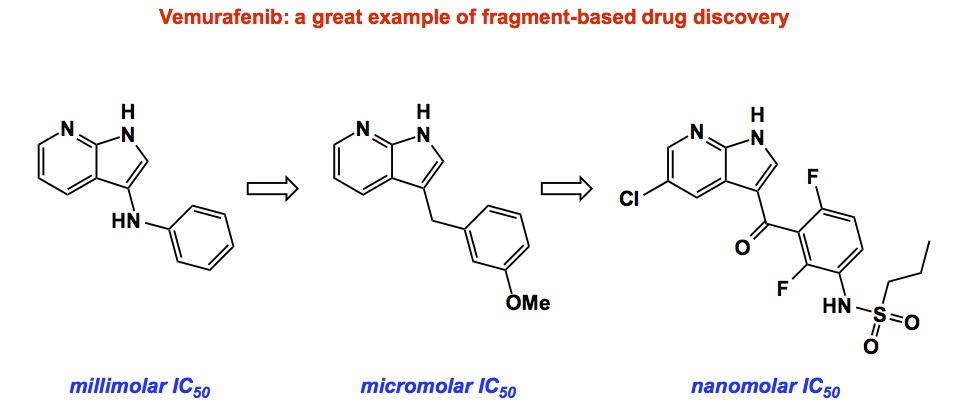
One notable concept I heard about from the scientists at Astex is that of a minimal pharmacophore. This corresponds to a system of classifying small heterocycles based on their capacity to engage targets. It  makes sense that some scaffolds are way “better” than others and, as you might imagine, the reasons are myriad. Astex has amassed an impressive portfolio of small molecule fragments they call Pyramid. I have always wanted to see a study that would put forth comparative metrics to gauge different scaffolds. Astex’s Pyramid is a tremendous resource in this regard. A paper describing the details of this methodology is in the works. However, I can illustrate what this is all about using one of the papers that are already out there. Take a look at the XIAP inhibitor study published by Astex not long ago. The chlorine substituent present in the molecule shown below has enabled a 50-fold jump in potency. While this might seem to just be a decent medicinal chemistry accomplishment, there is something to note about certain structural types that consistently display a knack to interact with protein pockets, be it via hydrogen bonds, stacking interactions, or other kinds of intermolecular forces. The framework that exists at Astex enables classification of weakly bound fragments and their comparative analysis. I also learned that computational assessment of the ability of different fragments to interact with their targets continues to be a challenge. Apparently, we are just not there yet in terms of fundamental understanding of weak interactions.

By the way, the final compound described by Astex in the paper below shows activity in a tumor xenograft model at a dose of 100mg/kg i.p., which is really impressive.

4

http://pubs.acs.org/doi/abs/10.1021/acs.jmedchem.5b00706

A couple of useful substitutions

I want to talk about two user-friendly aromatic substitutions today. While the mechanisms are entirely different, there is a common link. Both of these reactions made a difference in our approaches to either making or modifying halogenated aromatics. The first reaction is the aromatic bromination process that requires a curious combination of triphenylphosphine sulfide catalyst, an aromatic compound, and N-bromosuccinimide. My PhD student Sean Liew found this remarkably mild process in Gustafson’s Org Lett paper. I can highly recommend this reaction, whose only downfall is the production of phosphorous-based by-products. I don’t think that the role of triphenylphosphine sulfide has been fully delineated, if that is what you are interested in.

2

http://pubs.acs.org/doi/abs/10.1021/acs.orglett.5b00186

The other process is separated from the one above by 8 years. This is when Lilu Yu was doing her Masters degree in my lab and was in need of a mild method to replace aromatic fluorine by the hydroxyl group. I remember this process to be an excellent way to deliver the hydroxide nucleophile, although in a somewhat convoluted way. We used this chemistry, originally described by Green, when nothing else worked, so I would highly recommend this process.

3

http://www.sciencedirect.com/science/article/pii/S0040403902005610

Protruded rabbit ears

Peptide bonds are proteolytically unstable, which is why there have been many attempts to come up with their mimetics. The corresponding surrogates may or may not look similar to what they are designed to mimic, but their constituent atoms almost always occupy a similar volume in space (the isosteric hypothesis). In all of these cases, however, the hydrolytic stability of the peptidomimetic is substantially higher than that of its peptide counterpart.

There is an interesting recent paper by Mike Shipman and colleagues in Chem. Comm. The work centers around oxetanes as replacements for carbonyl groups in amides. The core synthetic chemistry involves conjugate addition of amines to oxetane-containing nitroalkenes. There are many interesting features of peptide structure that can be probed with this oxetane concept. The four-membered ring brings about a somewhat longer C-O distance than the one seen in a typical amide. In addition, there is a completely different rotational preference compared to the amide linkage that features the nitrogen lone pair in conjugation with the C=O antibonding orbital. This is a lovely piece of molecular engineering that goes to show that there is still a lot of room for basic research. I appreciate the fact that chemists have the ability to make something with no immediate application in mind, just to test the waters and to see what happens. And, by the way, the enduring rabbit ears are still expected to be there in “oxetanated” amides (see my earlier post: https://amphoteros.com/2015/06/25/rabbit-ears/).

2

http://pubs.rsc.org/en/Content/ArticleLanding/2014/CC/c4cc03507k