While in China

I have not posted anything for a few days because of my travel to Beijing and, afterwards, to Xuzhou (Jiangsu province). Currently, I am attending the ISOSDD-4 meeting (International Symposium on Organic Synthesis and Drug Discovery). I was invited to attend this conference by an old friend of mine, Professor Guigen Li of Texas Tech, who also has a research outpost in Nanjing (Jiangsu Province). Guigen and I go way back, to our days in the Sharpless lab at Scripps where we were both doing our postdoctoral stints in the late 90’s. Here, by the way, is a link to an important paper by Guigen, Chang, and Sharpless, which constitutes the first disclosure of the asymmetric aminohydroxylation reaction. This was, in fact, Guigen’s discovery, and is one of the many items that come to mind when I look back at those eventful years.

http://onlinelibrary.wiley.com/doi/10.1002/anie.199604511/abstract

Hans Adolfsson of Stockholm University is another person whom I have not seen for many years. He also hails from our days in the Sharpless lab. Hans is attending this meeting as well and I have been very happy to interact with him too. Hans is now full of extra responsibilities as the Vice Chancellor at Stockholm University. Despite his busy schedule, Hans has a vibrant research lab that has done some excellent work in the area of asymmetric hydrogenation using peptide ligands. One of the curious recent findings in the Adolfsson lab is that of amide reduction into enamines. While there is no clear-cut mechanistic rationale for this process, it is one of the most remarkable paths to enamines I know. If you follow my posts, you know that I always emphasize novel approaches to well-established intermediates in organic chemistry. This, in my mind, always offers fertile grounds to discovery.

Image

http://pubs.acs.org/doi/abs/10.1021/ol403302g

An eyesore here, a gem there

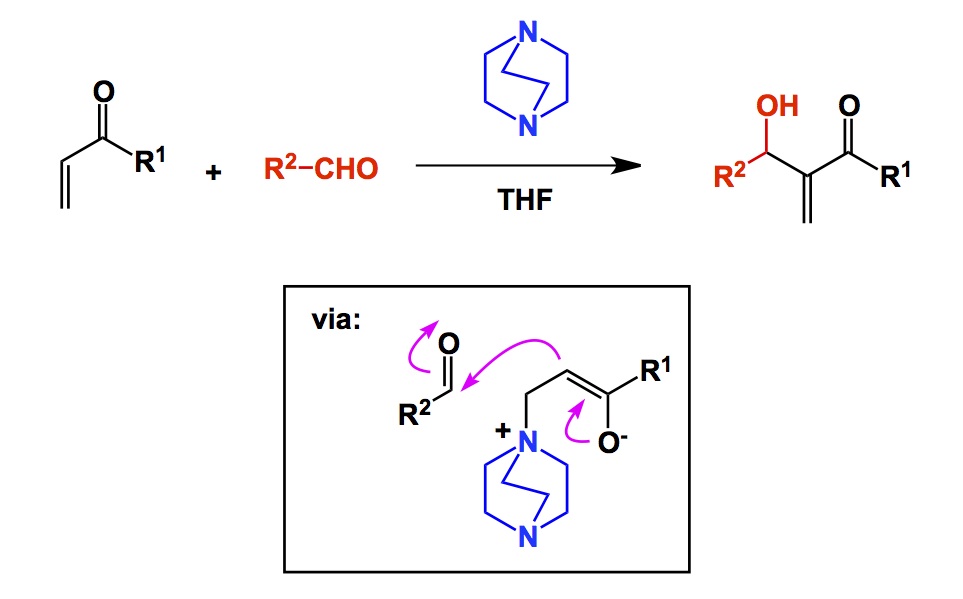
If I told you that there are some real eyesores in synthesis, I am sure you will know exactly what I mean. We have all been there. For example, you run a cyclization reaction and note that the best yields you record are for the so-called gem-dimethyl containing substrates. The reason is that you need some help from the Thorpe-Ingold effect that contributes to improved kinetics of cyclization by reducing the number of accessible conformers (plus some other reasons). Or you need a pro-nucleophile with a pKa that is suitable for the weak base you intend to use. Then you use a gem-diester. Again, you are stuck with it at the end, although this case is not as bad as the gem-dimethyl example. At least you have decarboxylation chemistry in your disposal and can “erase” one of the ester groups (if the rest of your molecule tolerates your conditions of choice, of course). At some point you feel dejected as no one asks questions along the lines of “Have you tried your reaction without the two methyl groups?” because everyone knows that you need the Thorpe-Ingold effect. They just give you a look that says “poor you”… It seems that gem-“anything” is bad news.

Image

But not necessarily. For a number of reasons, my lab has been looking at gem-dichloro aldehydes. Is this another one of those “gems”? I recalled to mind a great paper published by Tom Rovis and colleagues several years ago. In it, Tom showed a useful application for a molecule that contains a pair of “gem-offending” chlorines. In this case, what happens is a carbene-mediated transformation that leads to amide bond formation. Very cool stuff.

 Image

http://pubs.acs.org/doi/abs/10.1021/ja0764052

Small shifts offer big insights

Last week we said our goodbye to Rebecca Courtemanche, who finished up her MSc degree. Rebecca is now in Vancouver and we miss her already because she has been instrumental in our efforts to measure small molecule/protein interactions by NMR. I asked Rebecca to write a blog entry dedicated to some of the research she performed while at the University of Toronto. Here is her post:

“As a chemist, I have an innate curiosity to study molecular interactions in biological settings. Chemical probes are small molecules that interact with protein targets. Understanding these interactions give insight into a protein’s role in a disease and can guide future drug discovery. Interest in chemical probes has significantly grown over the past decade and their importance is addressed in Stephen Frye’s article entitled “The art of the chemical probe”:

http://www.nature.com/nchembio/journal/v6/n3/full/nchembio.296.html

When I was given the opportunity to research chemical probes for biologically relevant proteins last Fall I was very excited to ‘nerd-out’ (according to my non-chemist friends). Dr. Peter Brown’s group at the Structural Genomics Consortium, SGC, has been actively pursuing probes for epigenetic proteins. Along the way, we found that 1H-15N HSQC chemical shift mapping has been particularly insightful in distinguishing the strength of interaction between a molecule and a protein as well as the molecule’s binding location. Proteins were expressed and purified such that they were 15N enriched (we used 15N-labelled ammonium formate while growing cells). This way, for a 1H-15N-HSQC experiment, all H-N correlations from the backbone amide groups as well as some side chain H-N correlations can be observed. Together, they provide a map of chemical shifts unique for every protein. When a small molecule is added to the protein, the region of the protein directly involved in binding will undergo a structural rearrangement, thus inducing a change in the region’s magnetic environment. On an HSQC map you see below (the nature of the protein is still confidential), the unbound protein will have a different chemical shift map as compared to the bound protein. The amount of chemical shift movement relative to the concentration of the binding molecule provides a sense of the strength of binding and it is possible to calculate a dissociation constant (Kd).

Image

Figure 1. 1H-15N HSQC spectrum overlay: blue contours are the unbound protein and the red and green contours represent 1:1 and 1:3 molar ratios of protein to compound, respectively. 

Understanding the binding location on a protein can be achieved if it is known which NH correlations correspond to which amino acid. We are currently assigning our proteins by 3D NMR techniques using doubly labeled protein (C-13 and N-15). For more information pertaining to protein NMR theory see http://www.protein-nmr.org.uk/.”

Trouble at the periphery

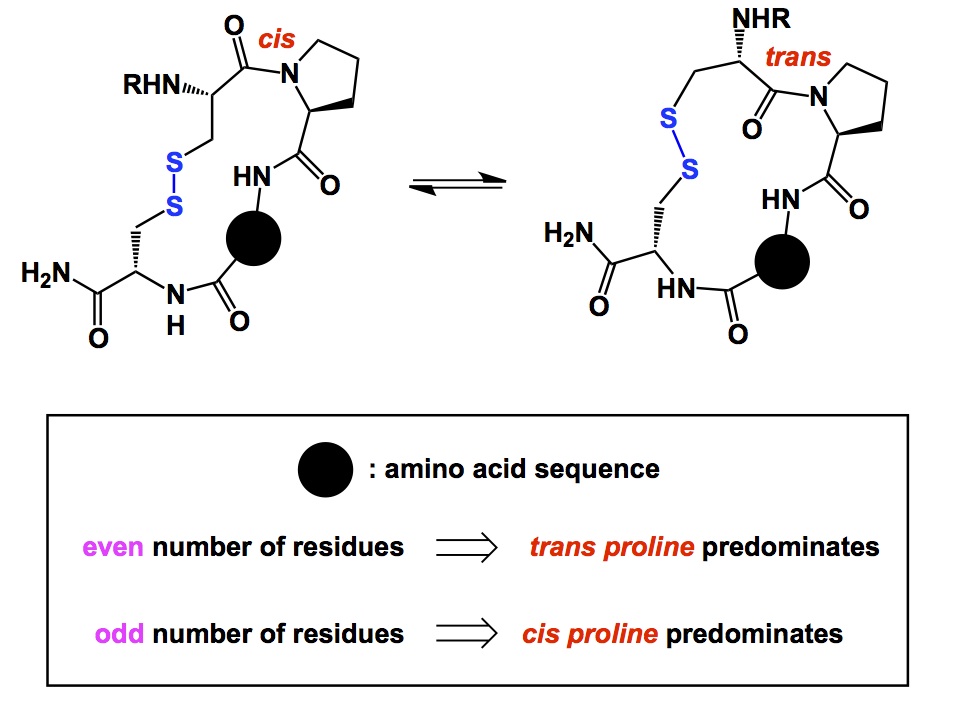
Amino acid side chains participate in a number of reactions that result in peptide modification. Some of these reactions are of fundamental significance and play an important role in folding processes. Disulfide formation by oxidation of two proximal cysteine residues is one such case. Apart from its relevance in protein biochemistry, this reversible process also ensures structural integrity of fairly small cyclic peptide systems. Ziconotide is an example of a disulphide-rich analgesic agent derived from a conotoxin.

There are also amino acid reactions one would want to avoid. Today I want to talk about threonine. I always viewed this amino acid with caution (and serine too). If you pay close attention, you will note that threonine looks like the product of an aldol reaction, in which the amide functionality acts as the enolate component, whereas acetaldehyde corresponds to the aldehyde partner. Whenever you see an adol process, you can be sure that its microscopic reverse is feasible. Writing in Organic Process Research and Development, a group from Astellas report a retro-aldol by-product in their synthesis of a cyclic peptide drug candidate. I think this is an important warning for those who work with serine and threonine containing peptides. Be careful with the base you use!

zzz1

http://pubs.acs.org/doi/pdf/10.1021/op500078y

Curious homologs

I think we all know about the significance of triazoles, which are readily accessible via [3+2] dipolar cycloaddition between organic azides and variously substituted alkynes. These aromatic heterocycles have found a myriad of applications, immortalized in what we now know as the click chemistry. Are there any 6-membered analogs derived from azides? This is the question I asked myself earlier today. These molecules would correspond to 1,2,3-triazines. As it turns out, there is a pretty nice method by which organic azides produce this sort of heterocycle. Below you see an example that involves triphenylphosphine that acts upon the molecule of an azido ketone. The role of triphenylphosphine in this Staudinger-like reaction is to “mop up” an oxygen atom that is produced upon attack of the terminal azide nitrogen at the carbonyl carbon. In this process, the organic azide acts as a nucleophile. The other notable case where an azide partakes in a polar mechanism is the so-called Aube-Schmidt process, although two nitrogen atoms are ultimately extruded as gas in that sequence. In the triazine case below, all nitrogen atoms stay put. It is not easy to see a concerted cycloaddition reaction that would deliver a 1,2,3-triazine from the corresponding azide, which is why I really like the condensation route shown.

Image

http://www.sciencedirect.com/science/article/pii/S0040402000003227#

From riches to rags?

That’s right, the other way around. Tonight we are talking about “passing the baton” to a weaker link. You are probably wondering what I am talking about. Here is a paper from my vault and the reason I continue to like this old contribution by Grigg and co-workers is that it is different from what we are accustomed to in the area of transition metal catalysis. We are used to seeing a lowly element such as boron, silicon, or tin pass the baton to a world-class metal such as palladium during transmetallation. But the reverse is happening in the Grigg case, which carries a certain unintended justice for the little guy. Earlier today I was discussing indium-mediated allylation reactions with my students and remembered the ChemComm article by Grigg. In the allylation reaction shown below, palladium starts the reaction, but indium is the one that finishes it up. Some might say that this is akin to putting a Lamborghini engine on a VW bug, but you know what: last time I checked, VW actually owns Lamborghini (this is a fact, by the way). I have to admit that this palladium-to-indium business is still a rarity. But it does have its place under the sun.

Image

http://pubs.rsc.org/en/content/articlehtml/2000/cc/b001457p

Handling nitrogen

Here is a great sequence to (-)-lepistine that has been developed by Professor Fukuyama and his students at the University of Tokyo. For many years, Fukuyama has been popularizing the use of the nosyl group. This chemistry has turned into one of the most useful ways to handle nitrogen in complex molecule synthesis. I forgot who told this to me, but common wisdom of synthesis tells us that adding one nitrogen atom to a molecule adds approximately one extra year to a student’s PhD. Just for clarity: I refer to a comparison between two molecules, one of which is one N atom “richer”. I have to admit that there is probably some truth to this statement (students from my lab: please ignore this sentence – otherwise we might be in trouble). Anyways… Back to Professor Fukuyama: the nosyl group is a fabulous way of handling nitrogen in synthesis. In the (-)-lepistine constuction, you see a great demonstration of clipping nosyl groups off, which generates an iminium ion in the same pot. After that, a lovely transannular collapse takes place, leading to the formation of the core of the natural product. Also noteworthy is the bridgehead double bond in the intermediate. All those things that are not supposed to happen in the second year organic chemistry I just taught two months or so ago!

rr

http://pubs.acs.org/doi/pdfplus/10.1021/ol5010033