Cognitive dissonance

I get puzzled when I hear my graduate students confront me with the following: “You are saying something that totally contradicts what you told me about this problem x months ago”. Sometimes they get really upset about it, but I am at a loss! If I have indeed changed my point of view, I say, it is likely because I have been exposed to some new data that have changed my opinion. Isn’t it logical? In fact, I submit that we aren’t really scientists unless we constantly adjust what we think upon availability of new evidence that challenges our previously held views. But I have to confess: I am not always good at doing this.

 Image

While it is often possible to change one’s view, it is by no means a comfortable thing to do all the time. I would even go one step further and say that one of the common shortcomings of our reasoning is failure to reconcile new evidence that is in conflict with our strongly held views. This phenomenon is referred to as cognitive dissonance and it describes excessive mental stress when we are forced to hold two or more contradictory beliefs or ideas at the same time. The assumption is that we seek consistency between our expectations and reality. So we build a fortress of knowledge in a particular domain and consider everything there to be factual. When a contradictory piece of evidence is upon us, we have a natural tendency to dismiss it and find ways of convincing ourselves that there must be something wrong with the evidence. This is, of course, very dangerous. Here is a trivial example that happened to me before Christmas: I went to buy a new TV and I had a strong view that it is the plasma TV that I ought to get. When I was in the store and the sales rep listed several difficult-to-argue facts about the virtues of the LCD technology, I dismissed them and was looking for an excuse to brush off any argument aside (“this sales guy was kind of weird anyway, he was too pushy,” I said to myself). This unimportant encounter aside, I wonder how ready are we to accept evidence that destroys our cozy view or theory? There is a lot of food for thought here. So (I am talking to the students who run research projects), next time you come across an NMR spectrum that looks a bit odd and is nowhere near what you expected to get, do not put it aside and forget about it. Discovery is a study of conflict and I have seen it time and again in my own lab. The best students are able to get over cognitive dissonance and make interesting discoveries.

Unconventional cleavage

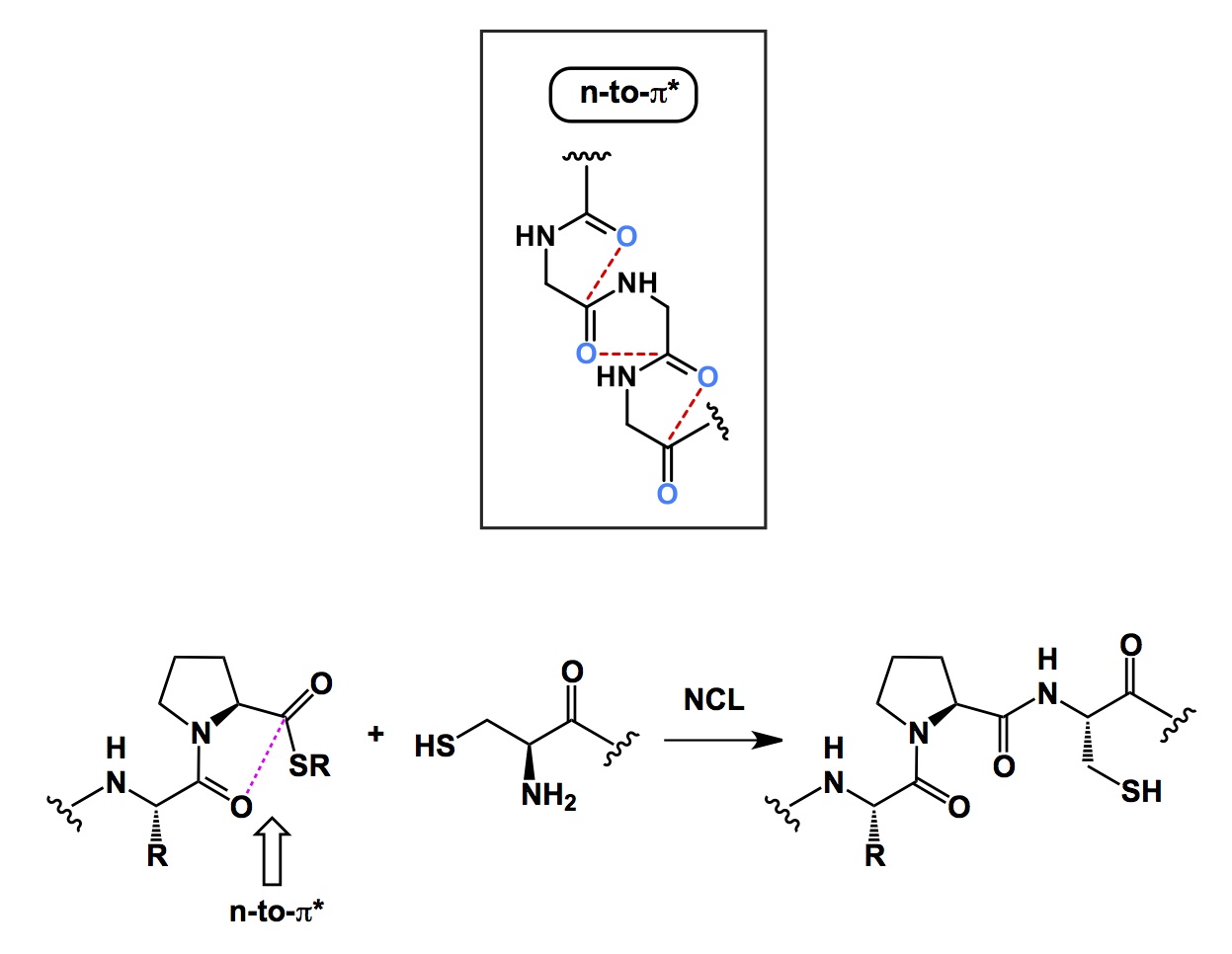
While solid phase peptide synthesis has reached impressive heights over the years, the predominant way of preparing peptides continues to be through the so-called C-to-N route. In this procedure, an amino acid is anchored to the solid support via its C- terminus. Subsequent steps amount to iterative coupling reactions with interspersed protection/deprotection steps. There are many advantages to the other mode of synthesis, which goes in the opposite direction: from N to C terminus. However, the corresponding methods are considerably less developed. I enjoyed reading the article published by Masurier and co-workers, wherein advances in the so-called pipecolic linker technology, were described. In the graphic below, I am showing a representative example showcasing this idea. To me, the most exciting part of this and related linkers is conceptual in nature. It is good to see methods that proceed through amide bond cleavage that is triggered by one of the amides (in this case, that of piperidine amide). This example underscores that under appropriate conditions, nearby amides can “bite” each other. For those of us who try to make peptides, this process is normally to be avoided. However, it can apparently be brought to good use. There’s something special about this pipecolic linker.

5http://onlinelibrary.wiley.com/doi/10.1002/chem.201201452/abstract

Paths less travelled

A lot of great science reported in the past was being pursued without an immediate application in mind. Earlier today, for reasons I cannot fully recall, I was thinking about a way of breaking the C-C bond of an epoxide. In doing so, I started reminiscing about some of Horst Prinzbach’s contributions to organic chemistry. Professor Prinzbach of Freiburg University has always been one of my scientific heroes, particularly after I met him some 20 years ago at one of the Loker Hydrocarbon Research Institute Symposia in Los Angeles. What stood out in my memory was Prinzbach’s paper published many years ago in Angewandte. In it, he and his students considered a thermally allowed [s2s + s2s + s2s] cycloreversion of a cyclic triepoxide that proceeded in good yields and selectivities. I am showing just one example below, but the scope is not limited only to epoxides. Mechanistically, this is one of those cases where it is easier to think of the microscopic reverse, rather than the forward process. You have to agree that the reaction shown below is not your mainstream epoxide chemistry.  Sometimes I wish chemists could continue working on problems that do not have an immediate application. Such challenges are self-fulfilling and are about pushing the frontiers of fundamental structure and bonding, rather than seeking an immediate application. Unfortunately, the synthesis community crossed that Rubicon a long time ago and there appears to be no way back to the “science for the sake of science” type of research… I do encourage you to think about how you would go about making the triepoxide starting material shown below. As you might imagine, this is not that straightforward!

Image

http://onlinelibrary.wiley.com/doi/10.1002/anie.197209421/abstract


Wrong things are not that wrong

Wrong ideas have contributed to the development of science in very significant ways. Take, for instance, the cyclol hypothesis. Dorothy Wrinch, a mathematician by training, has been the main proponent of this idea and advanced it rather ferociously. The book “I Died for Beauty” is a fascinating read. The centerpiece of Wrinch’s theory posits that protein folding results from covalent collapse of amides to generate cyclol-dominated structures. Below you can see a protein that has “folded” by way of cyclol formation (now all amide carbons are in their sp3 state). By the way, Dorothy Wrinch was a mathematician, which goes to show that one might want to be skeptical about a mathematiciain’s hypotheses related to chemical bonding, no matter how celebrated that person is. Indeed, any undergraduate chemistry student with knowledge of amino acid side chains should be able to run a “gedanken” (or “thought”) experiment and convince him/herself that it is not feasible to pack amino acid side chains according to the cyclol view of the world. But the theory had persisted until it was eventually discredited by Linus Pauling. While the cyclol idea was shown to be fundamentally wrong, its rejection had an enormous contribution to the discovery of hydrophobic effect. You can read about this in an excellent historical overview (see the link below). Image

http://www.ncbi.nlm.nih.gov/pmc/articles/PMC2143727/

Here is another twist: think about the green fluorescent protein (GFP). Maturation of its chromophore is due to a complicated cascade reaction that starts off a cyclol structure. Take a look below at how this happens. While here there are no multiple cyclol units similar to Wrinch’s folding idea, it is interesting that a significant protein (GFP) owes its function to a structure that has been forged through a covalent bond between two nearby amides. I think we should always remember Dorothy Wrinch!

Image

The strength is in numbers

Now that the spring semester is over, there is more time for research. But then again, teaching thoughts tend to pull you back. Kind of like that Al Pacino quote (later immortalized in the Sopranos show):

https://www.youtube.com/watch?v=CWXoOEsHguk

Seriously, though, those of us who spread the gospel of knowledge and enjoy doing it, have a baseline set of teaching ideas that we tend to go back to and refine over the years. I for one always catch myself thinking about better ways of delivering organic chemistry material. As I was riding my train back home today, I realized that there are concepts that consistently present trouble to students. This is what you might call “intangibles” of chemistry teaching. In other words, these concepts are so obvious that one does not feel a need to break them down in lectures, thinking that they must be self-explanatory. But this is wrong. I can name one such intangible now and it might sound ridiculous to some of you. Let’s say we describe a general reaction wherein A is converted into B. Many first year students have trouble grasping the fact that we are not talking about one molecule of A. Rather, we describe a distribution of molecules that vary in terms of kinetics. You might think this is trivial, but I am really adamant that here lies one of the fundamental flaws of how we present chemistry material. It is really important to emphasize the Boltzmann distribution all the time. If our students learn to think about ensembles of molecules, they will be able to have a more intuitive grasp of chemistry. They will better understand the concept of yield and the fact that it is a relative rates phenomenon. This understanding will help them in more advanced courses, where they will learn about bioactive molecules and get excited about nanomolar inhibitors (that are way “cooler” than the micromolar ones). I suppose things would be a bit more down to earth in the “nanomolar” camp when our students consider that it is not about just one magical “silver bullet”. In the case of a nanomolar binder, we are talking about 1014 molecules of that type swimming around!

Special events

I have been in Florida over the past four days, doing a bunch of things that loosely relate to peptide science. In fact, Orlando is where the American Peptide Society Meeting will be held in 2015. I found Miami to be particularly hot, and I suspect that Orlando will be even more so when our conference is held there in June 2015. But at least we will have a first class program for all of you peptide aficionados!

When I got home and sat in front of my computer, the first thing I noticed was a very cool JACS paper by Professor Shu-Li Yu. The authors describe a palladium system that allows for highly regioselective allylation of substituted pyrroles at the C-2 position. While the regioselectivity is largely driven by the relative steric congestion at the more likely allylation site (the NH), the overall dearomatization of the pyrrole core deserves attention and is very impressive. The products of this transformation are chiral aza-dienes that will almost certainly generate attention in the synthesis community. Noting unusual selectivity is often a sure recipe for a productive research project, and Yu’s paper is no exception. The best thing is that complexity clearly increases in this reaction, which always pleases one’s eye (and is not always what we see in the literature these days).

rrr

http://pubs.acs.org/doi/pdf/10.1021/ja5028138

Getting there virtually

β-Lactams have long been the antibiotics of choice in the fight against S. aureus infections, but resistance to these molecules has emerged, causing alarm bells. MRSA, or methicillin-resistant staphylococcus, has been a growing concern for a long time due to the so-called PBPs (Penicillin-Binding Proteins). β-Lactams are known to irreversibly acylate the active-site serine of PBPs, resulting in bacterial death. In contrast, PBP2a is refractory to inhibition by essentially all commercially available β-lactams. Below you see a generalized β-lactam structure and its PBP2 nemesis.

Image

There have been many ways to approach the problem of creating new antibiotics, particularly non-β-lactam types (to circumvent resistance). Inevitably, these methods call for screening some large collections of molecules. I was intrigued by a paper in JACS published by Chang and co-workers from the University of Notre Dame. Looking for potential inhibitors, the authors screened 1.2 million compounds from the ZINC database against the X-ray structure of PBP2a of MRSA. The ZINC database was created by the Shoichet lab at the UCSF (Brian is now at the University of Toronto, and is also a member of the SAB of Encycle Therapeutics, a company I started in 2012). The complexes obtained using this method were scored using DOCK, Gold, FlexX, and ChemScore. Subsequently, 29 molecules were synthesized and/or purchased. The lead compound shown below was generated using a comparatively small-scale synthetic campaign, which is the main attractive feature here. This substituted oxadiazole is an exciting entity that offers a new avenue for exploring non-β-lactam inhibitors of PBPs. What is the main lesson here, you might ask? I think it is a clear and demonstrable promise of addressing important problems using modern docking algorithms. Papers such as this underscore the power of screening virtual collections.

Image

http://pubs.acs.org/doi/abs/10.1021/ja500053x