Neighbourly ties

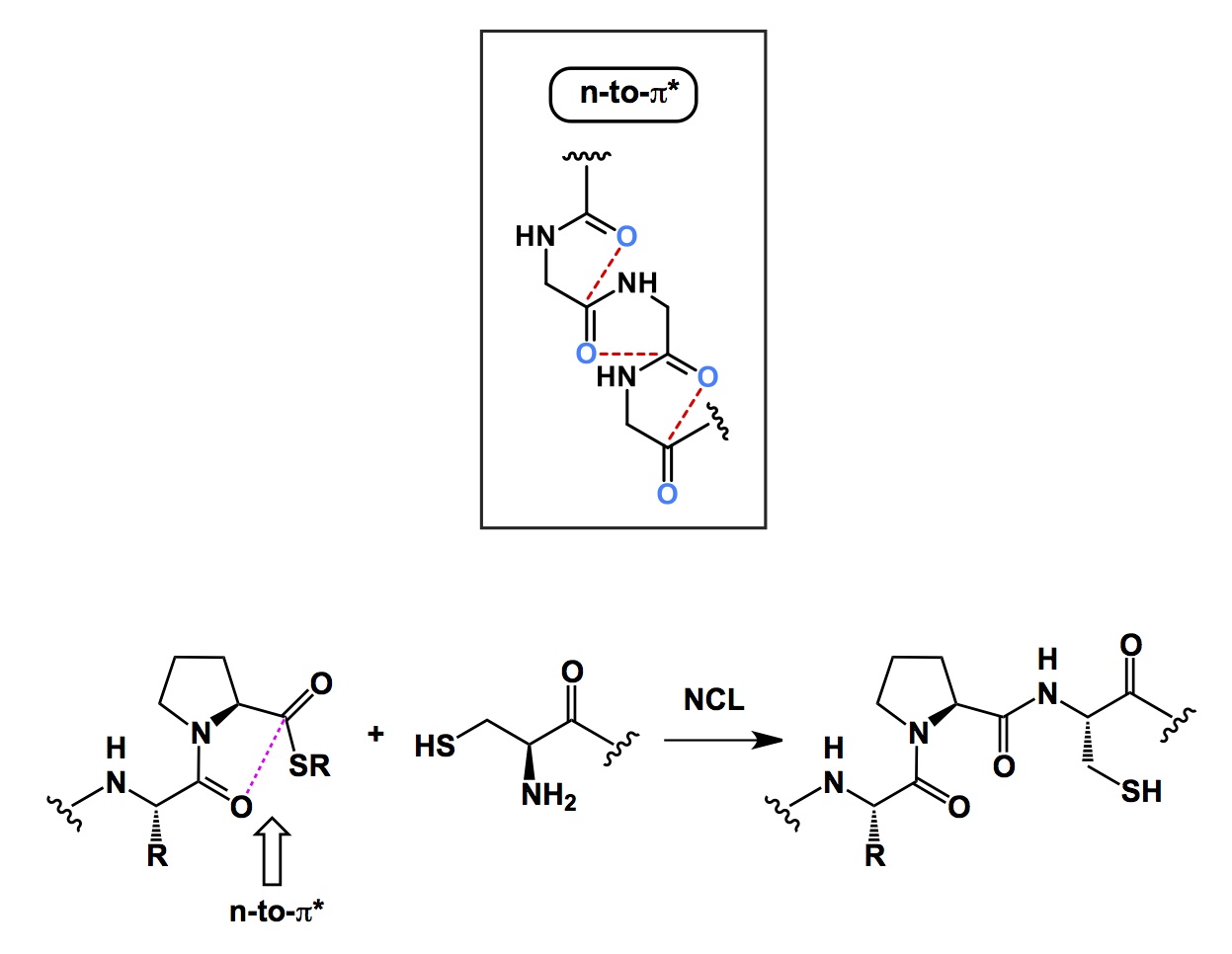
In 2009, Raines and Woolfson published their influential paper on the concept of n-to-pi* interaction in proteins (http://www.nature.com/nchembio/journal/v6/n8/full/nchembio.406.html). By analyzing the protein databank they came to the conclusion that there exists a previously unappreciated attractive interaction between backbone amides. This interaction arises from the delocalization of a lone pair of electrons (n) from an oxygen atom to the antibonding orbital (pi*) of the subsequent carbonyl group. For synthetic organic chemists this sort of interaction makes sense. Who can forget the Burgi-Dunitz trajectory of attack? However, it has gone under the radar of structural biologists, which is somewhat surprising (or not). Given the significance of this interaction, there is a push to adjust parametrization of many molecular modeling packages. There are many other implications, but what about peptide reactivity? I can think of one cool example. It comes from Kent and co-workers, who published an interesting Chem Comm paper not too long ago (http://pubs.rsc.org/en/content/articlehtml/2011/cc/c0cc04120c). In it, the authors explain the relatively low reactivity of prolyl thioesters in native chemical ligation. According to Kent, the n-to-pi* interaction is playing a role in diminishing the electrophilicity of the thioester.  

Image

Building blocks for peptides

There are many ways to make a peptide bond, which is one of the most ubiquitous linkages known to man. Regardless of the biosynthetic or synthetic origins of a particular process, the acid component is turned into a better electrophile during peptide bond formation. DCC couplings and active ester technologies do this job for countless chemists around the world. If you look at the active ester method, you will note that there is one major way of producing active esters: using the red disconnection marked below. But what about an alternative pathway shown in blue? This is a viable option, yet no one has thought of it prior to Jan van Maarseveen’s recent work in Chem. Eur. J. I talked with Jan about this project during my trip to the Netherlands this past June. The reaction is an “outside the box” way of looking at problems, which prompts “Why didn’t I think about this?” kind of question. Really, when you first consider this idea, you expect that it must have been tried prior to 2013 by the legions of synthetic chemists eager to test new substrates in coupling reactions. As it turns out, Jan was the first one to think about this application and reduce it to practice. My complements. Of note is the configurational stability of the alpha-stereocenter during the coupling reaction. This chemistry should open up many new synthetic possibilities.

Image

http://onlinelibrary.wiley.com/doi/10.1002/chem.201303347/abstract

Lemons, lemonade, and bromosporine

I have been in the UK for the past couple of days, visiting the SGC site at Oxford University. Paul Brennan has been my host here (http://www.ndm.ox.ac.uk/principal-investigators/researcher/paul-brennan). I thoroughly enjoyed my visit because I have got to interact with Paul and his group as well as a number of other PIs at the SGC. Paul showed me some of his recent science pertaining to the development of bromodomain inhibitors. Bromodomains are protein interaction modules that recognize ε-N-lysine acetylation motifs. I already mentioned them when I talked about isoxazoles. By the way, the name “bromodomain” has nothing to do with bromine. There are no bromine atoms in this protein, or nowhere close for that matter. Instead, the name appears to be related to the brahma (brm) gene, which is required for the activation of multiple homeotic genes in Drosophila. Don’t ask me how “brahma” became “bromo” as I do not think anyone has a clue. In terms of bromodomain inhibitors, there is an interesting story that has developed here in Oxford over the past year or so. Paul’s group has designed the so-called bromosporine (another interesting name… think about cyclosporine and staurosporine…). You can read about it at the following link: http://www.thesgc.org/scientists/chemical_probes/bromosporine. The strength of this molecule is in its promiscuity, which offers an interesting lesson to all of us. Promiscuous inhibitors such as bromosporine are invaluable in assay development due to their broad-spectrum mode of action. Indeed, when you have lemons – you make lemonade!

Bromosporine is a potent inhibitor of a range of bromodomain proteins. Consistent with SGC’s mantra, bromosporine has been released to the public and can now be purchased from a number of commercial sources. When I saw Paul’s nice synthesis of this molecule, it reminded me about the virtues of nucleophilic aromatic substitution. In the old days, pyridiazine was the workhorse of many ligand syntheses in the Sharpless lab. In Paul’s case, substituted trichloropyridazine is the starting electrophile that is subjected to treatment with hydrazine, which is followed by heterocycle formation using acetic acid. It is instructive to ponder about the regioselectivity of the first and second steps (which gives me an idea for a good cumulative exam question). Incidentally, it is the 5-membered heterocycle unit that acts as the acetyllysine mimic. This is seen in the co-crystal structure, although I do not think it has been deposited into the pdb thus far.

xxx

I am now off to London for a day. I’ve heard Natural History Museum has an interesting Darwin exhibit.

Empowering students with strong synthetic skills

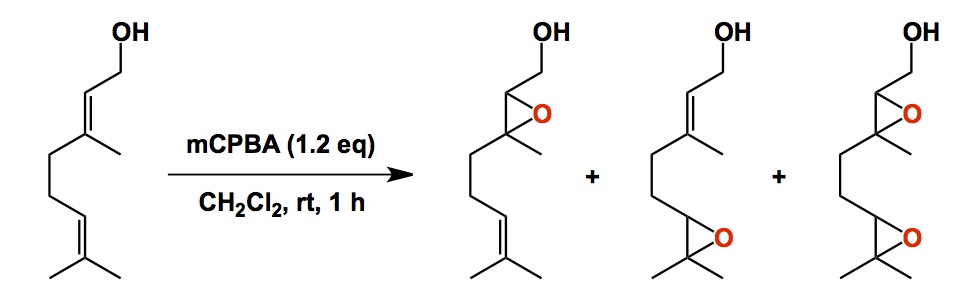
From a sheer pedagogical perspective, one of my all-time favorite papers is the well-crafted 2-page J. Chem. Ed. article by Tom Hoye and co-workers from the University of Minnesota. The goal of J. Chem. Ed. is to publish papers that serve as useful teaching tools. Hoye’s paper concerns with the epoxidation of geraniol. Sounds easy? The caveat is that the students have to perform this chemistry using 1mg of the starting material. The three epoxides derived from geraniol differ substantially in terms of their Rf. The students have to isolate and identify each product using conventional chromatography techniques. Each pure fraction is supposed to be characterized by 1H NMR. I know that the Chemistry Department at the University of Minnesota used this exercise as part of their teaching curriculum.

Image

http://pubs.acs.org/doi/abs/10.1021/ed083p919

Organic synthesis is an experimental science and such small-scale experience is invaluable. According to Tom, less than 1% of new graduate students can do this with confidence. So, if you are a beginning (or an intermediate) synthetic chemist – my suggestion is that you give this reaction a shot in your spare time (using a 1 mg scale!). You do not need to tell the result to your advisor, but you will know if you need to put more work into developing better command of experimental techniques. According to Tom, the ability to perform in this test correlates really well with experimental acumen across the entire range of preparative techniques.

Psychophysical sensations

The province of Szechuan, China, is widely regarded for its culinary delights. I applaud the Szechuan people’s commitment to food that feels suicidally hot. On the molecular level, the so-called Szechuan pepper is behind those dishes. The closest we get to this kind of food in Toronto is through a couple of restaurants in Chinatown that are notorious for their spicy Szechuan cuisine. Here is a shot of my lab at a group outing last week. I am also showing you alpha-hydroxy sanshool, the culprit present in those infamous Szechuan peppercorns. These peppercorns look weird, nothing like your typical pepper. Unfortunately, not everyone was able to join us in this journey (Jeff was running a TLC, whereas Serge probably wasn’t brave enough…).

Image

Now I understand why my tongue is numb every time I have Szechuan food. It is because alpha-hydroxy sanshool excites my neurons by inhibiting several (yes, not just one!) anesthetic-sensitive potassium ion channels. Here is a Nature Neuroscience paper that goes into the “unique and complex psychophysical sensations associated with the Szechuan pepper experience”.

http://www.nature.com/neuro/journal/v11/n7/full/nn.2143.html

Shifting sigma bonds in concert

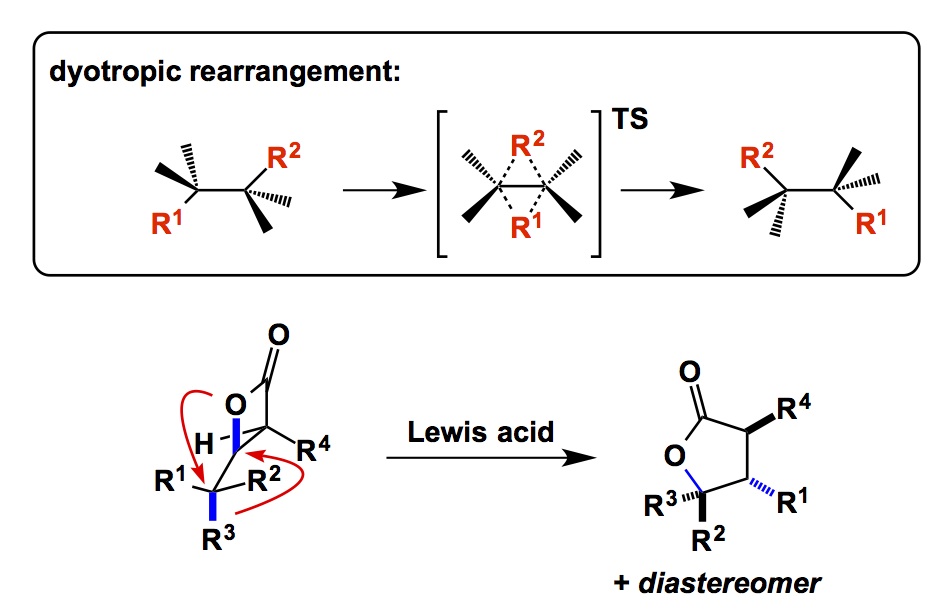
Nowadays, when one talks about discovering new reactions, one quickly realizes that there’s not a whole lot of fundamentally new elementary processes that remain unknown. As a result, novel reactions tend to be “composed” of different permutations of well-known elementary processes. Every now and then a mechanistically distinct transformation pops up. I keep an eye on reactions of that sort. Daniel Romo’s elegant experimental work coupled with Dean Tantillo’s theoretical approach provide a glimpse at some useful, yet fairly uncommon, types of reactions – the so-called dyotropic processes (see the graphic below). In sigmatropic rearrangements, a pi/sigma-system undergoes a transformation that results in a net translocation of one sigma bond and concomitant shift of the pi-system. In contrast, dyotropic rearrangements describe simultaneous migration of two sigma-bonds.  Evidence in the JACS report cited below suggests that, depending on the nature of the Lewis acid, a concerted or stepwise mechanism takes hold. While reactions of this kind have been known for some time, they have not reached the mainstream of synthesis. I think there is a lot of room for reaction discovery using this mode of reactivity in the context of complex electrophiles.

Image

http://pubs.acs.org/stoken/beta/select/abs/10.1021/ja303414a

Displacement of ice rings

Small molecules come in all sorts of different shapes and are capable of wonderful things. Of particular significance are those privileged types of small molecules that interact with their protein targets with high ligand efficiency. I will dedicate a future blog post to the concept of ligand efficiency, but I am sure that we all “feel” what it means without any formal definition. Ligand efficiency is a measure of how well a given molecule engages its innate features when it interacts with a protein target. Understanding the balance of enthalpy and entropy in this type of molecular recognition is paramount in probe/drug design. Great strides have been made in explaining (through docking simulations) how and why organic molecules interact with their targets. A lot of the developed algorithms work extremely well (Schrodinger’s Glide package is my favorite at the moment). The simulations may not have the best predictive power, but they are certainly capable of explaining experimental facts. Or are they?

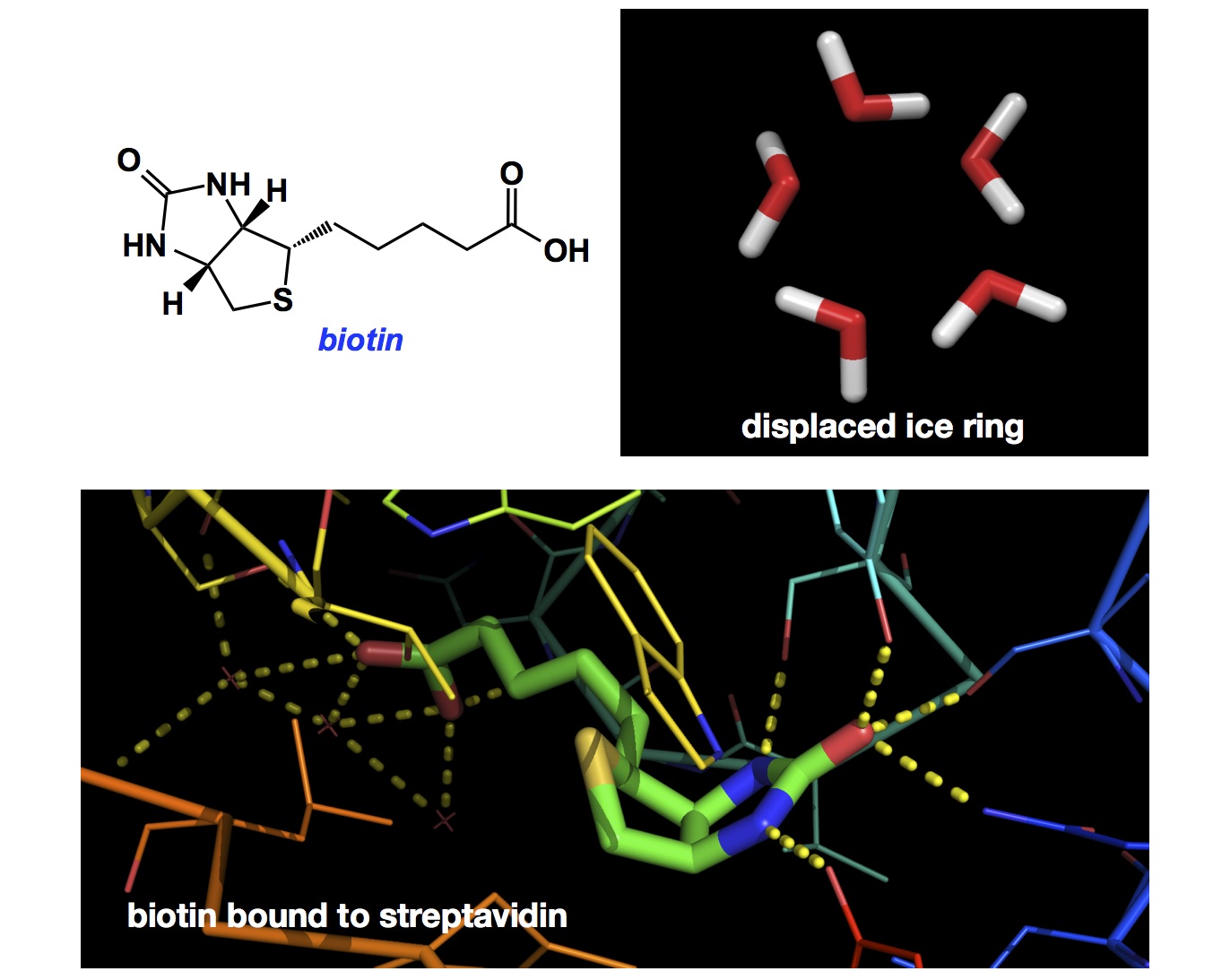
I give you one of the workhorses of molecular biology: biotin/streptavidin interaction. Everyone is aware of the significance of this non-covalent “glue”. There are many examples of affinity experiments that utilize the strength of biotin/streptavidin pair. Personally, I have been in awe of this system because I just don’t get it: how the heck is such tight binding possible? You look at the dinky little biotin molecule and there is just no way to expect that its binding interaction with streptavidin would be on the order of 10-14 mol/L (I mean the dissociation constant, Kd). It turns out that sophisticated modern simulations have a heck of a trouble predicting this extreme ligand efficiency. The experimentally determined binding affinity is ORDERS of magnitude higher than predicted. So what is the basis for this impressive affinity?

Image

It turns out that the reason likely lies in the amazing five-membered, ice-like ring of water molecules that is present in the binding site of streptavidin. Biotin is uniquely geared towards displacement of this “ice-ring” arrangement from the binding site, which generates a huge entropic driving force (see the graphic above showing the ring and the ultimate structure where biotin is in its place). There is still no way to predict this kind of behaviour computationally, I am afraid. The lesson here is that displacement of ordered waters is a VERY attractive way towards designing super-ligands. Berne and co-workers have published a very insightful PNAS paper on this subject several years ago (I thank Robert Campbell of Queens University for bringing this work to my attention):

http://www.pnas.org/content/104/3/808.long

On controversies in chemistry

As you have probably noticed, I am not using this blog as a forum to dwell on controversial, if not scandalous, topics pertaining to research. My goal is to comment on the exciting aspects of chemistry using current literature and some of the classics from the past that may have gone unnoticed or are being forgotten. We do need to have a system for our students to keep in mind that certain areas, despite claims by some overzealous practitioners of modern synthetic chemistry, were not actually discovered in the past 5 years. Instead, they might have remained under the radar for a while. I can speak from my personal experience in the field of trifluoromethylation. When I was working on my PhD aimed at silicon-based trifluoromethylation reagents with Prakash and Olah, very few people were involved in it (apart from the tightly knit fluorine community). Nowadays, everyone and their uncle is running trifluoromethyl group transfer processes and I notice, with surprise, that Burton’s, Prakash’s, Chambers’ papers are often not cited at all. Alas, rediscovery is a common irony of chemistry.

There is a lot to be said about scientific scandals that erupt from time to time. These scandals are sometimes caused by a report of an alleged attempt to manipulate data. I don’t even want to rehash this right now – you all know some of the recent cases, I will not turn my blog into a tabloid. I do think that deliberate mispresentation of data is wrong for many reasons. But discrepancies eventually get caught and mechanisms for catching fraud are more sophisticated now compared to 20, or even 10, years ago. Publishers are becoming irritated with those in the blogging community, whose goal is to seek and disclose fraudulent research. In the opinion of many journals and their editorial boards, exposure cannot be left to bloggers because there is little accounting for what is put in the public domain using this mechanism. Chembark (http://blog.chembark.com) is an interesting example. Recently, its owner Paul Bracher wrote a long rebuttal to the editorial that appeared in ACS Nano. You can take a look at it yourself. While I agree that spreading news about research misconduct using blogs is far from an ideal mechanism, we should remember that some people’s passion is to find faults in others’ papers. This activity is going to be difficult to regulate. However, if someone equates exposure of mistakes to the advent of internet, I would direct them to Caltech’s Richard Marsh. The phrase “getting Marshed” was coined in the 80’s when Dr. Marsh would periodically publish a paper in which he would comment on the mistakes he has found in published crystallographic group assignments. I can tell you: everyone was wary of getting Marshed.

Ryan Hili – the group page is live

Earlier today I was bouncing ideas about updating our lab webpage with my student Adam, which reminded me to check out how Ryan Hili was doing. I was happy to find his lab’s web page. Check it out: http://www.hili.uga.edu. A few words about Ryan, now an Assistant Professor at the University of Georgia. He did his PhD in our lab and laid the foundation for our inroads in the area of amphoteric reactivity, particularly with regard to the chemistry of aziridine aldehydes. I described some of this work in my previous posts. Upon graduation, Ryan accepted a postdoctoral position at Harvard and spent time with Professor David Liu. While in the Liu lab, Ryan developed an imaginative approach to evolve unnatural polymers. This experience has further shaped his interests for an independent program, which he initiated this past September. It looks to me that Ryan already has a lively group of students and his lab is up and running. My group and I will follow the direction of Ryan’s research and we wish him luck in his independent explorations!

It is 11:30pm and my wife and I just landed in Calgary, Alberta. We are about to drive to Banff through all these beautiful mountains. I should have listened to my student Sean who told me to drive during the day and enjoy the scenery!

On selective sulfonamide transformations

Chemoselective ways of making amines have been and continue to be a special type of craft in organic synthesis. I have heard several people say that adding one nitrogen to a molecule a graduate student is working on adds a year to his/her PhD… I suppose this is why I have a deep admiration for Fukuyama’s seminal studies in nosyl chemistry.

We had a group meeting a week or so ago when Frank Lee, a first year graduate student in my lab, put together a problem set dealing with a neat new way of deprotecting mesylates. This reaction comes from an Org. Lett. paper published in 2010 by Urabe and colleagues from the Tokyo Institute of Technology and it involves the N-mesyl functionality. The mesyl group has always been a bit of an outlier. Even the mechanism of mesylation is distinctly different from the one that we teach in the case of tosyl chloride. In Urabe’s case, it turns out that you can (almost) take advantage of the reverse process upon hitting a mesyl-protected amine with a strong base. You need a couple of equivalents of BuLi, along with oxygen sprinkled in between. Taken together, these steps offer a really nice base-promoted way of chemoselective removal of the mesyl group. Very significantly, other sulfonyl protectiong groups (such as Ts) survive these conditions because they do not possess acidic hydrogens. I can sense some far-reaching possibilities for chemoselective polyamine synthesis here… Thank you, Frank, for locating this useful paper!

Image

http://pubs.acs.org/doi/abs/10.1021/ol100086j